Wednesday, December 05, 2007

SE Asia VI - Penang

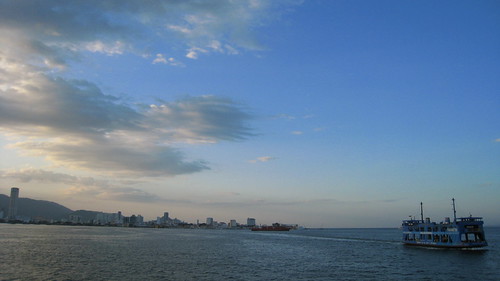
Penang is an island on the West Coast of the Malay peninsula. It is famous for being an outpost of the East India Company. It isn't a relic of the past, it is a living and breathing city. There are jungle clad hills to escape to, an assortment of temples, and beaches. If you can only spend time in one place in Malaysia I would recommend Penang, because it has a little bit of everything.

Penang is centred around Georgetown, the colonial capital of Penang It is similar to Melaka, in having historic buildings lining narrow traffic filled streets, however, Georgetown is a bit bigger than the old town of Melaka and the architecture is a bit more varied. Georgetown does have a certain air of decay to it. The colonial buildings are falling apart and it seems that building new houses is more important than refurbishing the pre-existing ones. There is a building boom on the island in condominiums, apartment complexes. The three cultures of Malaysia; Malay, Chinese and Indian, are well represented in Georgetown. Little India is the most colourful and dynamic part of Georgetown.

I mentioned in a previous post the tensions existing within multicultural Malaysia, especially with the Indians. The Malaysian Government has recently banned a leading Indian political organisation from holding protests. While the tension exists it is not apparent to the tourist and no one ever mentioned it to me directly. From a tourists point of view the three cultures are thriving in Georgetown. A great aspect of maintaining the identity of each culture is the variety of food on offer. There are a number of excellent food courts in Georgetown. World Food Market north of Komtar is very good and cheap, and few westerners seem to be aware of its existence. Indian food in Penang is particularly good, especially the banana leaf meals ( you eat off of a banana leaf).


The establishments I generally eat at fall somewhere between the street stall and the restaurant, hopefully combing the cheapness of the stall with the hygiene of the restaurant. The staff at these establishments are not always the easiest to pick out. The guy sitting down eating his dinner is the waiter, the guy picking his feet is the chef, and the guy standing outside who looked like he was going to mug you is the owner. It isn't surprising to find by the end of your meal that everyone eating in the restaurant is somehow involved in the operation. I would often find at these establishments that I would try and order something. The waiter would look at me quizzically and reply that what I wanted was not a good thing to order and in actual fact I wanted something completely different. The waiters expertise was generally spot on.


The seemingly undiscovered gem of Penang is Taman Negara Pulau Pinang (National Park of Penang). It is just a case of jumping on the 101 bus from Komtar which will take you to the northern beaches. The majority of people stop at Batu Ferringhi which is pleasant but heavily developed, the next beach along is Teluk Bahang. There is a small fishing village and the people are very friendly, it is also the gateway to the national park. After an hour and a half walk (and wade) through the jungle you arrive at Monkey Beach. It is a beautiful spot, with few people and plenty of wildlife. When you walk through the jungle you come across Monkeys and even Goannas. A family of dogs live on the beach, and are very cute. They are extremely happy to sit around you without feeding or patting them, and they are photogenic. Although watch out for Dad, he wandered off with one of my sandals.

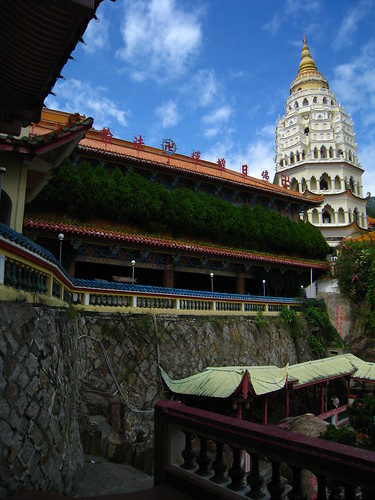
There are plenty of things to see in Penang. There is the world's third largest reclining Buddha. A Burmese Buddhist temple sits opposite the Thai temple (with the reclining Buddha) and is prettier. There is also Kek Lok Si another Buddhist temple this time perched on top of a hill. It is a beautiful spot overlooking the town of Air Itam. There are the expected tourist stalls on the way in but what I found disappointing were the stalls inside the temple complex. I can understand the sale of roof tiles with your name written on them to finance refurbishment, but stalls selling the usual tourist tat spoil it. Penang Hill is another very popular trip into the centre of the island. There are great views from the top, somewhat spoilt by the pollution haze. I choose to walk up with a hiker from the Cameron Highlands, Z. We went up the Jeep track, which is a road, but it is amazingly steep. It was a 6km walk up an incline that reminded me of Baldwin Street in New Zealand, the world's steepest street. I met plenty of friendly Malaysians on the way up, especially a couple of groups of school children who delighted in saying Hello to me. The problem with Penang Hill is that the funicular train that takes you down (and up) is very busy, the queue is about an hour at both ends and then you are packed in like commuters on the tube.

I stayed at Hutton Lodge in Georgetown. It is a recently opened guesthouse and not in the guidebooks yet. I only found out about it because of where I stayed in KL, Pondok Lodge, has the same owners. It is a renovated old building and has a historic feel to it even though it has been thoroughly refurbished. The staff are very friendly. I became Mr Steve for the week. Whenever I returned from a day out and about they would always ask me where I had been and what I had seen. One of the guys seemed particularly pleased to shake hands with me at any opportunity.


Penang was my last stop in Malaysia. I will certainly be back. Whilst there are tensions between the three peoples of Malaysia I found them all to be friendly and welcoming. The three cultures give the country great variety. The British seem to be very popular in Malaysia. There are a plethora of English football shirts (Man Utd, Liverpool, Chelsea and Arsenal). I was in a night market in KL after England lost to Croatia. I was walking passed a street stall with a TV showing a match report in Bahassa. The locals were shocked and genuinely disappointed that England had lost. (I don't know if the same sense of affection exists towards the Scottish and Welsh national teams.) I rarely got hassled in the country. The only regular annoyance were the taxi drivers and that was very mild. When walking passed restaurants and cafes you will get asked to come in but it isn't aggressive and there is generally a but of humour involved. For instance, I was walking through Tanah Rata when a waiter at an Indian restaurant tried to get me to come in, when I told him I had already eaten he replied "But you still look hungry sir". In short Malaysiua is an easy country to get to, straightforward to get around, there is lots to see, it is cheap, and the people are friendly.

Sunday, December 02, 2007

SE Asia V - Cameron Highlands

The Cameron Highlands are an oasis of cool air and calm rolling mountain hills in Malaysia. A complete contrast to KL. The scenery is stunning. There are jungle clad hills and tea plantation clad hills all around. There are also lots of Land Rovers. While I was in town I did some hiking and went to visit an Orangi Asli village in the jungle.

The Cameron Highlands have beautiful scenery. The scenery is not matched by the towns. The biggest town, and where most of the accommodation is, is Tanah Rata. Tanah Rata has the architectural quality of Basildon. The people are friendly and there are lots of good places to eat. I stayed at Father's Guesthouse in Tanah Rata. It is an institution on the backpackers circuit. The accommodation is in army style Nissan huts. They are basic (and a bit chilly at night) but at RM10 a night you can't go wrong. The toilet facilities are basic, but they do have hot showers and western toilets. There is a cafe which serves breakfast and dinner. Gerrard runs Father's Guesthouse and he is very helpful. I booked the tours he recommended and was not disappointed.

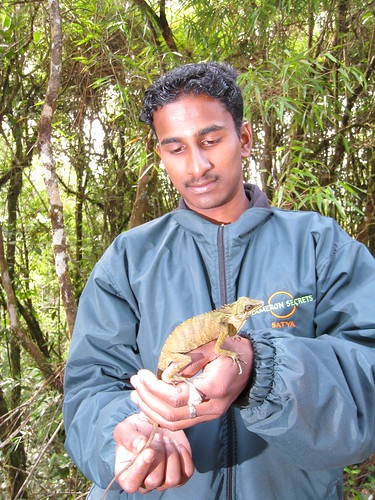
I did two tours in a day with Cameron Secrets (http://www.cameronsecrets.com/). I was up at 5.30am for the Morning Madness tour. We were taken to Gunung Brinchang the highest peak in Malaysia accessible by road. We were lucky enough to have a superb sunrise. We then did a hike through the mossy forest. Our guide Satya was excellent, he was an excellent source of information and funny with it. After that we went to the BOH tea plantation. The Cameron Highlands is famous for its tea. The tea here supplies the majority of what Malaysia drinks and they drink alot of tea. The tea hills are beautiful to look at.The British brought Indians to the Cameron highlands to create the tea plantations and to maintain them. It is only in recent years that wages have dropped and they jobs have gone to Indonesians on two year work contracts.

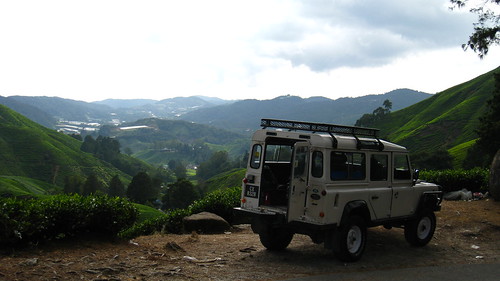
We spent the day driving round in Land Rover Defenders. The Cameron Highlands are packed to the brim with Land Rovers. I have never seen so many in one place before, and I have been to Land Rover club meetings. It seems to be one of the few parts of the world where the Toyota Landcruiser doesn't rein supreme. It is a legacy of the British involvement and the use of the Land Rover during the Communist insurgency on the peninsula. When the British left they sold the Land Rovers to the locals. They are used for absolutely everything. While you drive around the winding bends of the Cameron Highlands you see locals piled into the back of them, others with boxes of vegetables stacked high and the suspension giving under the strain.

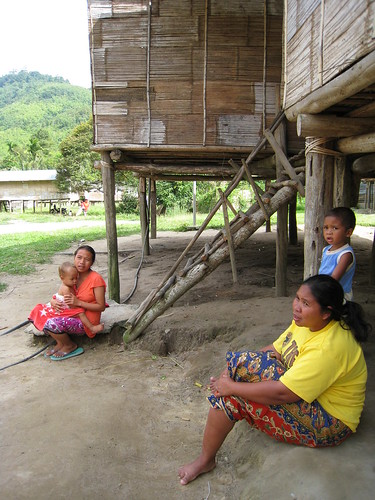
In the afternoon we visted an Orangi Asli village. The Orangi Asli are the native people of Malaysia. Their way of life, like most indigenous peoples, is slowly dying out. The Malaysiuan government is 'persuading' them to leave the jungles and move into the towns. The tour that Cameron Secrets offers is special because you are taken to a village in the jungle, an hour and a half from Tanah Rata. The particular village only allows Cameron Secrets to visit because the chief has befriended the two guides. The village is therefore not inundated with tourists and we were treated as guests. Kumar the guide was full of information and we had a much greater appreciation of the Orangi Alsi by the time we arrived. The village is just what you would expect, bamboo homes on stilts, lots of kids, chickens and dogs running around. Initially I felt somewhat awkward in the village. Whilst there was only me, Z and the guide it still felt like we were intruding. I like to merge into the background when I travel, to observe rather than be observed. It is achievable in the Western world but once you are taller and look different to everyone else it becomes a bit tricky to not literally stand out from the crowd. When visiting a native village you are guaranteed to stand out. The villagers noticeably warmed to our presence and interacted more and more with us over the time we were there. The children ran around us. A group of teenagers spoke to me in halting English. We were taught how to use a blowdart. it was a bamboo tube a few metres long, you are given a dart, you put it in the tube with some cotton wool (natural version), focus on the target (a flip-flop) and blow. I was pretty good, though the chief didn't seem particularly impressed. He invited us inside his hut where we shown musical instruments and tools. We were given a nose flute to play. I pushed it up my nose and blew threw it, the correct technique is to play it just in front of your nose and then blow. We were given an excellent cup of herbal tea, some jack fruit seeds and tapioca. The jack fruit seeds have the texture of bark, taste like BBQ crisps and apparently if you eat ten you will die. After the meal we had a go at a string puzzle. It was a piece of string looped through a bamboo puzzle. I had no idea how to do it and the chief demonstrated how you solved it. When we left the chiefs hut the kids were skipping outside. Kumar thought it would be a good idea if we took part. I haven't skipped since the early 1990s, which was shown in my efforts.

The Cameron Highlands have a number of trails marked through the hills for you to do under your own steam. Me, Z, Margeritta and Ella, a group of Melbourne girls, attempted Trail 8. It was an extremely gruel climb up tree routes through the jungle to the summit of the hill. It was followed by an equally taxing hike down the other side. The Cameron Highlands may not be humid but I was still sweating like it was going out of fashion.

Friday, November 30, 2007

SE Asia IV - Grand Prix Bartering

My bargaining skills had a great deal of practice at the A1GP in Sepang. A1GP is similar to Formula 1, the main difference is that the teams represent nations, the slogan is the 'World Cup of Motorsport'. The Sepang circuit is 75km from KL, next to the airport, though this doesn't mean it is easy to get to.

The first day I to went was practice. It was free to get in and one man and his dog showed up to watch. I got the train to Nilai, which took an hour, I then planned to catch a bus to the circuit as the Sepang website told me. Unfortunately there were no buses running to the circuit so I caught the bus to the airport, this took another hour. When I arrived I asked for the bus to the circuit and was told that no buses were running and I would have to catch a taxi. The taxi cost me RM38 (about 5 pounds) not an arm and a leg but the previous two hours of travel had cost me RM6. On the way back I stood at the side of the motorway with another spectator and attempted to flag down coaches bound for KL. We stood there for an hour unable to get a coach to stop. A plethora of taxis did attempt to come to our aid. It doesn't matter where you are in Malaysia, you can be minding your own business strolling down a street, when you will hear the light toot of a horn announcing that a taxi is ready and raring to take you wherever you may wish. Whilst waiting at the side of the motorway we negotiated with several drivers. They would propose outlandish charges of RM70 and we would counter with RM10. Eventually we found a driver who we haggled down to RM15. We got to the airport and then jumped on a coach to KL, it only cost RM10.


The next day was qualifying. I caught a coach to the airport and then managed to persuade the airport bus driver to go via the circuit (this was after I refused to get off the bus until I was taken there). When I left the circuit the extra spectators for qualifying had prompted taxis to pull up outside the entrance. "You want taxi sir?", "How much to the airport?", "50 Ringgits", ""I paid 15 yesterday", "No, no sir 40 Ringgits". I had this conversation with a number of drivers and carried on walking to the motorway. I was met with the toots of horns from taxis. They would offer me a price, and my new tactic became shutting the door on them after a bid I didn't like. A couple of drivers pulled up and after I rejected them they reversed along the hard shoulder to the previous turnoff. I was beginning to wonder whether my confidence in getting a low price was misplaced when a taxi pulled up and offered me the fare of RM10, I didn't bother haggling.

On race day I managed to get the airport coach to drop me off at the circuit. There was a decent turnout of spectators, probably around 5,000 people. At the end of the day I wandered out of the circuit and found drivers who weren't interested in taking me to the airport, they wanted the big fares to KL. I continued my stroll toward the motorway when a driver pulled up next to me and offered me RM40 to the airport, I said no 10, and shut the door. He opened the door and offered 30, I said no and shut the door. He opened the door and offered 20, I said no and I would accept 15. He said no so I walked off. I could hear him yelling in the background and then he pulled up next to me, "Jump in sir, I take you airport for 15 Ringgits". I should have gone lower.


I would recommend visiting Sepang for a race. It is a beautiful circuit, very modern, with great views of the track. It also gives you a crash course in bartering.

Sunday, November 25, 2007

SE Asia III - KL

Kuala Lumpur is a cross between Singapore and Melaka. It has the infrastructure of Singapore but is slightly mental. For instance, they have traffic lights but they are rarely obeyed. I was in Medaka square crossing the road at a set of lights, the green man started walking (he is animated in Malaysia) and the countdown clock started. I crossed only to have a motorcycle flash passed infront of me, a car carried on behind me and another car had to do an emergency stop next to me (talk about skid marks). I try to follow the policy of crossing when a local does and putting them between me and the oncoming traffic.

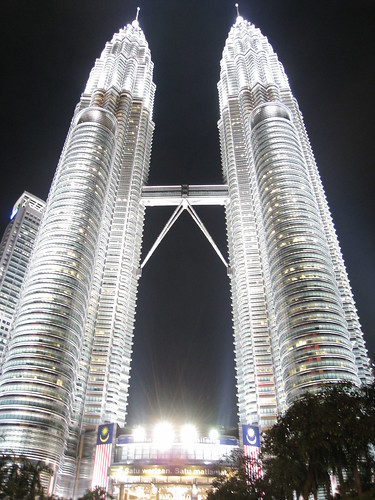
KL is a raw version of Singapore. The Petronas Towers are more dazzling than anything Singapore has to offer. Yet there are so many litter strewn alleys that you pass. There are whole streets of ruined buildings. The most disturbing scene I've yet seen on my travels was a man lying in the gutter outside the Times Square Mall. He was spread eagled on the floor with an open wound on his leg. There was a steady stream of people passing him on both sides of the packed pavement. I'm not suggesting that Malaysians are any less caring than other nations, I'm sure such a scene could be witnessed in London, Paris or New York. It just seems that the gap between rich and poor is greater here and more distinct.


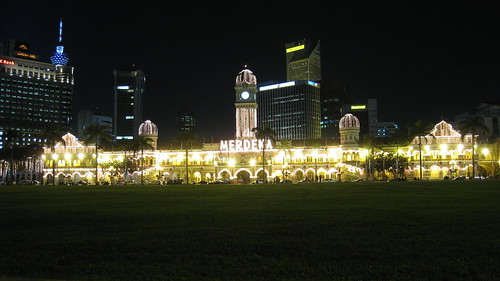
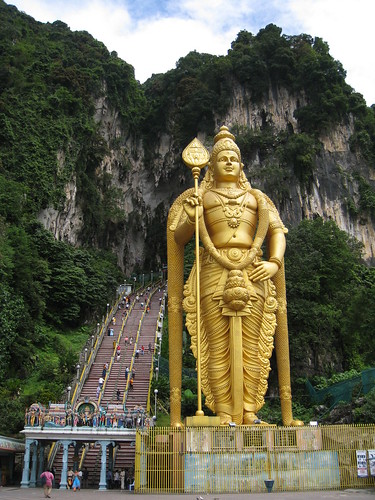
There is quite a bit to see in KL. The Petronas Towers are a must. The visit up to sky bridge is free (you just have to queue up in the morning for a ticket). It isn't the most exciting. partly due to Petronas using it as an opportunity for a company presentation, and partly due to you not being able to see the Petronas Towers. The view from the KL Tower is better, because you are higher up and you get to see the Petronas Towers. Merdeka square is pretty, and it is a good time to visit as Malaysia is celebrating its 50th year of independence, so there are plenty of flags. The Batu Caves are spectacular. They are Hindu temples outside of KL. It takes just over half an hour to get there by bus. When you get there you have to climb over 250 steps to get to the main temple. The main temple is full of monkeys. These monkeys are trained in the art of stealing food from tourists and intimidating small children. The drive on the bus is worth the trip in itself. In KL the bus conductors hawk for business. They hang out the side of the bus as you are driving along yelling out their destinations to anyone walking along the pavement. It gets even more intense at proper bus stops where they compete against one another for business.

I haven't faced a great deal of hawking since arriving in South East Asia, apart from the restaurateurs in Boat Quay Singapore. In China Town KL there is a giant street market. It is hot sweaty and claustrophobic. It is a hawkers paradise. They did their best to tempt me into their stall and at times would grab me by the arm. I met all attempts with a smile and shake of the head. I find that the best way to deal with hawkers is to smile and say no thankyou. It doesn't require you getting angry or frustrated. However, Bukit Bintang can try anyone's patience. It is a popular street in the Golden Triangle, close to where I was staying. During the day it is busy. In the evening it gets busier and the massage shops open. They have hawkers sitting on the street outside their establishments. When you walk passed they jump out at you with laminated picture cards of the work they offer. I tried to meet all advances with a smile and polite no thankyou. It does get frustrating when you are trying to get somewhere and they keep jumping out at you, especially when you have already rejected 5 and the hawker can see this but still believes that they will somehow persuade you.

I stayed at Pondok Lodge in KL. It is in the Golden Triangle just off of Bukit Bintang and within walking distance of the Petronas Towers. I had a bed for RM25.00 which included breakfast. Breakfast was not your typical hostel affair where blood thirsty backpackers compete to grab what they can. At Pondok Lodge they had a guy serve you, admittedly it was just 2 pieces of toast, a banana, a piece of fruit loaf and a cup of tea, but it was still nice. I ended up in twin room with a Pakistani guy who had been living there for a few months. The room was fine apart from the air conditioning being shared between two rooms. There was a hole in the wall between the two rooms and the air conditioning was cunningly placed in the middle. The controls were in the other room and we had the remote in our room. This meant that during the night there was a fight between both parties to keep it on or to keep it off. Pondok Lodge is above a number of bars, so it can be a bit noisy but I never found it a problem. They also have a rooftop terrace which is a great place to escape the hustle and bustle of KL and hopefully grab a breeze to stop sweating for 5 minutes.

Defining who a local is in KL and Malaysia isn't quite straight forward. There are 4 distinct groups of locals. There are the Orangi Asli the native people who live in tribes (more to come on them in the Cameron Highlands). There are the Malays, the Chinese and the Tamil Indians. The Malays are Muslim. I like all the colourful headscarfs. I can't remember which politician said that they found headscarfs 'confronting' but it struck me as a daft comment at the time and after is even more ridiculous when you travel in Malaysia. You are constantly greeted by smiling headscarf clad faces. The Chinese have lived in Malaysia prior to European involvement in the region. They moved to the Malay peninsula as traders. The Indians have a similar history, however, the greater part of the Tamil Indians were brought in by the British either as slaves or as workers. The deal struck between the groups when Malaysia gained independence from Britain was that the Malays would have political power, the Chinese would continue to hold the economic power and the Indians were left to fill in the gaps. On the surface this form of multi-culturalism seems to work. However, the 3 groups maintain separate lives. They work together but they do not live together. In my time in Malaysia even the 3 races working together is somewhat unusual. Shops and restaurants are generally staffed by one race. The people who agitate most against the status-quo are the Tamil Indian community because they get the roughest deal out of all three. While I was at the A1GP in Sepang there was a big demonstration in KL at the Petronas Towers.
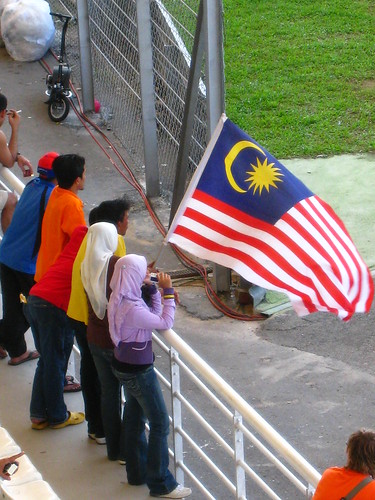
Click here for a link to a BBC News article about the Indian Demonstration. The Malay constitution states that only a Muslim can be head of the government. There is also defacto discrimination with Malays being entitled to open shops in certain areas where Indians and Chinese cannot. In a recent law regarding foreign firms starting businesses in Malaysia the law stated that the foreign firm must employ at least one Malay (not one Malay, Chinese, or Indian). This is all the more interesting after you have visited the National Museum in KL. It has a special section on Merdeka, celebrating 50 years of independence from Britain (hence all the Malaysian flags in my photos). There is a video presentation when an old Malay man tells his grandson (Malay) and his two friends (a Chinese girl and an Indian boy) about the struggle for independence. He says how the three races now live side by side, equally, in a free democracy.

Thursday, November 22, 2007

SE Asia II - You say Malacca I say Melaka

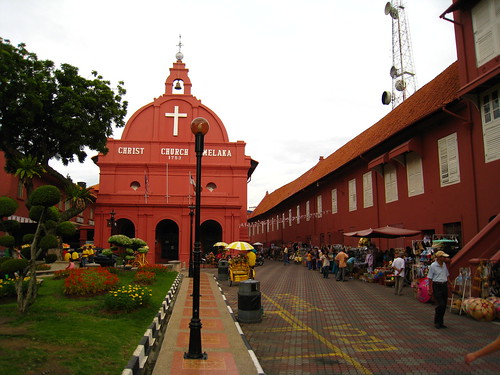
Melaka is the first major stop on the West Coast of the Malay Peninsula. It is famous (or infamous) for its colonial heritage. The Portugese got here in 1511, the Dutch kicked the Portugese out in 1641, the British moved the Dutch on in 1795 and the locals got rid of the British in 1957. The locals seem quite proud of this history, or at least the marketing people do. In Bahasa (the Malaysian language) it is spelt Malacca in English it is spelt Melaka.

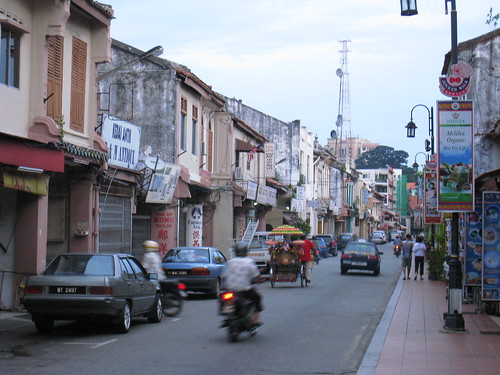
Melaka is a town of two halves. There is the new part of town with a couple of snazzy new malls and big open spaces. It felt akin to an Eastern European town square. The old town on the other hand has some colonial buildings, a Little India and a Chinatown. (I wonder why they aren't called Little China and India Town?). I liked Chinatown in Singapore because it was big and full of Chinese people. Chinatown in Melaka is even better because it still retains a historic quality. There are old temples dotted amongst the winding streets. The old town is great. It is a maze of narrow windy streets. The traffic through these streets is amazing, cars rush by with motorbikes weaving in between them. There is no footpath, so you try and doge oncoming traffic whilst avoiding falling into the open drains. I was surprised to see the cars had so few dents in them.

My first taste of public Malaysian public transport was the bus from the Coach station to the town centre. The array of buses outside the Coach terminal all looked like they needed a complete overhaul. The driver on mine seemed more concerned with playing with the buttons on the dashboard than paying attention to where he was going. The bus seemed to be in a constant state of motion, even when people were getting on and off, which was amazing considering the amount of traffic surrounding the bus.

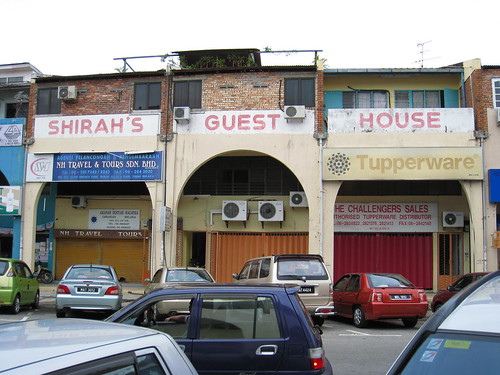
I stayed at Shirah's Guesthouse. A bed in a 6 person dorm cost 1.80 pounds. It was only me and an Italian guy who greeted me (and Shirah) by walking down the corridor naked. Generally first impressions aren't the best when the other party isn't wearing any clothes, it makes you wonder what else they consider acceptable behaviour. Nothing dodgy transpired at Shirah's, though there was an unpleasant odour coming from something in the room (possibly the naked Italian). The place was clean and tidy. The shower was cold, but I think that is standard in this part of the world. I was lucky to have a proper shower head, apparently there is normally just a hose connected to the water pipes of the toilet. They also had the luxury of western style toilets, no crouching hidden toilet paper.


I had my customary breakfast of Roti. Roti is an Indian dish, which is a kind of pancake but not quite. Even though it is the morning the Indians will eat Roti with curry sauce and some form of curried meat. They serve both of these in separate dishes to the Roti so you don't have to eat them. Roti is served in a variety of forms. I have had them with chocolate, banana and egg. In all these forms curry sauce and curried meat is supplied.

Thursday, November 15, 2007

SE Asia I - Singapore Smile

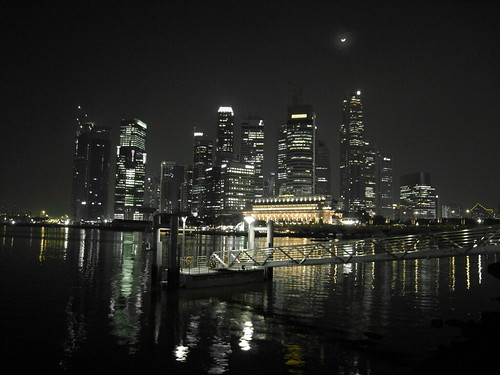
Singapore is the friendliest city I have visited on my travels. It is big, busy and full of people yet still manages to maintain a relaxed atmosphere. It is a melting pot of Chinese, Malays and Indians. I expected to see alot more Western faces than I did. Singapore is addicted to shopping. The shops are busy all day and well into the night. They also love food and you can understand why when it is excellent and it is as cheap as chips, a main meal will set you back just 2 pounds. The streets are busy into the night and feel safe throughout. I wandered the streets at all hours and had no problems,they don't even have the Western problem of drunks spilling on to the streets in the late hours (I think the expats jump/fall into taxis).

I was told by many people that Singapore was a sterile place with little atmosphere and no character. I found Singapore friendly because of the people I encountered and the atmosphere in the streets. It is safe and it is generally clean but that doesn't make it sterile. If you want things to be a bit crazy you can visit Little India, which is even more packed and crowded than the rest of the city. Singapore is heavily Westernised, but I thought that was a great quality. It is Asia's take on an ultra modern city and they have managed to do a better job than most.

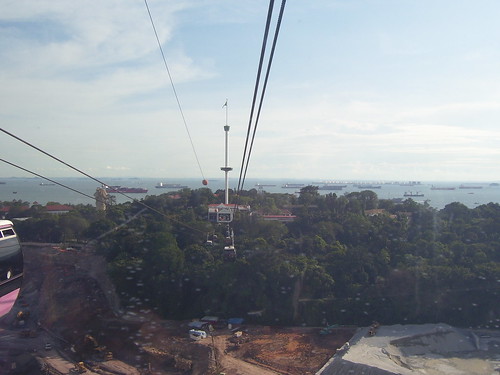
I had to visit Raffles while I was in Singapore. It is very much out of the Empire and it is a great set of buildings to wander around. I had a Singapore Sling cocktail in the Long Bar and was a little disappointed, it doesn't have the greatest air to it and is just a general tourist spot. I also went to Sentosa Island. It is a tourist resort for the locals and can be reached in a variety of ways. The best one is to jump on the cable car from Harbour Front and be whisked over the harbour on to the island. It is so good infact, that at night couples have candlelight dinners in the cable cars. It could well be very romantic but each time you reach the other end people stare at you as the car doors open and you swing passed eating dinner. Sentosa is a great place to watch the sunset, with beautiful man made beaches and a view of the city skyline.

Changi airport is by far the best airport I have been through. It feels big and open. It is also easy to get around. Once you go through immigration you walk straight through to the baggage carousels and then out through customs to the waiting taxis. There isn't a maze of confusing corridors to negotiate. There are also free internet terminals as you walk to immigration. Immigration was the friendliest I have came across, they didn't question you within an inch of your life and they even had complimentary mints. They weren't the cheap fifty different types of urine mints, but the individually packaged ones.

I flew to Singapore from Perth with Qantas. I've flown with Qantas domestically in Australia and internationally. In general I find their stewardesses snotty. They seem to have the attitude of how dare you sit on my plane. On the flight into Singapore they were much better than normal (possibly to do with the average being below the Qantas norm in the mid-twenties). I also discovered that flying on the small planes in and out of the mine sites in Western Australia means you appreciate the comforts of the modern planes even more. I couldn't believe how smooth the takeoff and how much room there was on board (nor how big the wing looked).

I stayed at the New 7th Storey Hotel near Bugis Junction. It is far from new and it isn't 7 storeys high (it is actually 9). It is, however, great budget accommodation. The dorm rooms only have 3 or 4 beds in them. They change the sheets everyday and give you a new toothbrush and a new bar of soap everyday. There is a TV in the room and air-conditioning. I was as ever pleasantly surprised by the people I met during my stay. I met Harry a German who was on his way to Australia. I spent a very entertaining afternoon with him shopping on Orchard Road (a Singaporean institution). He bartered with the shop owners and they gave him very funny banter back. I also met Annette from Australia who introduced me to her Singaporean friends and the delights of fish head soup. On the subject of fish head's they are a Singaporean delicacy and apparently when served a fish head you eat all of it. Another culinary delight is Pig Organ Soup, which is full of pig organ's including the intestines. I also had an unlikely dorm mate in an Orthodox Jew who was extremely shy and even more uncomfortable in his surroundings.
I was lucky enough to be able to move into a friend of the family's place in Singapore. Andrew (from Perth) put me up at his place in the Twin Regency Condos. I spent a very leisurely week at his place enjoying the 40 metre swimming pool and the close connections to town. The Singapore MRT is the best train system I have come across in a city. It is modern, clean, very cheap, and gets you where you want to go. The only complaint I have is with the locals who seem unable to fathom letting people get off the train before getting on the train. I don't know if I am looking back on the London Underground with rose tinted spectacles but I am pretty sure people would let you off before attempting to get on. Andrew also showed me Orchard Towers and Four Floors which is a great place to people watch, even if the people in question may not be of the highest repute.

Saturday, November 10, 2007

Auckland and Vancouver Tourist Guides

I have had a couple of my photo's published on an online tourist guide for Auckland and Vancouver, follow the links below to have a look:


Auckland


Vancouver

Friday, November 09, 2007

Oz XXX - And that is that. The end.

I like the quote even if it isn't entirely accurate. My time in the land down under has come to a close and my next stop is South East Asia. I had a superb time in Australia. I thoroughly enjoyed working in Sydney, 1770, and the Goldfields. The highlight of the year would be the 3 months working on the mines in WA, simply because it was a unique Australian experience. I was very lucky to have so many connections in Perth. I would not have been able to get my mines job otherwise, and it also meant I was given a roof over my head by Nadene and Andrew, Richard and Sandy, and Jon and Alexia. Not only did this mean that I got to save more money, but I also got to meet locals and see Perth from their perspective.

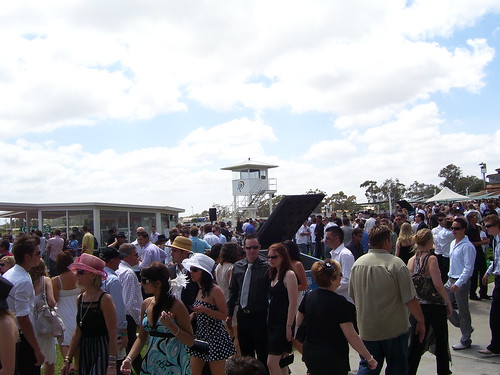
I managed to get to enjoy a big event on the Australian calendar before leaving, the Melbourne Cup. I wasn't actually in Melbourne for the Melbourne Cup but it is celebrated across the country with other horse racing events. So I made my way to Ascot Races with a mate from the mine site Alan. It was a true Australian day of drinking and gambling. Alan and I made an effort and wore a shirt and tie and about half of the guys there did, whilst the other half (the Bogans) were in board shorts and wife beater tops. All of the women took the opportunity to be glamorous with dresses and hats. ALthough these dresses were of varying degrees of taste and decency. The drinking started early at 11am and by midday a number of people seemed to be the worse for wear under the sun. By the afternoon taste and decency dropped as people stumbled around. There is something quintessentially Australian about gambling and drinking. It is a key part of any Australian celebration, none more so than Anzac day, the true Australia day. The equivalent of Remembrance Sunday, it takes place in April commemorating the Gallipoli landings, while there are dawn services across the country, by late morning the drinking begins and the 2-up gambling starts.

One of the great aspects of working on the mines in the outback were the characters that you would meet. My supervisor had been working on mines across Western Australia for years. He told one story where he was on his own in the Pilbarra sleeping on a camp bed in a swag (the Geo had left to leave him with tidying up to do). They had heard dingo howls in the distance but had thought nothing of it. During this particular night he woke up to find dingo's sniffing his neck and trying to open his swag with their paws. He said it was the longest half an hour of his life waiting for them to either attack him or get bored and leave. This guy had also managed to accrue huge gambling debts which meant he had to become a male stripper to pay them off. One job that paid particularly well was to be a human table where people would pay for the privilege of eating food off of you. A driller's offsider on one of the rigs was nicknamed Clivey (substitute rude word here) because whenever the driller told him to do something he would refer to an imaginary character named Clivey who was telling him what to do. He was another guy who had love and hate tattooed on his knuckles. It is no wonder that the drillers go slightly mad. Alot of them do month long stints and back at the beginning of November they were considering doing double stints, to take them up until Christmas and give themselves an extra week off. I would not want to leave the impression that all of the people on the mine sites were the salt of the earth. There were some people who were ridiculously lazy. We had a supervisor who would not come out to the core yard to do any work. He would just hide in the office all day and on a number of occasions he was caught in the mess watching TV. In the evening during dinner he would ask what you had been doing all day, rather than actually having a look himself. The trouble is he won't get the sack because the guy above him is even more lazy.

There are a number of things that I will miss from Australia. The good weather for starters. Although I won't miss bad weather when Australians would ask whether it reminded me of home. For the record it doesn't. Australians do seem to live in some sense of denial about rain. They tell you that it never rains and that they are experiencing one of the worst droughts on record, yet it does rain. When it does rain Australians refuse to wear raincoats. They wander around getting soaked, "It doesn't rain in Oz". I will miss the attitude of "No worries", "too easy", "it'll be right". I will miss the beaches and the wide open spaces. I won't miss the various assortments of wildlife that can kill you. I finally got to see a Redback in Perth, it looks like any other small spider. I may have even been bitten by something of the eight-legged variety as my forearm swelled up due to being bitten by something. In saying that you rarely see snakes and spiders around. The biggest spiders I saw were when I lived in Sydney, where there was a Huntsmen bigger than my hand in my house. The biggest snake I saw was in Byron Bay, a 2 metre long Python making its merry way along the grass behind the beach. I won't miss the hypochondriac response to the terrorist threat. I consider it highly unlikely that a terrorist would consider blowing anything up outside of Sydney or Canberra (even in these two cities I think its highly unlikely). I can't see Al Qaeda ordering a bus bombing in Tewantin (a tiny town near Noosa), and yet there are posters proclaiming such a fate. I will miss drive through off-licenses (bottleshops) because you never know when you might need a drink and how quickly you might need to get one. By the same token on every boat or ferry trip I have been on in Australia, no matter the size of vessel or duration of trip, there has always been an announcement that the bar was open. I will miss the Australian obsession with cold beer, not to sound too much of a Pomme but drinking a warm beer is not the end of the world. Australians, however, seem unable to contemplate such a fate. If you serve them a warm beer they take it as a slight against them. When we went for BBQs in the Bush on the mine site we would always have an esky full of ice, simply for the beer. I will miss the obsession with sport and the multitude of different sports being played. Aussie Rules may be legalised violence but it is certainly a good spectacle to watch.

Tuesday, November 06, 2007

OzXXIX - Out of the pan into the old gold mine

I had been working for the past couple of months at the Cosmos mine site for Jubilee Mines. During my last swing on site I was informed that I was moving to their other site, Bannockburn, in an hour and I was to pack my things. This was due to someone senior's nephew being a muppet. He was moved to Cosmos and I was moved to Bannockburn. Needless to say I wasn't pleased being used in such a way. However, it turned out to be a great experience and topped off my time in Australia. The Bannockburn is much more isolated, when we flew in we still had an hour's drive along dirt tracks to get to the site. The great thing about Bannockburn is that it is small. People are generally friendly and you get to know them much quicker. There is more work to do as a Fieldy but it is more varied and you spend a great deal of time driving through the Bush getting to whether you need to go. Backpackers don't come here and Englishmen are rare. There is a great feeling of space.


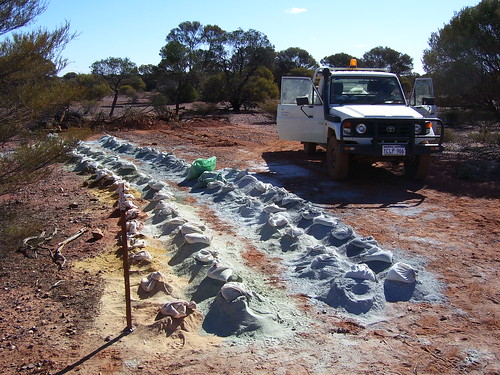
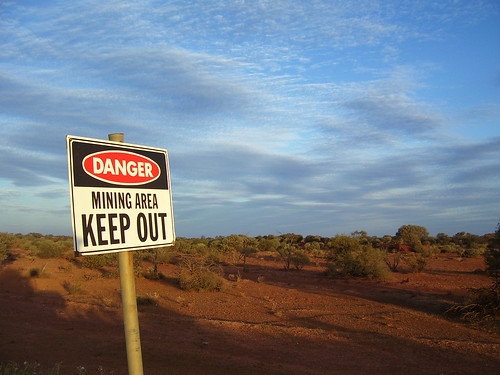
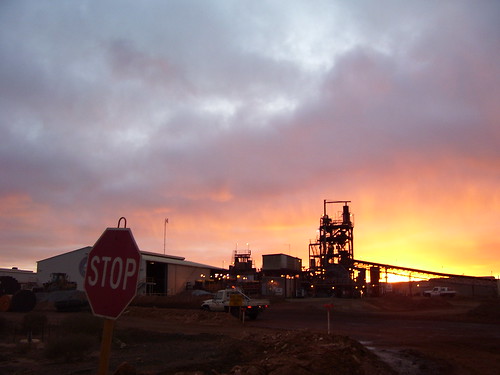
Bannockburn is an old gold mine abandoned in 1996 and is currently used as a base for Jubilee's Exploration team in the area. At Cosmos there is already an open pit and underground tunnels. Bannockburn will become the Sinclair mine for Jubilee and will begin operations in 12 months. There is currently no infrastructure at Sinclair hence why the Exploration team have to use the old gold mine accommodation. The rooms are old and the beds aren't great. You cannot drink the tap water due to frog's nesting in the supply. The frog's climb out of bathroom drains and toilet bowls. At Cosmos there are about 300 people on site at anyone time, whereas at Bannockburn there are only 40. This means the quality and variety of food is much less (especially as the cooking facilities are pretty poor). The Bannockburn core yard, where I spend most of my days, did not have any shade over the racks due to the core shed being built 200 metres in the wrong direction. Making a mistake with GPS coordinates isn't cheap, they moved the shed at a cost of $20,000. The only toilet facility at the core yard is a hole in the ground with a steel drum on top and a black plastic lid on top of that. The unfortunate thing is that this does not have a roof so under the Australian the black plastic seat gets awfully hot on top of the steel drum.


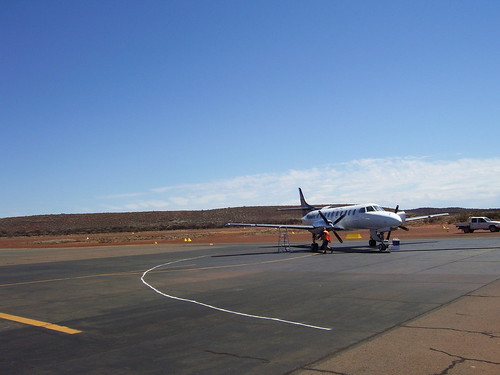
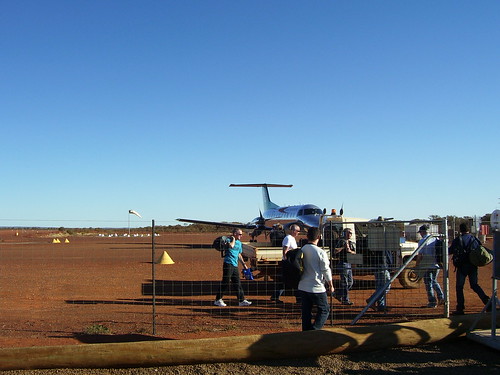
I still fly to and from site. We fly to a place called Leonora on smaller 18 seater planes. There is one row of seats on either side of the aisle and you have to crouch as you walk down the aisle. There isn't a toilet on board. Before we boarded the flight the pilot and co-pilot stood gave us our inflight food and drink as we waited to board (a cost cutting masure Ryanair may consider introducing). During takeoff and landing the curtain between the cabin and the cockpit is pulled back so you can see out the front and see what the pilot is up to. On my first flight out of Leonora we were informed that the flight was going to be delayed due to a fuel pump problem. I was sitting near the plane and overheard a member of the ground crew say "sometimes the trip switch in the cradle doesn't work, so I kicked it twice and now it's working." I hope this conversation doesn't take place at Heathrow. The pilot had already told us that he didn't fancy gliding into Perth and I wouldn't have liked to hear the request from the pilot for someone to climb out on to the wing and give it a kick.


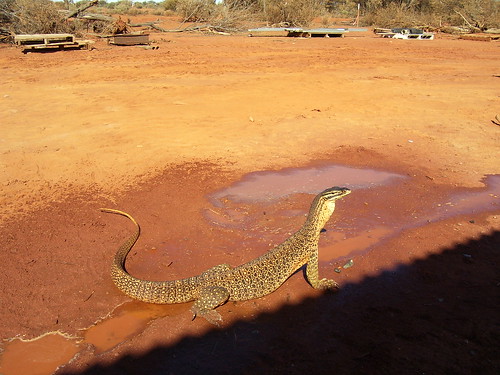
In general there is a great deal more wildlife around due to there being alot less people. There are more snakes, emus, eagles, kangaroos, and bungarra lizards. There are a number of resident bungarra's who have decided that the core yard provides an excellent source of drinking water and food for them. You will be cutting on one of the saws, turn round, and have a metre long lizard under your feet. At the russbish tip a massive bungarra has taken a very comfortable residence amongst the food scraps. The other day I watched a Kangaroo being chased by an Emu across the road as we drove by, we nearly managed to wipe out an entire Emu family on the roads the following day. One evening we had a BBQ out in the bush at a place called Eagle Rock. On the way back we saw a Kangaroo and a small Joey in the middle of the road. At the sight of us approaching the Joey tried to leap back into mum's pouch but she wasn't having any of it. We pulled up next to Joey and he bleated at us, then decided it was probably best to hop after mum. I unfortunately managed to hit an Emu on my way to the airport as I flew out for the last time.


A member of the wildlife fraternity who I wasn't quite so pleased to see more of were the flies. The number of flies was quite incredible. As soon as the sun was up they would swarm all over you. They would fly into every hole on your face. You could swipe away as much as you want, but even if you managed to get one another would soon follow. Someone would be having a covnersation only to start wretching as they swallowed a fly. We resorted to fly nets to preserve our sanity.


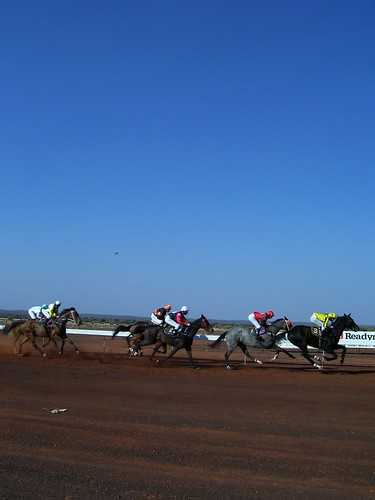
While I was there I managed to go to the Leinster Races. Leinster is a town owned by BHP Biliton. The company chooses who lives there and they run all the services. On the outskirts of town is a dirt horse racing track that they use periodically. It was obviously a big event in the Goldfields social calendar as people came from far and wide to drink and gamble. During the races most people stayed next to the bar and waited to hear the results rather than go outside and watch the horses fly passed. After the racing finished it was then followed by a game of 2-up. This involved even greater drinking and even more gambling. We were graced with the presence of the World Champion of 2-up.

Sunday, October 14, 2007

Oz XXIIX - We wish England was Australia

Here is a link to a very funny advert running on Australian TV at the moment. I don't know if it has been shown in the UK. It is an advert for Bundaberg Rum (nickname Bundy) and their logo is the polar bear.


Tuesday, September 04, 2007

Oz XXVIII - Don't tell Mum I work on a Mine

I am working on one of the mine sites out in the West Australian desert as an Exploration Field Technician. I got the job through a friend of the family in Perth who is a Geologist. When I met her she said she could get me a job as an Assistant Geologist. I thought she was taking the piss. However, it turned out that she was serious and had got me a job after speaking to her boss. I had already got a job in Perth as a Project Co-ordinator for an HR services company. I decided to go for the mining job because I am pretty sure I will never get another opportunity to work on a mine site. Although a co-worker recently enquired what mine sites were near where I lived back home.


The interview for the mine job felt like the introduction of an episode of 999. Michael Burke telling you all the ways in which people will maim themselves for the next hour. The guy told me about all of the equipment on site that I will be using. He then said about the dangers of old open mine shafts, the risks of dehydration, pictures of smashed up Utes. There was a section devoted to snakes, and their prevalence around the camp sites. He said he has developed a habit of looking at the ground to watch for snakes, not a good habit for city life. At one point he gave me a piece of core to hold (which is what they call the rock that they drill out of the ground). I wasn’t sure whether it was a test of strength, so I held it for the next 5 minutes. He took it out of my hands (I couldn't discern whether he was impressed by my Herculean efforts). I met one of the bosses who seemed slightly perplexed that my previous experience of geology was non-existent. I also had to gain my Marcsta qualification. The Marcsta is basic health and safety on mine sites. It involved another healthy dose of being told about the variety of ways that you can injure yourself on site. It really is common sense, where the answers are given to you for the tests that you take. The instructor missed one section out and I still managed to guess the right answers. The instructor had a bad habit of telling us how rich he was and how he drove a Subaru Impreza. I'm not sure what this was meant to demonstrate to us, other than that he was a Muppet.


The job was dependent on me passing a medical and a drugs test. The medical involved ticking various boxes on a sheet. I had a fitness test, apparently I fall into the 'Good' category (not Excellent, Average or Below Average). I was measured, weighed, had my blood pressure checked, demonstrated my ability to balance with my eyes closed, had my kidney's and liver checked, and was found to have no hernia's. Luckily I had the nous not to tick the box 'West Coast Eagles Player' or 'Competitor in Tour de France' for the drugs test. However, I was unfortunately too well hydrated to pass the drugs test. It turns out that one of the few instances when doctors don't want you to have clear urine is when you are having a drugs test. This meant that I had 3 attempts at the urine test. It is somewhat strange to have the colour and consistency of your urine discussed. On the third attempt I had reached sufficient apple juice likeness to have my sample deemed as acceptable.


The company I work for mines Nickel and the site I am on is apparently one of the richest Nickel deposits in the world. The site is one and a half hours flying time from Perth. It is about 400kms north of Kalgoorlie. If you wanted to drive it from Perth it would take about 12 hours. We get flown out on small 30 seat planes. To date all of my flights have been perfectly smooth and I have had some great views. In saying that the landings tend to be firm, especially when landing at the mine site. The landing strip isn't tarmac. When I first arrived I felt like I was in an episode of the Royal Flying Doctors. Apparently the flights can get quite hairy if the weather is poor. At times they don't allow any baggage on board because they know it is going to get bumpy. It has been known to see bits of duct tape hanging off the wings. Quite a few of the guys on site suffer from extreme flying phobias. One of the underground guys is known to curl up into a ball, and another takes two Valiums. He has to fly up a day earlier than everyone else to let them out of his system.


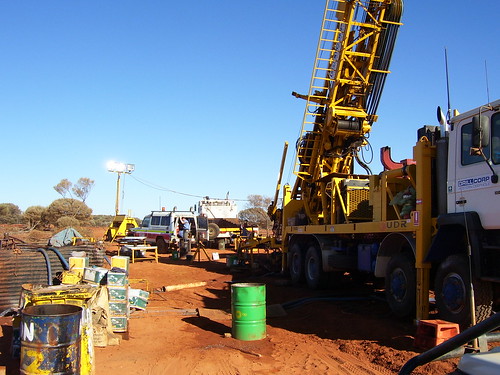
A typical day for me would involve getting up at 5am and going to the dry mess for breakfast. We would then have our morning meeting at 6am in the administration offices before going to the Core Yard office. A couple of fieldies (that is our nickname) will then do the rig run. They drive out to the drill rigs in the bush to collect the core that they drilled the day before and during the night (the drill rigs work 24 hours). The cores are drilled to find the Nickel and map the geology of the region so that they can dig shafts safely underground. We also download information from their gas detectors. We then bring the core back to to the yard. The core has to be marked up in a variety of ways and information has to be collected on it. During his process the Geos (Geologists) will decide which bits they want samples taken from and sent to Perth. We then cut it and bag it up. If it is particularly urgent it will be sent by plane to Perth. There are also underground rigs who bring their own core to the yard. So I spend most of my day in the core yard working on the core. The drill rigs can drill anywhere up to 2kms down. Other jobs come up such as going out into the bush to peg lines which will be cleared and then a rig will be brought into drill some shallow samples. We have morning smoko at 9am for half an hour, lunch for half an hour around midday and afternoon smoko at 3pm. The smoko is an Australian tradition. The day finishes at 5pm.


Whilst it may still be winter on the underside of the world it doesn't mean it is cold. The temperature on site seems to be completely dependent on the wind. If it is windy (and it has been a fair bit on my last two swings) then it is cold. However, if it isn't windy then it is pretty warm getting into the high-twenties. During the summer it can get up into the mid-forties. It has only rained once while I have been there and that was a pretty pathetic effort. In the summer the remnants of northern cyclones can flood the area in no time at all. I have already mentioned that there are plenty of snakes out here during the summer months (I am yet to see one). I spotted my first Bungarra Lizaard wandering around the maintenance sheds. It was about a metre and a half long. Apparently in the summer there are lots of them around. They aren't scared of humans, although when threatened they have a nasty habit of running up people due to their natural defence mechanism being to run up the tallest object. There are plenty of Kangaroos around and they even come into the Village under the cover of darkness.

There are plenty of characters on site. One of the guys who is on the Exploration team is a man of few words, who has love tattooed on the knuckles of one hand and hate tattooed on the other. (I don't want to have a meeting with either.) One of the Drillers is pretty unbeatable with banter. It isn't a place for fragile egos. About 90% of the people on site are male. A size able proportion fit the stereotype of big bearded guys who you wouldn't want to meet down a dark alley. In saying that the atmosphere is pretty friendly on site and when you wander around the village people will generally say 'G'day Mate' to one another. The stereotype of the big burly miner is broken down when you see a group huddled in the bar watching Ice Age or grabbing an ice cream in a cone. The language is colourful to say the least. I don't think I've been involved in a conversation that hasn't included fing this or cing that.


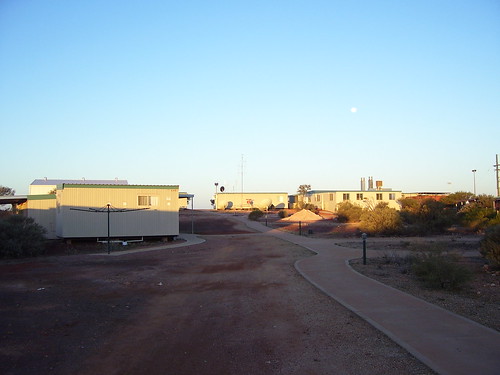
The Village facilities are good. We all live in dongas (essentially porta-cabins), the majority have ensuite showers and toilets. There is an air-conditioning unit and a phone in your room. They have a 25 metre swimming pool, though I'm pretty sure I managed to get overcome by the chlorine fumes last time I used it. At other mine sites they have 49 metre pools, due to pools that are 50 metres long requiring lifeguards. There is a tennis court with all the equipment supplied. The wet mess (bar) is pretty big and has a pool table. The prices for drink are very cheap. The food in the dry mess is the subject of much derision but I think it is pretty good. There is plenty of it and if you want to eat healthily you can. Particular foods do have a habit of coming back in a slightly modified version from the previous meal and the rissoles are renowned for revisiting you later in the day. Exploration are lucky enough to go back to the Village for a hot lunch whereas most people (all those underground) have to take their lunch with them at breakfast. They supply all of the food containers and have lots of different things for breakfast. The trouble is as you don't pay for anything and you can eat as much as you want, combined with beers, means that alot of people suffer from being overweight.

Oz XXVII - Splendid Isolation


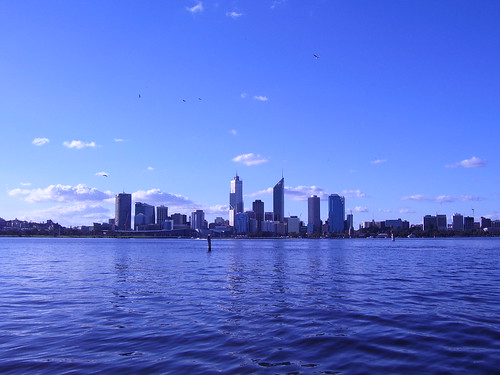
Perth is the most isolated city in the world. It is closer to Singapore then it is to Sydney. The classic standup gag in Sydney about Perth is you get on your flight arrive in Perth and put your clock back 20 years. It is a somewhat unfair depiction. Perth is a much more relaxed place in comparison to Melbourne and Sydney. Over in WA (Western Australia) it is somewhat controversial to say you liked living in Sydney. There is a strong sense of a separate West Coast identity to that of the Eastern states. You stick out like an East coaster if you keep attempting to order Schooners of beer; they only do Midis and Pints. You should not question some of the dodgy activities of the players from the West Coast Eagles (some of them like ice and not in a figure skating sense). In saying that I do like Perth. I am a quarter Perthian and have a lot of family/friend ties out here. I have said it before and I’ll know doubt raise it in the future, knowing locals and being able to stay with them makes a great deal of difference to your appreciation of a place. (I might have even have liked Portland if I knew someone who lived there.) There is good nightlife around the Northbridge area and there are plenty of beautiful places to relax in the sun. Kings Park is huge and has majestic views over the Swan River. The Swan River is very pretty and Cottesloe beach is a great place to watch the sunset.

I arrived at the beginning of August. My first few days were spent applying to temping agencies and seeing what sort of work I was offered. Perth is in the middle of a resource boom at the moment, lots of jobs have been created and they are short of workers. Wherever I have been people have spoken about all the work available in Perth. It certainly seems to be true. I was offered a few short term placements and then a long term placement at the Australian Institute of Management. I would recommend DFP temping agency, they were by far the quickest and most effective at getting me job offers. As it happens I am going to become a bit more directly involved in the resource boom, more to come on that later.

Perth has a similar feel to Vancouver about it. They are both cities that are growing. Perth feels like it is really trying to establish an identity for itself (maybe it needs an Expo). There is a lot of building work in the centre of town and a new rail line is being put in to the south of the city. People are friendlier than in the other Australian cities. Strangers talk to each other on buses and trains (unless its rush hour when all commuters act the way that everyone does around the world). Public transport is pretty good, though not as good as Sydney or Melbourne.

I had a great gig at the Comedy Lounge at the Hyde Park Hotel in Northbridge. I added some references to Helen Clark (the New Zealand PM) and the crowd lapped it up. The other acts were very good especially a musical duo. There had just been a big Aussie rules at the weekend between the two local rivals, Fremantle Dockers and the West Coast Eagles (the Dockers won) and I chatted about that. It was a particularly violent match, though not violent enough if you talk to the locals. While in the UK the commentators frown upon fights between players in sport, over here the Aussie commentators actively encourage it. There seemed to be palpable relief in the commentary box when the first derby (pronounced in American manner) fight started. The commentators were advising the players to get stuck in. The guy who ended up winning the Man of Match award was the guy who started most of the fights, so it must be part of the rules. I didn’t realise until that match that in Aussie Rules there isn’t the equivalent of the Yellow and Red cards. All the umpires can do is put the player on report after the match, so if a player does something particularly violent the only way he can be removed from the field of play is if the coach decides to take him off. This weekend a player for the Dockers got elbowed in the nose, breaking it and knocking him out cold. The player who did it carried on for the rest of the match, and it took place 50 metres behind play!

Oz XXVI - Wildflowers from Kings Park


Tuesday, August 07, 2007

Oz XXV - I would drive 3000kms and I would drive 3000 more

In the past two weeks I covered over 6,000kms on an Outback safari from Darwin to Adelaide via Litchfield National Park, Kakadu National Park, Katherine Gorge, the Devil's Marbles, Alice Springs, Kings Canyon, Uluru, Kata Tjuta, Coober Pedy, Port Augusta, the Flinders Ranges, Wilpena Pound, and the Clare Valley. From the Tropical North through the Red Centre to the Festival State. Whilst this involved a lot of sitting in a bus it also involved swimming in water holes, crocodile spotting, kayaking, hiking, sleeping in swags and sitting around camp fires.

I made the schoolboy error of assuming that I would be able to find accommodation without a problem in Darwin so I left booking it until the day of my flight. It turns out that this time of year is high season in Darwin. I worked my way through the list of hostels in the Rough Guide and ended up at Frogshollow Backpackers. A frog would be displeased to arrive here in the middle of the night. It is a hostel that was once good and has fallen into ruin. It is untidy and dirty. Litter is strewn about the place and has obviously been there for some time. The mattresses are questionable to say the least, with blood stains underneath (a sign of bed bugs). I was lucky to be in one of the few rooms with air conditioning. Darwin in the middle of winter is still humid. Luckily when we came back from the trip I was booked into the Cavennagh, which is much nicer, although if you are on the ground floor you are next to the bar area. Darwin is a pretty relaxed place, much more modern than I expected. There is a pretty beach, Mindel, which is apparently safe to swim in this time of year. During the summer they pulled out over 200 Saltwater Crocodiles from the Harbour area. Parliament is open to members of the public, there are some good museums and a few old buildings.


Whilst sitting in a bus for long periods for a sizeable portion of the 14 days may not be the most fun, some of the things that happened on the bus made it a unique trip rather than just a sight to sight dash. There was a great bunch of people on the bus and there were eight of us who were on all 3 legs of the trip together. We were rather lucky to have a legendary Japanese guy on the trip, Koshi (or as the Brits mistakenly call him Yoshi). He could start a party in a prison cell. I originally met him back in 1770 at Cool Bananas. On the first day of the trip in Litchfield we kept stopping at places for a swim and Koshi only had a towel the size of a flannel, which meant whenever he got changed he would flash everyone. As we knew this was going to happen we could turn away in time, however, other groups weren’t so fortunate. His enthusiasm for pretty much everything was infectious. His rendition of the Japanese national anthem was better than any other anthem (Canada came a distant last on the anthem stakes as they couldn’t remember the words).

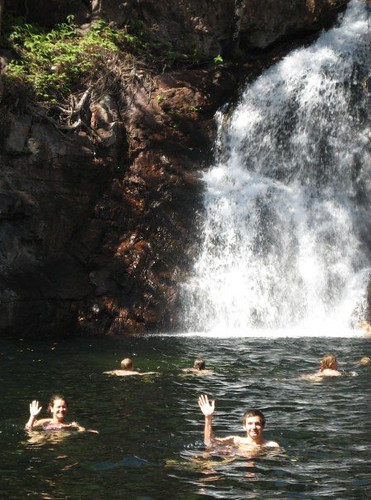
The Kakadu leg of the trip is known as the swimming trip amongst the guides. We went swimming every day. There are some amazingly beautiful spots. It felt like you were strolling or swimming through an Indian Jones film set at times. Due to it being the dry season we were able to get to all the 'attractions' that Kakadu has to offer, during the wet season it is impossible to get out there. If you choose to book a Kakadu trip during the wet season Adventure Tours won't actually take you to Kakadu. We went to Twin Falls and Jim Jim Falls. The guides on our trip had never been to Twin Falls before. Last year Twin Falls was only open to the public for 3 weeks of the year and Jim Jim Falls was only open for 9 weeks. We weren't allowed to swim at Twin Falls because the area had not been cleared of Saltwater Crocodiles. Crocodile attacks are relatively rare but they do seem to happen to German backpackers frequently. So much so that the Germans on our trip were somewhat concerned about swimming in Kakadu. If you do want a safeguard to being attacked by a Saltie then the best thing is to swim with someone smaller than you (or a German, a small German is even better) and the Crocodile will go for them. I nearly got into a spot of bother at Jim Jim. The water is ice cold as it pours off of the Arnhem Escarpment. To get to the falls you have to climb over boulders for half an hour, you then get to the first pool which you have to swim across. After that you climb over some bigger boulders to get to the pool where the waterfall pours into. In the scenic moment my brain didn't really contemplate how far it was to the waterfall. I went swimming off to it with this middle aged Dutch guy. The water was pitch black due to the depth of the pool. We got over to the waterfall without a problem. We climbed up on a ledge to get out of the water we then swam back. I hadn't realised that we had swam a good few hundred metres. So much so that on the way back I was pretty exhausted and still had a hundred metres to go. The dutch guy was in a similar predicament and there wasn't anyone who could have got out to us in time. It certainly concentrated the mind in getting back to the boulders.

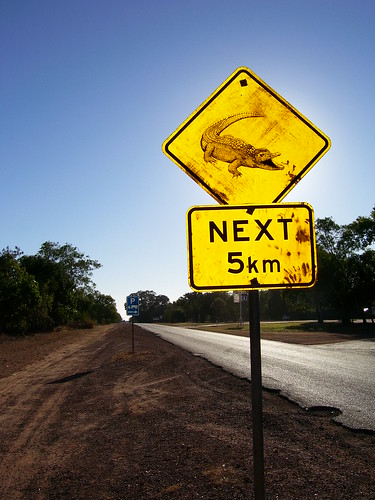
There is more to Kakadu then simply swimming in breathtaking waterfalls. We visited Ubirr with some of the oldest Aboriginal rock art, it is possible that these were painted 20,000 years ago. There is a great lookout here (used in Crocodile Dundee) with one of the most majestic views I have experienced. We also did a cruise along the Mary River. It has the highest concentration of Saltwater Crocodiles in the world. The reaction on the small tin boat as the 4 metre long beats simply opened their mouths was audible. We had the pleasure of watching them scramble off the banks into the water, a pleasure that quickly turned to concern as they came within a few feet of the boat before submerging. Due to it being pretty rough terrain in Kakadu we were in a big 4x4 truck. It felt like we were in a Paris-Dakar truck and we didn't hang about on the corrugated tracks getting to speeds of 100kms. Not fast enough to miss the sights of Kangaroos hopping around and Brumbies (wild horses) galloping through the bush.

Considering I was the only Englishmen on the trip I was surprised at the level of moaning during the three days in Kakdu. The English are pretty renowned for moaning. I was chatting to a Quebec lady on the East Coast who has been here there and everywhere. She said how a defining feature of the English was complaining. I corrected her and said that we don’t complain, because that would indicate an activity on our part of righting the wrong against us. Rather what the English do is to moan and do nothing about it. For instance, if you are having a bad meal at a restaurant you will probably moan about this with your fellow diners but when the waiter comes over to ask how the meal is you will say it is fine. The Kakadu trip proved that moaning isn’t only an Anglican thing.

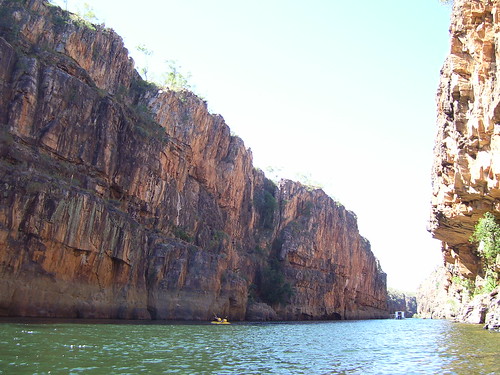
On the trip from Darwin to Alice Springs our first stop was Katherine. We went kayaking up the Katherine Gorge, which could feature in an Indiana Jones film. We kayaked along the gorge, which at the beginning seemed like a great idea until after an hour's paddle we had only got to the end of the first gorge (there are thirteen in total). We made it some way into the second and then turned back. It is pretty exhausting stuff. I wouldn't do it if you are a newly wed couple. Physical exhaustion tests your limits of politeness. Anglo-Japanese relations were tested at this point as to how best to kayak back (there really aren't that many options). I would also suggest picking the biggest and strongest person to be your partner, Steve Redgrave might be a good choice if he is hanging around.

From Katherine we had a big day of driving down to Juno Horse Farm, near Tennant Creek. This was our first taster of the swag. The swag is a one man tent designed by Australians. It is two pieces of canvas stitched together with a sleeping mat inside. You put your sleeping bag inside and that is your bed for the night. If it rains or gets too cold you can pull a flap over your head. If you need a pillow you just put your shoes under the mat. While sleeping next to the fire seems like a good idea you don't want to get too close as spitting embers can set alight to your swag and give you an unpleasant wake-up call in the middle of the night. We were pretty lucky with the weather when we slept in swags. It didn't rain and it didn't get too cold. The coldest it got was probably down to 5 degrees. I had spoken to people who had slept around Uluru when it was sub-zero and they woke up with ice on the inside of the swag! In the summer if you wonder why your guide is sleeping on top of the trailer that is because they don't want a snake to come and join them during the night. It is also not the best idea to unroll your swag and leave it out before getting into it as it does present a nice safe environment for the various creatures to set up home.

Alice Springs is a lot nicer than I thought it would be. There is a bit of a cafe culture developing and there are plenty of things to see around the city (though having a car helps). The weather was good, even though we were there in the depths of winter, with temperatures in the high twenties to early thirties. In the summer the forties are not unusual. I was told not to walk alone around the city at night or even during the day. I can't say I encountered any trouble. The Northern Territories are infamous for the highest level of murder and violent crime in Australia. Unfortunately most of this occurs in the isolated Aboriginal communities. The sad predicament of the Aboriginal people is plain to see throughout the Northern Territories. It is the Elephant in the room that people are unwilling to talk about. It is a strange juxtaposition that Australia embraces Aboriginal culture for the tourists but doesn't embrace the Aboriginal people. They do not seem part of Australian society. Outside of the Northern Territories it is unusual to see Aboriginal people and when you do they tend to be outcasts. I found the people of Alice to be extremely friendly but I didn't interact with any Aboriginals, they are there without actually being there. One of the few Aboriginals who I did meet was the guide at the Telegraph station. The Telegraph station is why Alice Springs exists. The guide seemed to be the Australian equivalent of Bill Cosby, if slightly more befuddled. He told countless stories and tales of the people who had lived there (he was one of them when it was an orphanage for the 'Stolen Generation'). I am not sure that his accounts of the conversations between historical figures was entirely accurate but he was certainly enthusiastic and entertaining.

The first stop from Alice Springs was Kings Canyon. As you may have gathered distances are pretty vast over in Australia and especially in the Outback. We were picked up at 5.15am, registered and actually left Alice at about 6am. After stopping at the Eldundra roadhouse for half an hour we arrived at Kings Canyon at 12pm. We had a quick lunch and then hit the Canyon. Kings Canyon is renowned for Heart Attack Hill. It is the starting point of the walk around the Canyon rim. It is called Heart Attack Hill because people have heart attacks trying to climb it. We were there and it was in the high twenties, with another 5-10 degrees on top of the Canyon. It was warm but in the summer it can get to over forty degrees on the Canyon floor and when it does they close the walk. It is another stunning film set, with one of the highlights being the Lost City. Rock domes as far as the eye can see. On one section of the walk the guide got us all to be quiet so that we could spot Pygmy Koalas, we all stood under this tree gazing up at what turned out to be Koala key rings hung in the trees to trick the tourists.

Uluru is a pretty spectacular sight. Our first sighting of it was with the sun rising as we drove from the Yulara camp site to the base for a walk around it. Somewhat controversially the Japanese guy was going to climb it which is frowned upon by the Aboriginals and most people besides. As it turned out it was too windy for him to climb it anyway. When you walk around Uluru there are certain parts that you are not allowed to take photos of because they are sacred spots. There are signs up advising you of this but it is disappointing to see people taking photos anyway whether out of ignorance or carelessness. I was quite surprised to see so many trees around the base. The area around Uluru is quite green, I had imagine it would be just red soil all around. What makes Uluru geologically interesting is that it is the world’s largest monolith (single piece of rock). They do have a cultural centre here which is pretty good but as ever there weren’t any Aboriginals working there. We also did a walk through part of Kata Tjuta (the Olgas). They are really strange to look at. There is a classic tourist image of them but I didn’t realise how spread out and vast they are.

The bus fun really peaked on the trip from Alice to Adelaide. The guides were young and still really enjoyed their jobs. They went that bit extra for us rather simply going from A to B and whilst the two previous guides hadn’t been bad these guys were exemplary. We stopped at the road side attempting to catch Emus. We ran up sand dunes to catch a sunset. We waved off the other coaches after the Uluru sunset and then drove round serenading those who were left with “Stand by Me”. We then got to the campsite and serenaded those at the campsite with “Stand by Me”. In general if there was someone we could sing “Stand by Me” to then we would. A running gag was taking pictures of people while they slept and avoiding the dreaded Vegemite for being last on the bus.

Coober Pedy is by far the most unique place I have visited on my travels. It is in the desert on the route between Alice and Adelaide. The scenery is truly remote, it is flat without any vegetation for hundreds of kilometres around. Coober Pedy exists because of opals. Along the highway are mounds of earth that have been excavated and noodled to find opals. A local law means that only individuals can mine these lands and it has stopped big companies coming in and excavating the whole area. In town lots of the homes have been carved into the rock, so that the residents can escape the 50 degree heat in the summer. It was used in the Mad Max films and feels like a lifetime away from anything else I have experienced.

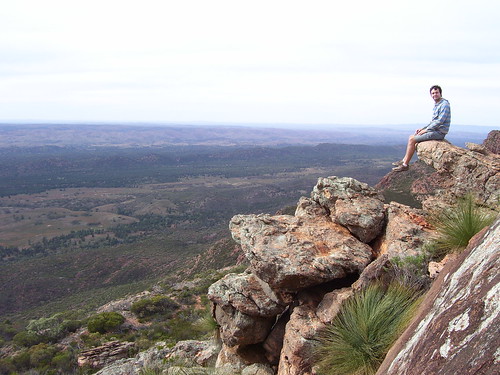
The Flinders Ranges are really beautiful. They are on par with parts of New Zealand and they could easily have stood in as backdrops for Lord of the Rings. It is such a contrast to come down from the flat vastness of Coober Pedy to then see the Flinders slowly rise up and then be amongst them. The views were superb and the drive along the winding roads was great. I could easily have spent longer here. We stayed next to Wilpena Pound and the next day climbed up to the top of the rim of what appears to be a vast crater. It was by far the toughest walk on the trip. It was 2kms up and took two and a half hours. The walk (and at times climb) was one of the highlights of the 14 days.

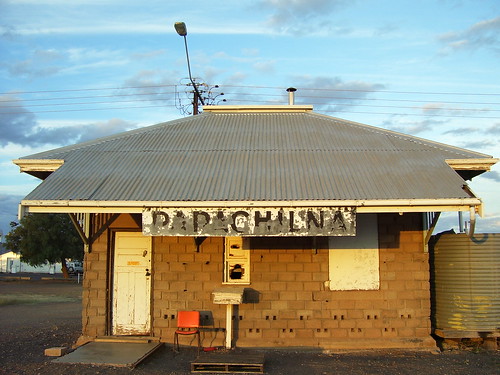
The final night of the trip was spent at Parachilna. A tiny outback village. On one side in the distance are the Flinders Ranges and on the other is nothing. Parachilna’s claims to fame are the Prairie Hotel Pub and that the world’s longest front pulled train passes the town twice a day. It carries coal to the power station in Port Augusta. We ran outside during dinner to catch a sight of this in the dark and I can confirm that it is a long train. For dinner we had Kangaroo cutlets, Emu burgers and Camel sausages. There is a school but there aren’t any children because an old woman in town scared the families away by wielding a shotgun. When we arrived one of the girl’s said, “Are we actually staying here?” and seemed quite incredulous that we were. I thought it was great because it was such a run down place and that gave it character. One evening was more than enough time though. The Prairie Hotel is owned by a family originating from the Isle of Man and they brew their own beer and use the Three Legs of Man as their logo.

The final day was pretty relaxed as we cruised down from the Flinders to Adelaide via the Clare Valley wine region. We stopped at Seven Hills Winery for some tasting. Once we got into the Flinders it had got pretty chilly. It is the middle of winter on the bottom of the world. We arrived in Adelaide on what felt like a typical English Autumn day. Chilly, wet, and windy. I did this 14 day trip with Adventure Tours and would recommend it. They do a variety of trips across Australia. We stayed in a variety of accommodation, from swags to hostels and huts. The food was excellent and everyone pitched in to help prepare and cook. It does make a difference if the trip is only half full. For the last six days we had a half full bus and as such everyone could stretch out. For Kakadu and on to Alice we had the full twenty four people and this meant that the bus was crowded and that there weren't any leftovers from the food. I would recommend booking any tour with them through Peter Pans Noosa. I managed to get a couple of hundred dollars off the brochure price. I would suggest giving any of the backpacker travel agents a call before booking directly with the company because they are bound to be able to get you a discount out of their commission.