Sunday, May 18, 2008

China III - Back to the Huizhou

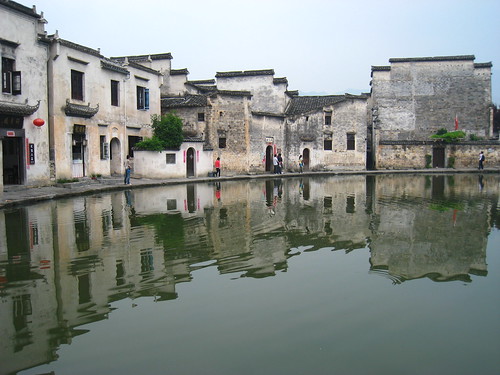
The Huizhou villages are wonderful time capsules of a bygone age. They are a complete contrast to the huge cities of China today. While they have not escaped tourism, some are listed as world heritage sites, they do still retain a unique charm. They do appear to be off the western tourist trail. It was the longest I went without seeing another westerner, five days, and the longest I went without coming across someone who could speak English. Although that is not to say the Chinese do not know about the villages and as with anywhere in China avoiding visiting over a weekend is probably a smart move.

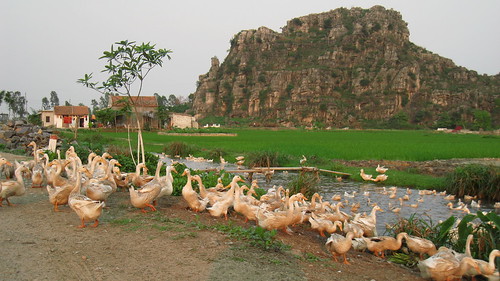
Although modern Chinese tourism has managed to get its claws into them. My first taste of Huizhou villages was around the city of Wuyuan. I hired a motorbike and driver for the day. My driver didn't speak a word of English but that didn't stop us negotiating a price for the day and where I wanted to visit. The only trouble I faced was that even though he didn't speak English and I didn't speak Chinese he did insist on leading me around all of the villages. While that did give me a chance to sit down and eat peanuts with some locals it also led us to having a falling out. We visited Qinghua for Rainbow Bridge (20Y). There was not a great deal to see and while the bridge is historic and pretty it would not be a great loss to skip it. It was interesting but there was not a great deal there and it was very touristy. I went to Big Likeng (20Y) which was amazing. Of all the Huizhou villages I have visited it was the least touristy and most atmospheric. I spent part of the afternoon sitting with the driver in someones home eating peanuts and drinking Green tea while watching earthquake coverage on the TV. The drive there and back was pretty good as well winding through the forest following the river. We drove to Qinghua for lunch. Lunch was a bit tricky as no one spoke English, eventually I managed to order a bowl of noodle soup with meat which turned out to be pretty good. The Chinese ability to down a bowl of noodles is a sight to behold. The afternoon stops at Si Xi and Yancun (36Y) were excellent, although me and the driver were having a falling out by this stage. I think this was down to me becoming increasingly frustrated with playing follow the leader with him. I spent the night in Little Likeng (30Y). We went on to Xian Qi (20Y) which was a glorified tourist market, though there was a pretty little village on a walk across fields. The whole day cost 160Y (including 40Y extra to visit Xian Qi). I stayed in a small basic guesthouse in Little Likheng for just 40Y (shared bathroom). You might assume that Little Likeng is smaller than Big Likeng, however, you would be wrong. Little Likeng is very pretty with a small river running through the centre. I was lucky enough to see the village ducks being rounded up along the river as the sun set. It is also one of the busiest places for tourists in the Wuyuan. I would recommend spending the night in Little Likeng so that you can appreciate the place before the tourists arrive (or after they have left).


Hongcun is one of the UNESCO listed Huizhou villages. The whole village was originally laid out in the shape of an ox. The west end of the village, called Leigang Hill, resembles an ox head and that is where two huge trees stand like ox horns. At the front and rear of the village are four bridges that span a Jiyin stream and resemble four legs of the ox. The several hundred well-arranged houses form the body of the ox, and the 1,000-meter-long Jiyin stream that meanders through the village is regarded as its intestines. A crescent pond in the village is the ox‘s fourth stomach, its known as the postage stamp and is a great place for photographs. I arrived in Hongcun in the evening. I went wandering off into town to try and find somewhere to stay. I found one quite large hotel with no one inside. a woman appeared and after some gesticulating she led me to a room, we agreed on a price and I started unpacking. A guy arrived had a loud conversation with the woman and then gesticulated that I could not stay. I tried to understand why not and gesticulated back, but to no avail. I went off wandering again and ended up at the entrance to Hongcun (by the bridge) where there was a small but very modern hotel, with a price to match of 150Y for a double ensuite. It seems the hoteliers of Hongcun are rather unused to Westerners. After agreeing upon a price I then had to go through an elaborate charade to demonstrate my understanding the principles of a key deposit (that I return the key when I leave). A couple of Chinese students who spoke a bit of English were drafted in to help with the charades. I think the hotelier assumed I had just been parachuted into central China without staying anywhere else before. The great advantage of staying the night in the village is being able to explore the myriad of alleyways at dusk and dawn without the hordes of tourists. However, the Chinese do get up early so it does not take long for them to arrive. Some people might suggest that once you have seen one Huizhou village you have seen them all. While this isn't true it is nice to be able to break up the visit by going to Mekung. Mekung (20Y) is a very small Huizhou village high up on a ridge overlooking a bamboo covered valley. The walk through the bamboo forest to the village takes about an hour. It is beautiful, and while I was there very quiet even though Hongcun was busy.

Wuyuan was a much bigger city than I realised when I returned to it from visiting the villages. I went to find the Post Office so I could send some postcards. I found the word for Post Office in the back of my guide book and headed out asking locals as I went. I eventually found the Post Office. The women working there were most surprised to see me walk in and were a bit flummoxed by what I could possibly want. After a while they cottoned on to my wanting stamps. In the meantime a crowd of customers surrounded me to see what was going on. A particularly short Chinese guy was most impressed by my height and that I was from England. I had some dumplings for lunch which again was a bit tricky. I walked into a dumpling shop. I was met by surprised stares. When they decided I want something to eat they got a pointing stick for me to use on the wall menu the only trouble being it was all in mandarin. I used the poking sticking to point at the food of the other customers. I also stumbled across the peculiar Chinese brothels. Peculiar because they are as obvious as anything sitting in the street barely disguised as hairdressers.

I reached Wuyuan from Wuhan. It was a convoluted journey. I caught a train from Wuchang to Jiulang., It was a hard seat in a double decker train which took three hours. I arrived at Jiulang only to have a problem finding the bus station. After wandering around for a while a girl approached me speaking English offering to help me. She helped me to find the bus station where I then caught a bus to Jindezhen which took another two and a half hours along a large empty dual carriageway with helpful signs in English such as 'Overspeeding Prohibited". I arrived in Jindezhen at the bus station opposite the train station to discover there no onward buses to Wuyuan. I walked around to the other bus station in town where I caught a bus to Wuyuan for the one and a half hour journey. The journey to Wuyuan was very beautiful once we left the urban sprawl of Jindezhen behind. I arrived in Wuyuan at 7pm. I was immediately latched on to by a moto driver wanting to take me to one of the nearby villages. I eventually lost him and settled into a hotel next to the bus station for 80Y. After spending the night at Little Likeng I caught a bus from Wuyuan to Tunxi which took two hours. I caught another bus straight on to Yixian (one hour, 12Y) and then another bus on to Hongcun (2Y). I caught a moto from Hongcun to Mekung (30Y). I got the moto driver to write down his mobile number so that I could call him from the guardhouse for the journey back to Hongcun. I then caught a bus to Yixian and a bus from there to Tunxi.

Wednesday, May 14, 2008

China II - Yangshuo and Tour Group Rebellion

Yangshuo was described to me as the most Western friendly town in China. Yangshuo is a tourist town. The reason everyone is here, of course, is for the stunning scenery. Huge karst rocks pop out of the verdant green rice paddies while rivers sweep around the hills. The area covered by the karst scenery is vast and its easy to spend a few days cycling around.


Yangshuo is pleasant but it does suffer from tourist town problems. There are for starters lots of people there as tourists and lots of people attempting to make money from the tourists. It isn't a bad place to be based and it is quite easy to escape the town and get into the karst scenery.

In a contrast to the karst scenery of Ninh Binh in northern Vietnam old buildings and villages have survived to a greater extent and they lend an atmosphere to the scenery. Unsurprisingly with the number of tourists in Yangshuo there are lots of tourists out and about in the countryside. The vast number of which stay in certain tourist traps. I went off cycling on my own and escaped the crowds. Without doubt the prettiest area was along the Yulong River. The river is lined by the karst cliffs and green rice paddies. I had a great lunch and a long chat with the owner of the Mountain and Water Farmer Restaurant in the old village of Jiu Xian. She had a book of English words that visitors added to. For some reason we got chatting about arteries and veins. I'm not sure she entirely understood my definitions of the two. Another great village was Xing Ping where I did a disappointing cruise along the Li River. However, the village itself was very interesting once you got into the back streets away from the river.


On the way back from my second day of cycling along the Yulong River the chain slipped off on my bike and jammed between the gears and the wheel. I could not budge it for love nor money. An old man appeared to see what was going on, whereupon he disappeared to return with an adjustable spanner. By this time my hands were covered in grease. The old man disappeared again only this time to return with a bowl of water and some soap.

For some reason at the end of my stay in Yangshuo I broke a cardinal rule of travelling. I decided to do some organised tours. I'm not sure why I chose to do this but having done my best to avoid the organised tour in South East Asia I chose to do a couple in Yangshuo. An organised tour is not always a bad thing, however, prices are so low in Asia it is nearly always possible to organise it yourself with a local. I did a boat trip along the Li River for 60Y which was really disappointing. A bus picked me up from Fawlty Towers guesthouse and we were driven to Xing Ping for 5.50Y put into smaller buses costing 2Y where we were driven up the river to another landing stage and put in small boats where we had possibly a twenty minute trip along the river before stopping on a sandbank for twenty minutes and then coming back down the river. I followed this up the next day by visiting the Dragons Backbone Rice Terraces. These are beautiful rice terraces carved on the mountain side by hill tribes. It is a beautiful spot well worth a visit. It is possible to catch public transport there. I chose to do a day trip from Yangshuo and get dropped off in Guilin on the way back where I could catch a train to Wuhan. We spent four hours on the bus getting there. As we neared the guide then informed us that having paid 160Y we would each have to pay an extra 50Y to watch a 45 minute show about the long haired hill tribe women. When we voiced our unease about this and the fact it was not part of the advertised itinerary the Chinese tour guide got very angry. I lead a rebellion of the westerners on board who wanted to spend as much time on the rice terraces themselves. The coach was half Chinese and half Western tourists. The tour guide would not drop us at the bottom of the rice terraces so we had to walk the fifteen minutes to the entrance and she made a big deal of saying that if we were late back she would leave without us. Some of the Chinese tourists joined us and we marched off in search of the rice terraces. There is another bus you have to catch to the rice terraces themselves and then there are a couple of main view points. What was particularly annoying was that if you went to see the long hair show you would not have time to go to both view points. The only reason to do the tour is to save time, if you have a few days then it is much better to do it yourself.
I travelled to Guilin from Nanning on the N722 train. I had purchased my ticket the previous day from a very smiley ticket seller. I think I bought a hard seat but I wasn't entirely sure because everything on my ticket was in Mandarin apart from some numbers. The ticket cost 65Y. Hundreds of people were getting on the train the next morning. Everything was organised. I wandered down the train with my ticket whilst the waiting attendants pointed me in the right direction. Once I was aboard passengers helped me find the right seat in the double decker train.

I arrived in the huge Guilin train station intent on catching a bus straight to Yangshuo. It was not as easy as I hoped. The Chinese passengers headed off in different directions. There were lots of buses milling about but I was struggling to work out which ones went to Yanghsuo whilst trying to avoid the shouting touts. After getting on a couple of buses and refusing the prices they tried to charge me I found a bus that would take me for 14Y. I headed off for the hour journey to Yangshuo with a guy behind me blowing his nose on the floor. I stayed at Fawlty Towers Guesthouse immediately opposite the entrance to the bus station. The staff were friendly and helpful. However, I was disappointed in the tour they sold me for the Li River.

Thursday, May 08, 2008

China I - Into China

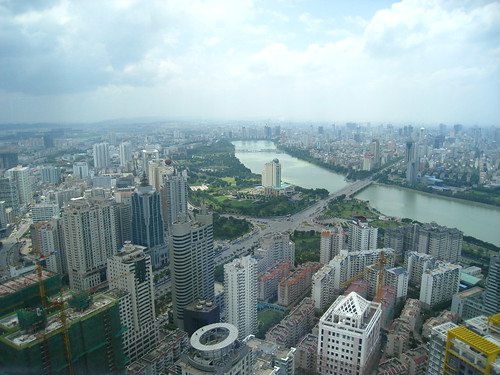
I finally left Hanoi after what turned out to be a month stay. Hanoi grew on me while I was there and it was nice to have a break from travelling, but I was still glad to be leaving. The contrast between Hanoi and Nanning is vast. Both are sprawling cities but Nanning has such a feeling of space, maybe characterless space but space nevertheless. What I found amazing is that Nanning is not a famous or particulatly big Chinese city and yet it is huge. Not only is it huge but it is getting bigger. Nanning does have something of a Milton Keynes or Canberra feel to it. The streets are big and wide. Everything is spread out and planned. On the face of it there doesn't appear to be any links to Nanning's past. The border crossing was a bit laboured on the Chinese side but I eventually got through, luckily I'm not Sloakian.


The border crossing on the Vietnamese side is quite low key. There is an immigration section to check your passport, the guy said something to me in Vietnamese which I didn't understand but the Vietnamese found funny. The bus doesn't cross the border instead bright yellow golf buggies drive you to the Chinese side. The Chinese immigration building is vast. It is a big impressive statement. The Chinese side of the border seems to be something of a tourist destination. There is a big gate and some old buildings. Once inside you have the health check to go through. This involves filling in a card and saying you don't have any SARS symptoms. The official took the cards and didn't bat an eyelid. Next up is customs who were searching a Chinese (or Vietnamese) guy's bags but waved me through. Out of the 6 of us on the bus only one other was a westerner, another backpacker. He was Slovakian. He wasn't scruffy and from his accent it sounded like he had been educated abroad. For some reason the Chinese immigration official didn't like his passport. The only question I overheard was, "Where are you going?" and I got the impression that the answer wasn't sufficient to quell the official's interest. At this point another official arrived with a very big magnifying glass. An official then appeared next to me and asked to see my passport and arrival card (you fill one of these in). The Slovakian and I were then sent back to customs. My bag was opened by a very nice and very young Chinese official whose English was excellent. He pulled some things out of bag and took an interest in my documents folder where I keep photocopies of passports and visas but he didn't really thoroughly search it. I had my Lonely Planet China guidebook wrapped up inside and he didn't find it. Apparently Chinese customs have been known to confiscate Lonely Planet China guidebooks because the map shows Taiwan as a separate country which is not correct according to China. I was sent back to immigration where the official (again another young guy) thoroughly checked my passport and asked me to remove my glasses to check I matched my photo. He was particularly interested in the emergency contact details of my relatives. These guys were't American customs and immigration officials. They were really quite pleasant. All of the officials asked me where I was going and I told them Nanning. They didn't ask where I was staying or delve any deeper. I'm not really sure why the Slovakian registered such interest. He was still at immigration when the golf cart drove off outside.

The drive from the border to Nanning was uneventful. While uneventful just crossing the border showed a marked changed between China and Vietnam. Not only were the Chinese immigration buildings much more grand. The road was a dual carriageway all the way to Nanning and even 3 lanes at times. I've not been on such a big modern road since Thailand I'm pretty sure they aren't in as good condition. Lining the roads the scenery could have been from Vietnam. Lots of rice paddies with farmers in conical hats working away. There were small towns of square concrete houses. Yet there were also big petrol stations that you see in Western countries and we stopped at a motorway services. The buildings were huge and looked very new but there didn't seem many people around and the buildings seemed to be mainly empty. It was true of the roads aswell. There was very little traffic.

Nanning appeared out of the green countryside like an oasis in a desert. Not that it was a welcome sight rather it just seemed to come out of nowhere. Normally when you approach a city you travel through the suburbs, small houses and shops, and as you get closer to the centre the buildings get bigger. It was only when we turned off of the motorway that Nanning appeared. The outskirts were huge towers and skyscrapers. Not only were there lots of huge towers but there were even more being built. I've not seen so many cranes in one place before. When we arrived at the station the coach station was packed with coaches and buses. I caught a bus (number 6) to the train station, at least I hoped so. I got on and showed the bus driver the symbol in mandarin and he motioned me to get on. The journey across Nanning took some time. There is alot of traffic and Nanning is big. The newest tower seem to be around the bus station but there is building work across the city. Once you get closer to the train station you start to notice some old buildings. Its strange to see them, something common in cities across the world. A glimpse at what Nanning once looked like. They aren't necessarily attractive and it looks like they will be soon wiped away.

Nanning is alot less chaotic than Hanoi. The streets are very wide. In the middle are 3 or two lanes for traffic going in either direction. On either side are bicycle and motorbike lanes. All the traffic obeys the traffic lights and no one touts their horns. It was quite a hazy day when I arrived and the towers in Nanning appeared out of the haze. I'm not sure if this is pollution or just the weather, but the haze did seem to get worse further into the city. The second day was much clearer but there was still a bit of a haze. To appreciate the size of Nanning I went up to the City Top viewing gallery in Royal Plaza (Royal Plaza has large statues of Elephants which you can't miss on the number 6 bus route). From up high you can see how big Nanning is and how much bigger it is getting.


I stayed at Ying Bin Hotel opposite the train station. I got a double room with ensuite hot shower, air-conditioning, TV, and a computer with internet for 120Y. Ying Bin Hotel is huge and has the feel of a hospital. There are two receptions, I went to the one on the corner with Cahoyang LU and there always seemed to be someone who spoke English. In the corridors there was a great sign which had a picture of lips and a finger over them with some mandarin chracters underneath was written "lightly". After I had checked in I wandered down Chaoyang Lu to look for somewhere to eat. The streets were pretty busy. During the day the streets are not busy but there is still lots going on. In the shade of the trees men sit around playing Chinese chess and what appears to be poker. There is also line dancing, which in the evening takes on a techno theme while alongside people are ballroom dancing. I went down a side street and came across a noodle shop. I wandered in and tried to order something to eat. The staff didn't speak English and I couldn't work out what was actually in the noodles. In the end I pointed at the picture on the wall and ordered a drink which came to less than a dollar. The noodles arrived in a very spicy broth with peanuts some greens and some wontons. It was very nice though very spicy. The staff took a keen interest in me. They were all teenagers apart from the cook. I tried to get them to teach me some Chinese. One of them was not impressed by my chopstick technique. I'm pretty good with chopsticks, I was picking peanuts out of the soup and can eat rice with them. He considered my technique all wrong and kept moving the chopsticks in my hand to his satisfaction. The next night I ate at Pizza Hut. Pizza Hut is quite a flash affair. Not only have they mastered the western pizza but they have also mastered Western serving standards. They seemingly forgot about my pizza and it wasn't until I reminded them that my pizza suddenly after everyone else had left the restaurant. The meal cost me $14, quite a difference to the bowl of noodles and not quite so satisfying. On the way back from Pizza Hut I was walking along Chaoyang Lu when I noticed groups of women hanging around suspiciously. I say suspiciously because while there were lots of people out on the streets these women were in groups but not talking to one just watching the crowd. When they noticed a man or a group of men walk passed they would walk along side them and chat to them. It seems that prostitution is really blatant in China. In my hotel room I had a telephone and throughout the evening it would ring. I'm not sure what they wanted but in the guidebook it says prostitutes will ring rooms directly. I took the phone off of the hook.

I got a bus from Hanoi to Nanning with Honggai Tourist for 300,000VND. I bought the ticket at Hong Ha Hotel (204 Tran Quang Khai). The bus company have a new office next to the front entrance to the hotel, but if no one is in there go to the hotel. The bus leaves from opposite the hotel, it is a green bus. There were only 6 people on the bus when I got it but it still departed at 9.30am on the dot. There are two buses one at 7.30am and 9.30am. Once you cross the border you are transferred to another bus to take you to Nanning. I arrived in Nanning at 5.30pm (China is 1 hour ahead of Vietnam). I changed the bus ticket 6 times because of the troubles with getting visas arranged and they never gave me a problem changing the ticket (or charged me a fee).

Wednesday, April 30, 2008

SE Asia XXXX - England United

In Vietnam you are guaranteed to be asked, "Where are you from?". Generally it is part of a triumvirate of questions the other two being, "How old are you?" and, " Are you married?". When I say "Anh" (England) the response is always positive. It seems in Vietnamese eyes (if not South East Asian eyes generally) the defining feature of England is football, or more precisely the Premiership. Lots of Vietnamese do not speak English, or have a limited grasp of English and yet when they discover I am English they want to know if I am from Manchester. In no other country have I been asked if I came from Manchester. Manchester Untied appear to be the unofficial national team of Vietnam. I'm yet to meet a Vietnamese who supports any other team. In Laos the majority of people I spoke to support Arsenal, Chelsea, Liverpool and Manchester United, or as one Monk put it, "I support the Premiership". In Thailand the big four receive a hearty following but Liverpool are the undoubted leaders. In all my travels I am yet to find a South East Asian who supports Tottenham. Although the Vietnamese upon hearing that I support Spurs reply, " Robbie Keane".

When I was in Thailand I had a long chat with a guy from Bangkok on the train to Ayutthaya who lambasted McClaren's decision to drop Beckham. In Kuala Lumpar I was in an unsavoury part of town and saw a street stall with a TV showing highlights of the England vs Croatia qualifying game for Euro 2008. When it was announced that England had failed to qualify there was shock amongst the group. In Trang I was having difficulty explaining to a group of Thais that I was English. We were at a bus stop and the bus stop had a huge Barclays Premier League advert on it, after pointing at that for a while the penny dropped. When I arrived at my guesthouse in Hanoi the manager launched into a match report on the Champions League semi-finals. In Laos whilst doing a trek through the Luang Nam Tha National park I was discussing with one of the guides his support of the Big Four.

Tuesday, April 29, 2008

SE Asia XXXIX - Hanoi Visa Woes

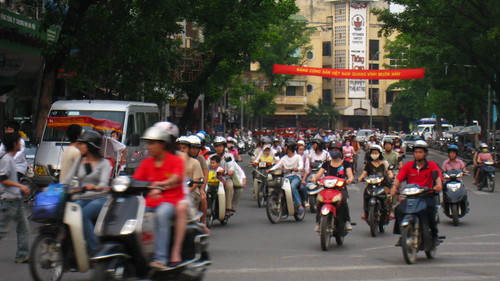
I had a love hate relationship with Hanoi. The city is vibrant. The Old Quarter is full of old buildings and has lots of atmosphere. However, the city is manic. The narrow streets of the Old Quarter are full of traffic. It feels like you are part of the traffic as you walk around and dodge the motorbikes. It felt stressful simply wandering the streets. The Old Quarter reminded me of the packed streets near the riverfront in Phnom Penh. While they are not as chaotic or dirty they feel suffocating especially when the traffic backs up during rush hour.


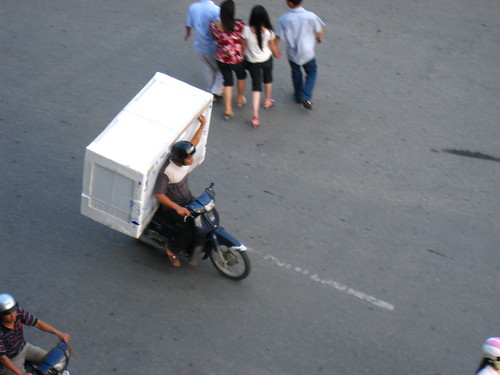
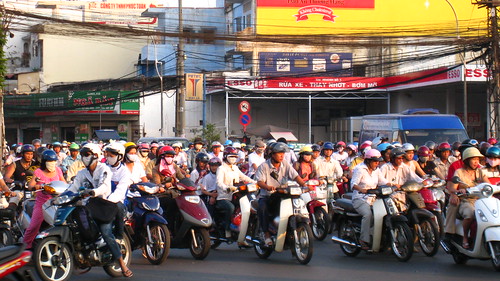
The traffic in Hanoi is amazing. The motorbikes swarm the streets in a constant whir of action. The sight of western tourists standing by the side of the road waiting for a gap is common. The trick to crossing is to step out and keep walking whether there is a gap or not. Moto's will carry everything and anything. A mattress presents no problem, even a family of five on a motorbike is not a problem. In such chaos I was surprised at how rare it was to see an accident.

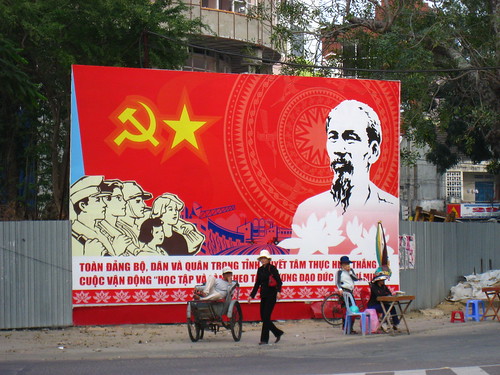
A must see in Hanoi is Ho Chi Minh's mausoleum. You would be forgiven for believing that Ho Chi Minh is still alive with the number of images you see of him across Vietnam. White uniformed guards line the way as you walk single file into the mausoleum. They are there to shush anyone who dares to speak in Uncle Ho's presence. It is a bit strange seeing his grey frail body lying there.

The first place I stayed in Hanoi was Thien Trang. I had a broom cupboard of an ensuite room for $10. When I got back from Halong Bay I moved to Real Darling Cafe. I had an ensuite for $8. Real Darling also had dorm rooms and there was a travellers atmosphere in the cafe downstairs. I stayed there for two weeks and get on well with the staff. Real Darling Cafe were very helpful and charged one of the better prices for organising visas.


I spent a month in Hanoi because of problems procuring onward visas. The first problem was that the Chinese changed their visa rules. The change occurred just a week before I applied. The change made it much more difficult to get a visa and nigh on impossible to get a double entry visa. The stop in issuing double-entry visas was a problem because my plan had been to go to Hong Kong to get my Russian and Mongolian visas. It is not possible to get a Russian visa in China as a tourist. If I went to Hong Kong then I would have to get another Chinese visa which could prove expensive or impossible. I decided to try and get my Russian visa in Hanoi. Unfortunately the Russian Embassy require that you have the original copy of the letter of invitation to Russia. It costs $35 to obtain the letter from an agent on the internet, however, getting it sent from Russia took 4 working days and cost me an extra $75! I then discovered that the Russian Embassy would only issue me a visa if I had at least a 90 day Vietnamese Visa. I only had a 30 day Vietnamese Visa which I extended once. The 90 day visa cost me an extra $115. In the meantime I got my Mongolian one which was a relatively straightforward affair.

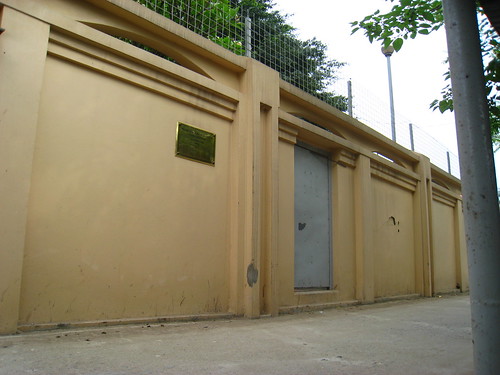
The Russian Embassy is a huge concrete complex which is ugly even by Vietnamese building standards. The address of the Russian Embassy is 191 La Thanh. However, the Embassy is located next to 1133 La Thanh. I don't know if this is a cunning deception to confuse enemies. The Consular is on the other side of the complex down an obscure alleyway. If you follow the high walls round you will eventually find some benches opposite a steel door. The only thing to tell you this is the place is a plaque with opening hours, and a glass cabinet with pictures of Russia. Apparently Russia has aircraft carriers, women and missiles. The steel door opened a little after 9am. It did not open so much as you heard a click, whereupon the Vietnamese guard opened the door. Inside the steel door was a small square with a single door in the corner. There was no sign of the person who unlocked the steel door. I wasn't sure whether to open the door in the corner. I nudged it and it opened. I was presented with a small room and a huge metal detector. On one side was a large window with a letterbox at the bottom and a very tall beautiful Russian woman standing behind the glass. I showed her my passport and she gave me an English application form. I filled it in. While I was filling it in the Vietnamese women who had been sitting on the benches outside came in. I queued up behind two of them. A third walked in and moved in front of me. A fourth walked in and managed to squeeze herself between me and the newly arrived third woman. I was somewhat amazed and tapped the woman on the shoulder. She looked at me and giggled. These four women were thoroughly enjoying themselves peering over one anothers shoulders to see what the Russsian official was doing. The Vietnamese don't really undertand queueing and my tap on the shoulder rather than eliciting a realisation of her queue jumping seemed to signal a different intent on my part. She wouldn't make eye contact with me but her compatriots did. They looked at me, chatted with their friend, giggled, and looked at me again. The Vietnamese left and the Russian offical looked at my papers. They all seemed to be in order. It turned out that she did speak English as she asked me when I wanted my passport back. One day processing costs $55. All in all my 30 day tourist visa cost $255.

The first time I went to the Russian Embassy it was very quiet and I was shown in ahead of the few Vietnamese who were waiting. The second time it was absolutely packed and I had to wait an hour before I could skip the queue and queue inside for another hour. How quickly you can skip the queue depends on what Vietnamese guard is outside. I went back because the machine readable line at the bottom had a spelling mistake in my first name. Apparently this doesn't matter so long as your name is spelt correctly on the main part of the visa. (I didn't have any problems in Russia with the misspelt machine readable line).

The Mongolian Embassy in Hanoi is the least official embassy I have visited. The Embassy is in the new diplomatic quarter. It is off the main road behind the Pakistan and Nigerian Embassies, and the opposite the Brunei Embassy. The address is Villa No. 5 but consular activities take place at Villa No. 6. A Vietnamese guard pointed me across the road. I rang the door bell and a gentleman opened the gate for me and showed me into the house. I was lead into what appeared to be someone's living room. A large desk sat at one end with a computer and some seats. A large Mongolian with a Russian accent sat behind the deak. He gave me a form in English which I filled in, I asked for same day processing which cost $60. (I got a 30 day visa with up to 90 days before entry). I did not require a letter of invitation or an itinerary.

I arranged my Russian and Mongolian visas myself. I went through Real Darling Cafe for my Vietnamese visa extension, 90 day Vietnamese Visa, and my Chinese visa. There are a few people who work there but the best person to use is Mrs Nguyen Thi Luong who always knew what she was talking about and if she did not know the answer she phoned someone to clarify. Real Darling Cafe Guest House, 33 Hang Quat Street (0084) 48269386. I found them to be very helpful.

How to find the Russian and Mongolian Embassies in Hanoi


To find the Russian Embassy you head west along Kim Ma St until you reach the huge Daewoo Hotel, from here carry straight on along Kim Ma St until you pass a boating lake on your right (Swan boats). There will then be a large junction over to your left is a huge ugly concrete complex, this is the Russian Embassy. Follow the high walls along to the right (as you face the Embassy) and you will come to an alleyway. If you walk down this alleyway you will come to a row of benches and a steel door. The Russian Embassy in Hanoi is open Monday 9-12, 16-17, Tuesday 9-12, Wednesday 9-12, 16-17, Thursday 16-17, Friday 9-12.


To find the Mongolian Embassy go to the Family Medical Practice (on the Lonely Planet map) 298i Kim Ma Street. From the clinic walk west to the first junction with traffic lights, turn right and cross over the road, about halfway down the road is the Nigerian Embassy turn left along the street between the Nigerian and Pakistan Embassies. Follow the short street to the end, on your left is Villa No. 5, infront is the Brunei Embassy, and on your right is the Mongolian consular Villa No. 6. It is only open Tuesday and Thursday morning to process visas.

Thursday, April 17, 2008

SE Asia XXXVIII - Halong Bay


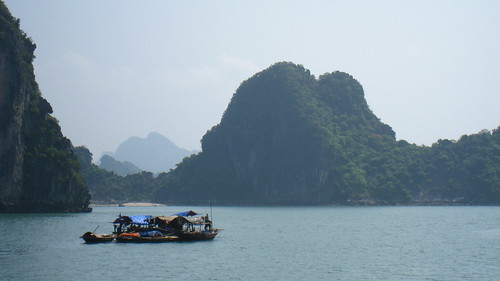
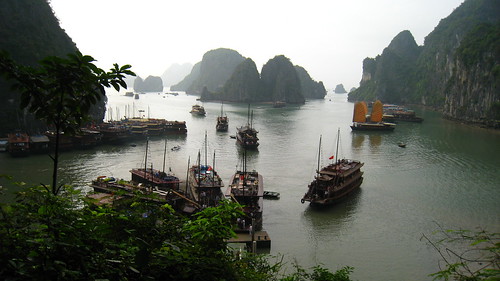
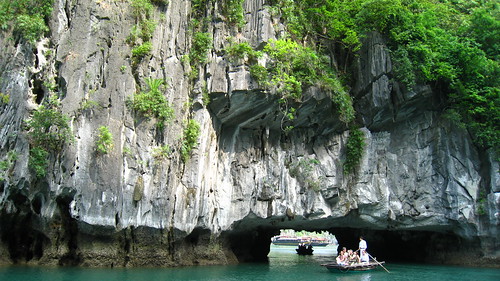
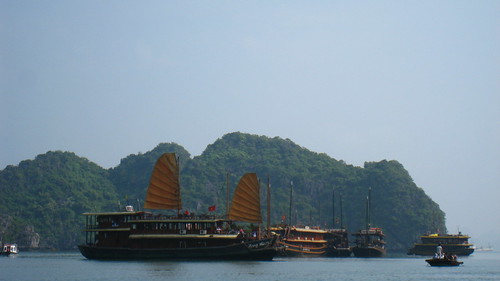
Halong Bay is a beautiful area in Northern Vietnam. It is a stunning bay with over 2,000 limestone karst cliffs rising out of the water. I did a 2 day/1 night tour out into Halong Bay. I was very lucky with the group on board with a mix of young and old who were quite happy to sit around and have a chat and enjoy the scenery. The trip to Halong Bay was easily the best thing I did during my stay in Hanoi. It was so quiet and relaxing. When we got dropped off in Hanoi the noise and chaos resumed instantly. I went for the expensive tour option for Halong Bay and had a very enjoyable time.

The only negative aspects to the trip were problems that all trips will suffer from. The journey to Halong City to catch the boat takes a while, 3-4 hours. Halong Bay itself is very busy. I was aware of this but other people were a bit disappointed by the sheer number of boats around us. Even though there are lots of boats it still feels quite serene. The number of tourists becomes obvious when you go ashore. We went to Amazing Cave which is worth a look but you do fight it out with lots of other tourists and may aswell stay on board the boat and enjoy the scenery. We then climbd up to a view point, packed with tourists. We went for a swim here and I made sure not to put my head under the water. There was lots of litter in the water and some Australian girls were convinced that there were jellyfish. When we anchored there were at least 35 boats in the same spot (there are apparently only 3 overnight anchorage points in Halong Bay so they are all busy). We were on the outside of the group so it was peaceful apart from a couple of generators.

I did a 2 day, 1 night trip to Halong Bay with Handspan tour operator. It cost $155 which included a $30 single supplement, all food on board, and transfers to and from Halong City. Drinks on board were pricey (but this seems to be standard on any boat) $1 for a can of coke, $1 for a small bottle of bottle, and $2 for a can of Tiger Bee. We were on the Valentine Boat although there was nothing written on the boat to indicate the name. The only name was "Bai Tho Co Tourist" and the number 3998. The facilities on board were excellent. There was a large upper deck where you could lay on a sun chair and enjoy the view. The rooms were more like a hotel room then a boat cabin. The ensuite bathroom was easily the nicest bathroom I had during my stay in Vietnam. The food was plentiful and very good. There was lots of seafood. Our first lunch consisted of a large crab each, followed by shrimps, then spring rolls, squid with vegetables, and a fish. Dinner was a different type of crab , a huge prawn cocktail, squid in breadcrumbs, mixed vegetables, rice and another fish. Breakfast consisted of some pastries, unlimited coffee, tea and orange juice (or so it seemed). The guides were good and not mini-Hitlers. In South-East Asia the guides I have come across tend to be authoritarian, or at least the language barrier means they aren't quite so good at sugar coating their commands. The tour guide had some interesting interpretations on what the rocks in Amazing Cave represented. I'm not sure if he gives the same explanation to every group.

The choice of trips to Halong Bay present a bit of a minefield to the budget traveller. The truly budget tours for under $30 are known for problms with safety, food, theft and not getting what you were told you would get for your money. Even the mid-range tours for around $80 can be hit and miss. If you would like a full run-down of the different options for Halong Bay tours read this article on the Travelfish website. I wouldn't recommend a day trip to the Bay because it takes 3-4hours by bus to get here which doesn't leave you much time to enjoy Halong Bay.

Tuesday, April 08, 2008

SE Asia XXXVII - Into the North

Travellers often skip north Vietnam between Hanoi and Hue. Dong Ha and Dong Hoi do not have a great deal to offer unless you are interested in the DMZ battlefields. Ninh Binh on the other hand is a really beautiful area and a great place to relax for a few days.

Dong Ha is not the most pleasant place I have been to. It straddles the main north south highway. I stayed there because it is the closest town to the DMZ. The DMZ used to separate north and south Vietnam. It was the site of fierce battles. There are lots of sites associated with the Vietnam war scattered around the area. I went on a motorbike tour organised with DMZ Cafe costing $17. I went with Mr Khan we visited Doc Mieu Base, then to Vinh Moc, Hien Luong Bridge at Ben Hai River, Truong Son National Cemetary and then Con Tien Fire Base. The best part of the trip was visiting Vinh Moc for the tunnels. The tunnels were dug by the locals to escape the bombardment during the war. They are over 2 kms in length. The tunnels grew in complexity during the war to include kitchens and hospitals, 17 babies were born in the tunnels during the war. The rest of the sites are a bit difficult to appreciate because often there is not a great deal to see. The great advantage of having a motorbike tour was that my driver Mr Khan was an interpreter for the Americans so he was able to draw on his personal experiences in the area. He was bitter about how the Americans had cut and run. We drove along the Ben Hai river, the old border and he showed me the B52 craters sitting amongst the rice paddies. One of the sad legacies of the war is that there is no recognition of the sacrifice made by the South Vietnamese soldiers. South Vietnamese war cemeteries were bulldozed after the war or simply allowed to fall apart. We visited Truong Son National Cemetary which only has the remains of North Vietnamese soldiers. I arrived in Dong Ha from Hue by train hard seat 18,000 VND. A rather persistent moto driver took me to Ha Noi 2 Hotel 120,000 VND for an ensuite. I left Dong Ha for Dong Hoi by train which cost 26,000VND for a hard seat. A family had colonised my seat, with small children at my feet. Dong Hoi is a much more attractive town than Dong Ha. It sits on the coast across an estuary. There is not a great deal to see in the town, down to the American bombing campaign. There are the remains of the old city wall and a burnt out shell of a church. I did come across a guy who tried to speak to me in German, which he had learnt when living in East Germany in the 1980s. I didn't see any other Westerners while I was there. I stayed at Nam Lang in Dong Hoi which was new and was pretty good value at $10 for an ensuite.

One of the highlights of my stay in Vietnam was Ninh Binh. Ninh Binh has the famous limestone karst scenery that you will read alot about in my blog. It is a really pretty area and much less touristy than I expected. There are a couple of tourists spots that are over crowded but they are easy to avoid. I spent a few days cycling around the area enjoying the scenery. I enjoyed staying in Ninh Binh because it is a typical Vietnamese town. Not far from Ninh Binh is Phat Diem made famous by Graham's Green 'Quiet American'. It is a pretty little town with a bizarre looking cathedral. I was there for the Sunday service with huge crowds. I was targeted by a local nutter who wanted a fight with me. I wondered if it was because I stayed at Thanthuy's Guesthouse the main place for backpackers in town with a large dining area which is a good place to meet people. I didn't think the staff were great and certain things seemed to be priced highly. I hired bikes from Ngoc Anh Hotel the other side of the main highway. I caught the morning train from Ninh Binh to Hanoi, which cost 43,000VND.

Friday, April 04, 2008

SE Asia XXXVI - Hoi An and Hue

Hoi An feels like a time capsule. The buildings appear lovingly decrepit. There is a somewhat sleepy feel by the normal frenetic Vietnamese standards. It is unsurprising to find tourists dominating the town. Unfortunately this domination has brought all the negative aspects you would expect. There are a large number of tailors, accompanied by a fair share of craft shops and general tourist tat shops. The old shops that once existed in the streets of Hoi An have all but disappeared. The touting from these tourist shops isn't that aggressive but you wander around constantly hearing, 'come in my shop' and 'you buy something'.

While I was in Hoi An I went to get my hair cut. It was a bargain at 30,000VND. The only trouble was that I got my hair shaved off rather than trimmed. A shaven head did not cause me any problems but I was chatting to an Asian American and he was telling me that when he first arrived in Thailand he had a shaven head. The trouble was the locals assumed he was a monk and were quite confused by him not acting like a monk. South East Asians are remarkably well preened. It is not only women but men. It is not uncommon sight to see a man preening himself in his scooter mirrors. No matter what size the town or village there is always a hairdressers, if not a handful. The only real exception are in the hill tribe areas and there you see people picking lice out of one another's hair. The scruffy look is not in fashion. Men are well groomed and do not have designer stubble, the most the Vietnamese will stretch to is a whispy Ho chi Minh style goatee. Men look and act quite femininely. Men and boys are very touchy feely with one another, in a way that would appear strange in the West. It is not uncommon to see men sleeping on top of one another in the midday sun. Throughout South East Asia and on the streets of Vietnamese towns the sight of a barber is very common. They setup against a wall or a tree with a mirror and a chair. In Vietnam barbers also come equipped with headlamps and a variety of long brushes, almost a mini chimney sweep kit, used to clean people's ears out by the side of the road.

Hoi An can make you wonder whether the stereotype of Vietnamese out for every dollar in your wallet are in actual fact true. I did not find this to be true. However, like everywhere else in the world where tourists congregate they attract people who are there purely to make money from them. It is even more obvious and contrasting in South East Asia where the locals are poor and the tourists are rich. Hoi An has a problem with this because it is a small place dominated by the tourist trade. I often found the Vietnamese to be helpful beyond the call of duty. When I was in Saigon I posted a parcel home. The Vietnamese post office worker who packed the parcel was very efficient and told me that by going over a certain weight the cost of the parcel would jump. He told me to take something out. I arrived in Danong only to discover that there was an international fireworks competition taking place that evening and there was no available accommodation. After walking around all the hotels I could not find any accommodation. I stumbled into Phu an Hotel where a helpful guest translated for me with the staff who booked a taxi to take me to Hoi An (30kms down the road), a hotel in Hoi An, and allowed me to leave my bag there until the fireworks finished. That is not to suggest that the Vietnamese are not adverse to making a profit. Bargaining is required and the key is playing a game. Keeping a smile on your face and acting playfully is important because everyone saves face. It is no good losing your temper. In South East Asia to lose ones temper means you and the other person have lost face.
I caught the local bus from Hoi An to Danong which takes just over an hour. I knew that this bus should only cost 10,000VND. We set off the conductor came over to me. She started at 40,000VND which I laughed at and politely declined. She sat next to me for a while seeing if I would give. Eventually she went back to the other passengers and collected the money from them before coming back to me and settling upon a much more reasonable 20,000VND. I had already purchased my train ticket to Hue through my guesthouse in Hoi An for 95,000VND. The train was packed. The journey to Hue from Danong is particularly beautiful as the train winds its way along the coast. I enjoyed Hue because it is bigger than Hoi An and better able to absorb the tourists that visit. I felt that there was a great deal more to see ad that what was there was more genuine and less commercialised. The westerner backpacker area of guesthouses has not overrun the historical part of town. The citadel is great to look at and the Imperial Enclosure is fascinating to walk around. I spent a good few hours there without being hassled. There are certain key attractions that everyone goes to see in the Imperial Enclosure and then they leave. The Imperial Enclosure is enormous and there is a lot more to wander around and explore than most people realise. While I was there I also cycled out to the Tu Doc tomb and the Ho Quyen an Elephant and Tiger fighting arena. It looks like a Roman fighting arena and is in amazingly good condition.
I did have a problem in Hue with my accommodation. I stayed south of Le Loi at Binh III for $8. I had agreed I would move rooms the next day. Unfortunately their definition of moving rooms involved banging on my door from 7am. I got increasingly annoyed with them so that I checked out, when I did they turned nasty and tried to up the price already agreed. Unfortunately when face is lost then the rules of the game change. I moved to the guesthouse opposite Binh Dong III for $8 and was not disturbed. In Hoi An I stayed at Dai Long Hotel for $15 a night, which was a nice place but a touch overpriced.

Saturday, March 29, 2008

SE Asia XXXV - My Lai Massacre

The Son My Memorial sits near the coast off of Highway 1A from Quang Ngai (if you want to know how to get there check the previous post). The scenery is very beautiful. Rich green rice paddies were covered by big blue skies. It is strange to visit a memorial to such a terible event in such a beautiful place. The My Lai Massacre took place on the 16th March 1968. 504 civilians wer killed by US troops. The My Lai massacre is commonly seen as an example of when a few soldiers go 'bad'. In Actual fact the massacre was an authorised mission and the soldiers were told "...anyone down there was VC or VC sympathisers." Leioonard Gonzales of Charlie Company testified to the Peers Inquiry that "that day was a massacre", the command was "...kill anyhting and evrything...". The BBC has recently broadcast a documentary using recording from the PEers Inquiry that investigated thge cover-up of the incident. The Inquiry produced 20,000 pages and 400 hours of audio recordings. However, Jerome Walsh a lawyer at the Inquory described General Peers findings as being gagaed and that it was a "...fiasco of military justice". The BBC broadcast the documentary for the 40th anniversary of the massacre.
The Son My Memorial is a moving place to visit. Inside the museum is a wall with the names of the victims. There are Ron Haeberle's (US Army official photographer) photographs of the massacre. There are personal accounts from survivors and parts of village life that survived the village being burnt to the ground. The way the memorial presents the crime can grate with western sensibilities. There is a large diorama of US troops shooting women and children, accurate but not something I think you would see in a western equivalent. The descriptions of photographs refer to imperialist puppets and the usual anti-capitalist diatribe. What is very powerful is the recreation of the village after the massacre. Ruined huts are scattered around rice fields. While I was there old women were working in the rice paddies. Next to each hut are details of the family who lived and died there. The concrete paths that link them have small bare foot prints mixed with large G.I. boot prints. I'm not sure the concrete models of dead livestock fitted in but that may just be my western sensibilities again.

Below is the introduction to the documentary from the BBC website. "For a year after My Lai, the rapes and murders were covered up. Much of what we know thereafter came from the widely publicised court martial of Lt William Calley in 1970/71. He was the only man ever found guilty of any offences at My Lai. But the massacre was much more than the actions of a few rogue individual soldiers. It was carefully planned and a high body-count was the main aim. Before Calley's trial, The US Army itself held its own investigation into the massacre. "The Peers Inquiry" heard evidence behind closed doors inside the Pentagon from December 1969 to March 1970. *The inquiry recordings lay forgotten for nearly 40 years. Tonight, for the first time, you can hear the testimonies of those involved and the full extent of US Army activity on the ground on16th March 1968. You can also hear new interviews with soldiers who took part and with one of the members of the panel of the Peers Inquiry. Over 14 weeks, Lt General William Peers and his panel took statements from 403 witnesses: soldiers, senior officers, chaplains, journalists and Vietnamese. The findings of the investigation were so uncomfortable for the US Military they were suppressed. Some 400 hours of tape were recorded - and classified. Until now. The accounts are shocking: "The first shot hit a baby in the head and I turned around and (was) sick" - one soldier. Another: "Most people in our company didn't consider the Vietnamese human…..A guy would just grab one of the girls there and ….they shot the girls when they got done." The tapes of the Peers Inquiry prove that US soldiers raped and killed hundreds of civilians in not just one but three villages that day. They prove that two companies - not only the infamous Charlie Company - were involved. They show how badly trained and ignorant of the laws of war many of the young soldiers were. These tapes also prove that the orders "to leave nothing alive" came from senior officers. The Peers Inquiry made key recommendations about the training of soldiers fighting insurgents and about the responsibility of leaders in wartime - issues with huge resonance today in Afghanistan and Iraq. The programme is presented by American military journalist, Robert Hodierne, himself a journalist in Vietnam." http://www.bbc.co.uk/radio4/1968/mylai.shtml
Friday, March 28, 2008

SE Asia XXXIV - On the road

I covered a lot of ground in a few days making my way down from the highlands and on to the coast. What stood out from these days were the insane risks that Vietnamese minibus drivers take. They all seem to have been schooled at "Get Away Driver's R'US". What is amazing is that everyone sits back and accepts the detours and crazy driving manoeuvres as common practice. Apart from one woman sitting next to me squealing, though that may have been because she was sitting next to me.

The bus from Buon Ma Thout to Nha Trang was packed by the time we had driven around and picked up passengers outside of the bus station. I caught the 6am bus to Nha Trang for 70,000VND. The journey down from the highlands to the coast is very pretty. A Catholic missionary joined the bus. Joseph was working in the Phillipines and had come back to Vietnam to visit his relatives. His English was excellent and we chatted about Vietnam and travelling. My plan for the day was to go to Quy Nhon a further 4 hours of travelling from Nha Trang., Joseph informed me that there was a direct bus from Buon Ma Thout to Quy Nhon, something I didn't know and would have made the journey quicker as it takes a different route. I decided to jump off of the bus once we joined Highway 1A that runs from Saigon to Hanoi. It struck me as pointless going to Nha Trang to come back on myself to go to Quy Nhon. Joseph wasn't a fan of the plan and quite worried for my safety. Apart from anything else he was worried I would get ripped off. As it turned out the only dodgy thing that happened was a rather friendly moto driving stroking my arm. I only waited ten minutes for a bus heading to Quang Ngai. I did have to negotaite with the conductor. After many noises on my part and much lauighter from the rest of the passnengers I paid 60,000VND to Quy Nhon. The bus was packed but the driver was taking life easy. The view of the coast was spectacular even if the clouds of cigarette smoke obscured it. I was surprised to find Highway 1A, the main artery linking north and south Vietnam to be nothing more than a normal road with hard shoulders that were slow lanes for local traffic. At one point the road climbed up the side of a cliff face and plunged over the other side only to be confronted with huge pot holes with truck and bus swerving to avoid them.


Quy Nhon is a small Vietnamese town on the coast. It sits in a pretty bay. The beach is very long, colourful fishing boats are moored just off shore or sit on the beach itself. Quy Nhon is a small town by Vietnamese standards but is still pretty big and busy. There are very few western tourists. Quy Nhon is certainly a nice place to break up the journey going north. There are some Cham towers in the town and the locals appear to be genuinely pleased to see you. I stayed at Barbara's Backapckers a hostel setup by a New Zealand woman. It was a nice place with lots of informaion on what to do in the area. I stayed in a 6 bed dorm for 50,000VND which only two of us shared.

Minibus drivers in South East Asia are psychotic. Vietnamese minibus drivers are among the more mental. I got a minibus from Quy Nhon to Quang Ngai. I arrived at the bus startion on a moto and as soon as I got off a guy was chasing me. I agreed 50,000VND for the journey to Quang Ngai and got in. I asked when we would be leaving, he said 8am (it was 7.30am). I was the only passenger. We roared off down the road. The driver must have gone to the bank robber driving school. We chased down moto drivers and screached to a halt alongside them, before doing a u-turn and flying off in the opposite direction. It had more in keeping with a kidnapping than a bus service. The minibus pulled up next to a guy standing next to the road, the conductor jumped out and bundled him into the back of the minbus. We went back to the bus station where a German joined us. We waited around for a good twenty minutes before doing some more circuits of the local area. We eventually had a pretty full transit van and we started on the road north. The airconditioning wasn't working and it felt like a sauna. The driver was really going for it. He did the usual crazy manoevoures, passing on blind bends, overtaking with traffic coming at us head on, forcing motos off of the rod, while at the same time having the horn blasting and the conductor leaning out of the window screaming "oi, oi, oi" at anything in our path. I could understand driving like this to get to our destination quickly but then we would slow for no apparent reason before speeding up again. Click here for a video of some of the risks he took, if you listen carefully you can hear the "oi,oi,oi". We would drive at 120 km/h through the centre of a town before slowing in the countryside with no potential for picking up passengers. When people were seen at the side of the road we would pull up beside them and the conductors would try to kidnapp them. The locals at the side of the road appeared to be just as repulsed by their hard sell tactics as foreigners are.

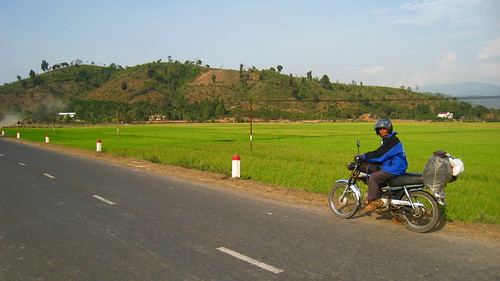
I was going to Quang Ngai to visit the Son My Memorial to the My Lai Massacre. I have written about that in a separate post. I got dropped off at the ringroad in Quang Ngai and wandered over to a roadside cafe. I had a cheap lunch and then the moto mafia descended. I knew the cost of a return journey to Son My should be 50,000VND but that as a westerner you were highly unlikely to get this price so the best you could hope for was 100,000VND. Two moto drivers sat down and their initial offer was 200,000VND. I laughed and said nothing. The negotiations drew a small crowd. I could see little point in returning a price so collected my bags and asked to use the toilet. I was directed to a muddy chicken coup out the back. When I returned the patriarch of the family said 100,000VND, I agreed to the price and he directed me to a moto driver (I left my big bag at the cafe). The scenery is very beautiful, big blue skies with rich green rice paddies lining the road.

After my visit to the Son My Memorial I returned to Quang Ngai to continue my journey north to Danang. I had another hair raising minibus journey ahead of me. I got my bags and walked across the roadf to catch a bus heading north. A minibus was waiting. The conductor tried to nget me on board for 90,000VND which I knew was way overpriced. I put my bag down and sat at the side of the road confident more buses would be along shortly. She returned and offered a cheap price, I refused eventually it came down to 50,000VND and I accepted. On board it turned out that the minibus was not departing for Danang immediately. We toured around the ring road. After twenty minutes we were full and I assumed we would be leaving for Danang. Another full minibus pulled up infront of us and all of their passengers got off and got on to our already full minibus. When I say minibus we were in a Ford transit van. There were seats for about twenty people. The back seat seat was folded down and they manged to squeeze 40 people into the van. The conductor hung out of the sliding door touting for even more passengers while yelling "oi,oi,oi" at anything in our path. The driver was of course mentally deranged, even with the number of passengers on board we went at light speed to Danang. Click here for one video and a second video of his driving. Sitting next to me was a local from Quang Ngai going to Danang to watch the fireworks. It turned out that an international fireworks competition was on in Danang and that was why so many people were going.

I arrived in Danang and caught the local bus from the bus station to the centre of town for 3,000VND. I hunted high and low for a room for the night and could not find anywhere, not even at the expensive hotels. I went to Phu An Hotel and asked for a room. They didn't have any either so I asked about buses to Hoi An. It turned out that there were no more buses to Hoi An. Luckily a guy at the reception who was staying at the hotel spoke excellent English. He said a taxi to Hoi An should cost no more than 300,000VND. A hefty sum but in the end it was my only option. I went to watch the fireworks. There was a huge crowd but for some reason no one had apparently told the crowd where the fireworks were going to be. Everyone was setup around the bridge but the fireworks were on the other side of town. They looked impressive if slightly far away. I caught the taxi afterwards toi Hoi an, which cost 280,000VND and took 40 minutes. I had booked a room at Dai Long Hotel for $15 (the first room I had booked since I was in Krabi back in December).

Thursday, March 27, 2008

SE Asia XXXIII - Motorcycle Diaries

On the Vietnam travelling circuit Dalat is a famous stop for its scenery and cool climate. Dalat is also famous for the Easy Riders. Motorcyle riders who take tourists on tours of Dalat and furthafield. I spent 3 days on the back of Mr Titi's motorbike. Its a great way to travel and to get off of the beaten track. Dalat is the Cameron Highlands of Vietnam. The French came here to escape the humidity of Saigon. In many respects its similar to the Cameron Highlands the scenery is lovely but the town is unlikely to win any beauty pageants.

The first day I did a day trip around Dalat. There is quite a bit to see in the surroundings of Dalat. We stopped in a couple of Pagodas and went to see how various things are made. Dalat is up in the hills and the roads are undulating. The French introduced pine trees here and it makes for a nice aroma. It is noticeable that the hills have been cleared of most of their natural vegetation. Mr Titi said that the change has come in the past twenty years with the government bringing northern migrants to resettle in the area. The clearing has increased as the price of coffee has risen. Of the stops the best by far was Elephant Waterfall. It is a stunning waterfall in a picturesque setting. It seems that the heavy rain that greeted my arrival in Dalat happens every afternoon. I wasn't aware of this and when we returned inthe afternoon I got completely soaked. I would recommend heading out in the morning and getting back before the rains come. On the return to Dalat Mr Tit gave me the hard sell for a longer tip. I agreed to 2 days because the day charge at $60 was too much for any longer.

The best part of the next two days travelling was getting out away from the normal tourist circuit. It was great to cruise along on the back of the mtorobike and enjoy the scenery. It was funny to see the reaction of locals as they did a double take when they realised a foreigner was driving by. We left Dalat at 8.30am. Out from Dalat we stopped at Tuyen Lam Lake. It is a very big lake with a pagoda on top of a hill. We headed down out of the hills to Chicken Village a very touristy small village that apparently got its name from the number of chickens that lived in the village. A giant concrete chicken sits in the middle of the village. From there the next hour was a bit dull we stopped to see more things being made before the scenery changed for the better. More green rice paddies appeared and we started to head back into the hills. We made our way up over mountain passes to see some stunning views. At random points Mr Titi would drop me off to walk and he would wait up ahead. I got some very strange looks from Vietnamese driving passed wondering how a random foreigner got himself into the middle of nowhere. We stopped in K'bong No for a coffee. It was a very small town sitting astride a river. We arrived in Du Lich the night's stop at 5pm. I wandered around the town as the sun was setting. The town was not pretty but the scenery surroudning it certainly was. I also had a strange encounter with the wildlife. I was walking down the main street after buying some water when an elephant suddenly appeared next to me. The mahoot didn't bat an eyelid and the elephant strode off into the distance. We stayed at Du Lich Mo Trung for $8 I got a fan room with single bed and cold ensuite. It was a good evening spent with a few more Easy Riders and their passengers. A lot of rice wine was drunk. The next day we left at 8.30am to drive down to a local village just outside of Dalat. From there we stopped at a brickworks and continued on to Gia Long and Dray Sap Falls. Two extremely impressive waterfalls. We then arrived in Buon Ma Thout at 2.30pm, a touch early for my liking.
Mr Titi was a safe driver and relatively chatty. He gave quite a bit of commentary although alot of this was lost in the wind noise. I did find it a bit uncomfortable when we would wander into people's homes at the end of which Mr Tit would declare "You take picture now". Actually at the end of every commentary or side trip would be the order "You take picture now". I assumed that as an Easy Rider he has an arrangement to go into people's homes. Most of the time the owners were oblivious, sometimes they were welcoming, and at other times I got the distinct impression that we were not welcome. I got the impression Mr Tit didn't have my best interests in mind., He got into a sulk when I choose the cheaper option for the stay in Du Lich, even though it turned out a number of other Easy Riders were staying there with their passengers which made for a fun evening.When we arrived in Buon Ma Thout it was 2.30pm. I had paid for two full days at $60, 2.30pm was not a full day. I had felt like Mr Titi was riushing me during the stops but then he seemed to be the previous day and we didn't arrive until 5pm at Du Lich. The arrival in Buon Ma Thout was furthered soured by the receptionist at the guesthouse Mr Titi took me to lying about what time buses left for Nha Trang. She said there weren't anymore, I asked around the corner and they said there were two still to go. When I confronted her she wasn't in the least bit apologetic, simple saying "I think you stay here tonight". I found somewhere else. Mr Titi was there and didn't do anything to help me, he seemed more intent on getting his commission.

I wasn't going to give my money to the lying receptionist so I wandered around town looking for somewhere else to stay. A task further complicated by the completely wrong Lonely Planet map. It turned out that finding cheap accommodation in Buon Ma Thout wasn't as easy as I hoped and I ended up getting a moto out to the bus station (15,000VND) where I stayed at Ban Me Hotel five minutes walk away. After some negotiation i got a twin room, with fan, and hot ensuite for $10. I seemed to be the only guest, its best days were long gone but it was acceptable. I had dinner at one of the roadside cafes. The locals were extremely surprised to see me wander in and even more surprised to see me eat the food. I left Buon Ma Thout on the 6am bus to Nha Trang for 70,000VND (4 hour journey).

I got one of the Open Tour buses from Ho Chi Minh City to Dalat. I went with TM Brothers Open Tour Bus for $6. I wouldn't recommend them. The journey to Dalat took seven hours. The bus was only a quarter full but the seats were small and uncomfortbale. It wasn't helped by the bus driver constantly using the air horns which seemed to be mounted inside the bus next to my head. There was torrential rain on our journey up to Dalat and when we pulled our bags out from underneath they were soaked through. What annoyed me further was that we were dropped at a place and they tried to hard sell us a room. I suppose it wasn't surprising as this is how the Open Tour buses make their money. The advantage of the Open Tour buses is that they depart from Pham Ngu Loo, although we still managed to leave an hour later than scheduled. I would avoid TM Brothers or TM Cafe in the future and use a different operator.


Thursday, March 20, 2008

SE Asia XXXII - Ho Chi Minh City

Ho Chi Minh City (HCMC) or Saigon, as the locals still call it and the train timetables say, is a huge sprawling city. The preservation of old buildings has unsurprisngly been of low priority and cake towers dominated the streets. The most interesting aspect of Saigon is the traffic and that doesn't bode well for the rest of the city. The traffic is amazing. The roads whether wide or narrow are filled with motorcycles and the odd car . To cross the road is a game of chicken across the street and become engulfed by the motorcyle swarm. There are traffic lights in HCMC but they are rarely obeyed. The traffic enmasse decide when the lights have changed colour, irrespective of whether they have. It is not unusual to discovert that the pavement you are walking on has become an express lane to skip a traffic jam or a set of traffic lights. HCMC does have some sights of interest but you could easily see these in a day or two.

HCMC is alot more civilised than I imagined. My expectations had been sufficiently lowered after reading "Don't tell Mum I work on the Rigs"and the story of driving into Saigon in a taxi and being robbed with a machete across your throat. However, time has done its job and Saigon is quite civilised certinaly more so than Phnom Penh. Phnom Penh felt much more unpleasant. I would not want to live in Phnom Penh but I could live in Saigon. I wandered large parts of the city and never had a problem other than the traffic. I walked around at night with a bag and never felt threatened.One of the complaints I often hear baout Vietnam is that people are only out to make money from you and that this is especially true in the south. There is one tourist area in HCMC, Pham Ngu Loo. I choose not to stay here and instead stayed in Co Giang at Kim Loan. If you stay in Pham Ngu Loo then you could well be left with this impression. Co Giang, south of Pham Ngu Loo, is just an alleyway with some guesthouses running along it and doesn't have the restaurants or tourist shops. It means that you don't get hassled apart form a couple of moto drivers. Pham Ngu Loo was the only place in Saigon I got hassled. I've not come across people trying to shine your shoes, but this was common in Pham Ngu Loo (and as it turned out in other touristy parts of Vietnam). In the rest of the city there are moto drivers who try and attract your attention but I didn't find the ones in Saigon that irritating. I think its because Saigon is so big that they are more spread out. I found the motos to come in handy at times. Saigon is huge and at times the streets are faceless with the same cake towers lining the way. It is easy to wander for a while and get lost. The motos I used to get back to Co Giang were all pretty good and I didn't have to bargain hard with them to get a fair price. I stayed at Kim Loan in Co Giang. I got a twin fan room with hot ensuite, TV, fridge, and table chair for $10. The husband and wife who ran it were relatively friendly although their teenage daughters didn't seem quite so pleased with guests wandering in and out of the house.
HCMC has a number of museums. The most interesting is the War Remnants Museum, formerly called the Museum of Chinese and American War Crimes. It is one of the best museums I have visited. A great deal of unpleasant material is presented in a tasteful if confronting manner. There are lots of disturbing pictures of the victims of the Vietnam War and victims from the reprecussions of the use of herbicides (particularly disturbing are conjoined babies in glass jars). I found the most interesting exhibit was Requiem. An exhibition of photographs from war correspondents who died during the American War (as the Vietnamese call it). The Reunification Palace is also well worth visiting. It is famous as the site of the South Vietnamese surrender to the North after tanks crashed through the palace gates. It was built in the 1960s and has an uncanny resemblance to Tracy island. Another popular tourist sight is the main post office. It is in an old French building and inside is a large portrait of Ho Chi Minh. The staff here are excellent.

Wednesday, March 19, 2008

SE Asia XXXI - Pleased to meet you

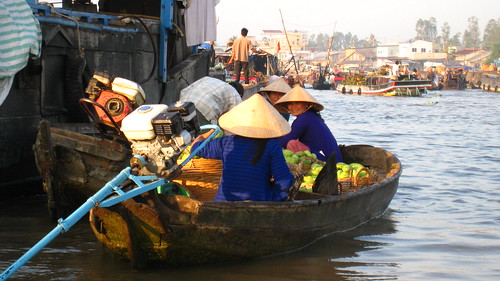
The Mekong Delta is a great introduction to Vietnam. It is busy, bright, and colourful. When you cross the border into Vietnam from Cambodia the contrast is huge. I've not seen rivers so full of commerce and trade in Laos or Cambodia, or Thailand for that matter. There are alot more people and there are alot more people out on the water. The Mekong Delta is an excellent place to travel around because of the transport connections. Wherever I was there seemed to be minibuses leaving regularly to all corners of the Delta.


Cahu Doc was my favourite spot in the Mekong Delta. It is a smaller town than Can Tho and it is a bit more off the tourist radar so there are fewer visitors. There are some good places to eat and it is easy to get around. Chau Doc is similar to Cambodian as it is centred around a market. Chau Doc's streets are narrow and there is alot of traffic. It does have a charm. There is the odd French building hidden amongst the cake towers. The people are friendly and appear to be pleased to see you. While you see Khmer faces, the change in the way people look is noticeable and much more noticebale than crossing from Thailand to Laos or Laos to Cambodia.I stayed at Vinh Phuoc Hotel in Chau Doc, where a fan twin room was $7, with hot shower ensuite. The staff were quite friendly and helpful. I did a trip out to the floating houses and Cham village, with a woman rowing the boat standing up and her two children joining us. It was a nice way to see the community. I paid a somewhat inflat $5 for the hour and a half trip. I also messed up on negotiating a moto to Sam Mountain and paid 40,000VND for a trip that could be done by public bus for 3,000VND. Sam Mountain is a Vietnamese tourist destination. There are lots of Buddhist shrines in gaudy colours. Bars line the path down the 'mountain' and are filled to the brim with hammocks. The view from the top is good if a bit hazy. It is amazing just how flat the area is, although not surprising considering this is a river delta. The Vietnamese were most surprised to see more on their bus back into town. I pulled out my phrasebook and it was leafed through with great interest.

From Chau Doc I went to Ha Tien by bus, the journey took three hours. I arrived at the bus station early and there were three locals on board. They were most surprised to see a westerner getting onboard. They took a keen interest in me and merrily chatted to me in Vietnamese even though I couldn't understand a word of what they were saying. I got my phrasebook out and they had a flick through and asked me some questions. I then became something of a zoo exhibit as they seemed to discuss me. The women were none too impressed by my stubbily face. The bus was almost full once we pulled out of the station only to stop outside the station to pick up an extended Cambodian family. I was squeezed next to a young Cambodian guy who managed to get through half a pack of cigarettes in the short time he was on the bus.

I arrived in Ha Tien to be greeted by the moto mafifa. It turned out the bus station had been moved and was now further away from town. I refused all motos and walked to town, it was only a 15 minute walk, but I was shadowed by a moto driver the whole way. I managed to drop the tail and found Tu Anh Hotel. I had a double hot shower ensuite, air-conditioning, and TV for $10. The staff were a bit strange. When I came back in the evening I was in my room and they came knocking on the door and searched around my room. I'm not sure what they thought I could have smuggled in considering I walked passed them to get in and collected my key from them. I wasn't hugely impressed by Ha Tien the town. There is alot of building work going on and there aren't many people around in the middle of the day. I was hanging around in a cafe poking some awful food when a Vietnamese guy sat down at my table. I'm always a bit dubious at such interruptions because so many times they turn out to be trying to sell you something. Unsurprisingly he was trying to sell me something, a moto tour. I didn't want to hang around Ha Tien for the afternoon and the prices he quoted were pretty good.

I went off with Mr Trinh Ngoc The (0918 574 780 trinhngocthe2000@yahoo.com) for an afternoon trip to Thach Dong Cave Pagoda and Mui Nai beach for 40,000. It was a very relaxing afternoon. The scenery is beautiful and there is little traffic. Green rice paddies line the roads and water buffalos plod nonchalantly around. The road back from Mui Nai along the coast is especially beautiful. History is not far away. Inside the Thatch Dong Cave Pagoda is the Stele of Hatred which commemorates the massacre by the Khmer Rouge of 130 people here on 14 March 1978. Along the coast road is a large cemtery for Vietnamese troops who died in Cambodia. Mr Trinh was a good guide and very chatty.

The next day Mr Trinh took me to Hon Chong the next day for 50,000 VND. There are no buses from Ha Tien to Hon Chong. The journey to Hon Chong is quite pretty apart from the cement factories.While the afternoon trip from Ha Tien was a very relaxed affair the morning trip to Hon Chong was quite the opposite. Mr Trinh was on a mission to get there as quickly as possible. We roared off to Hon Chong. The helmet he gave me swung around on my head, so with one hand I had to hold it in place while with the other I held on for grim life. Every time I got a moto in Vietnam they always gave me a helmet to wear, whether that helmet fitted was another matter. I often wore helmets Laurel and Hardy style perched on top of my head. Normally you don't need to hold on to the back bar when travelling by moto but Mr Trinh was flying over bridges and bouncing his way across the pot holes. We rounded one bend to be confronted by a truck and bus coming towards us head on. I closed my eyes. We managed to get by unscathed apart from a shower of gravel.

Hon Chong is a picturesque spot on the coast. The town isn't very big and what there is is spread along the two beaches. There were no other westerners around. The only real sign of activity was around Chua Hang Grotto with hordes of Vietnamese tourists. There is a great restaurant overlooking one of the bays at Hon Trem Guesthouse. The food is excellent and the view over the bay is beautiful. I was staying at Huong Bien Guesthouse, the cheapest guesthouse in town. For $8 I got a fan twin room with cold ensuite. It was alittle bit dodgy but I thought it was OK. The family who ran it were quite friendly apart from the manager who was way too friendly and fake. Sure enough when i returned in the evening and confirmed that I would be leaving tomorrow she turned nasty (even though I had said I would when I arrived). My room had become distinctly less appealling in the intervening hours aswell. The room was like sauna. There were no screens so I couldn't open the windows. There were already lots of mosquitos to keep me company. The hordes of Vietnamese tourists had all descended upon Huong Bien Guesthouse for the night. I asked the manager what time the bus to Rach Gia was and she said 5am. I'm pretty sure there were later ones and I thought she told me this time to spite me. I got up at 5am and the bus didn't come past until 5.30am. I sat with some locals in the meantime, one of whom who spoke broken English implied there were later buses.

The bus got about 20 minutes down the road while picking up parcel after parcel. The conductor came to me and summarily demanded 100,000VND. I hadn't been in Vietnam long but I knew this was far too much. I refused. He justified the price due to my bag being on the seat next to me, something he told me to bring on board with me. I refused and paid him 50,000VND. It took 3 hours to reach Rach Gia. I didn't hang around. I caught a minibus to Can Tho. The Mekong Delta is an excellent place to travel around because of the transport connections. Wherever I was there seemed to be minibuses leaving regularly to all corners of the Delta, apart from Hon Chong. It was another two and a half hours and 47,000VND to Can Tho. There was a twelve year old policeman sitting next to me who was quite chatty. The road was very bumpy. I was on an official minibus run by Mai Linh, a company who run taxis and minibuses throughout Vietnam. Mai Linh minibuses are quite a high standard but there is still very little room when they are full. Luckily there were only 5 people on the minibus so we could spread out.

I arrived in Can Tho to discover I was at the bus station 8kms from town. I only discovered this after walking 8kms to town. Can Thoi is a big busy town. It is quite charming along the riverfront. There is of course lots of activity in the water. A great place to watch it all is from a cafe on top of the ferry ticket office. A friendly family run it and the dad seems to spend most of his time watching whats going on on the water aswell. There are lots of boats heading off to different corners of the Delta. The small ferry boats looked OK but they were absolutely packed to the rafters and didn't look like a comfortable way to travel. I came to Can Tho to visit the floating markets. I went to Cai Rang and Phong Dien floating markets. I did this independently. I talked to a moto driver, or rather gestured, and we agreed on 100,000VND on a round trip to visit both market including waiting time. Gestures can convey alot, combined with a trusty phrasebook. We went to Cai Rang first and I hired a boat to go out into the market. It was more tricky than I imagined. Most people hire a boat in Can Tho but this takes longer and you don't get to Phong Dien in time for the market. The prices at Cai Rang were higher than from Can Tho and I eventually found one for 70,000VND for an hour. I got the impression that these guys did not normally take tourists out and that I was doing them a favour. They sat me in their boat and pushed me down the muddy bank. Once in the water the woman paddled me around the barges and boats. Cai Rang is huge, there are lots of big barges piled high with different fruit and vegetables. In between the big boats and barges were small boats buying the produce as well as ones selling snacks and drinks. After an hour I tried to get my paddler to take me back, it took a few attempts but she eventually did. Once she did I had to climb over a few boats and on to a pier. I gave her 70,000VND and then she started demanding more money. I gave her 10,000VND but was very annoyed. In paying 70,000VND I already felt like I was being charitable. Phong Dien is a much smaller place and the market is much smaller. In many ways it is more attractive. I didn't feel the need to go out on the water and instead watched the proceedings over a cafe sua da (iced coffee with sweetened condensed milk). When my moto driver took me back to Can Tho he tried to demand more money from me. I laughed at him, and paid him the 100,000VND we had agreed to. I had not come across people suddenly demanding more money in the reast of South East Asia. I had paid too much and been ripped off but at least I had done so in agreement. To demand more money after the event struck me as underhand.
I had assumed oprganising the trip from Can Tho independently would be cheaper than going through an agent. Can Tho had its own Del Boy who greeted me at Hien II Guesthouse. The guesthouse was surprisingly nice. The room was small but I had a fan double and hot ensuite for $7. Del Boy then proceeded to sell me a huge tour which I had no interest in doing. I managed to lose him but kept bumping into him around town. He seemed to appear out of every alleyway, reminding me of my promise to think about his tour. As it was the shorter tour that I did would have been cheaper with him then organising it myself, assuming no hidden charges appeared. I didn't see Del Boy around Hien II for the next couple of days. I don't think he works there, I think he just goes from guesthouse to guesthosue trying to sell his tours.

I left Can Tho for Ho Chi Minh City (aka Saigon). I was on another minibus which was packed. I tried to get the a seat with legroom but the guy putting people in the bus wasn't happy with me sitting there. I eventually persuaded a small man to take my seat so that I could have some space. I do find that the Vietnamese like their power and if they tell you to sit somewhere then they will not give in. Maybe this is true of people in general or it could be to do with loss of face in Asian culture. I have assigned you a seat you will sit in the seat. The journey was as life threatening as ever as we raced to HCMC. It was made more hazardous by the BO fumes being emitted by the old woman sitting infront of me. I arrived at Mien Tay bus station in HCMC, the moto mafia descended and I found a driver who would take me for 50,000VND to Co Giang.