Thursday, June 05, 2008

Mongolia


I left Erlian in the morning. The border is north of the town. I went to the central market to try and find the Russian jeeps that go to Zam Uud. You know you are in the right place because hordes of women with roles of bank notes descend upon you wanting to exchange money. I only had 200Y left and exchanged it for 32,000TNG which seemed a good exchange rate but at the border crossing you can get a better one at the official exchanges. I intended to take one of the Russian jeeps. Instead I was directed into the back of a very shabby looking VW Passat. The driver charged me 70Y and off we went. What I hadn't realised when I got in was that the rear seat I was sitting on was not a seat. I had noticed a quilt over the back seat and assumed it was because the seat had worn out. What I did not realise until I was sitting bent double was that the quilt was covering a layer of sacks. There was another layer of sacks along the rear parcel shelf and there were sacks in the front seat wells. I don't know what was in these sacks but it was something that he had made a poor attempt to conceal. So we roared 5 minutes up the road before stopping for half an hour, turning round and going back to the market and waiting there another half an hour while he talked to some mafioso figures. Two more locals joined me on the back seat and we set off for the border. The road through Erlian, across the border, and into Zam Uud is perfectly straight. We roared up to Chinese customs, the driver was very keen on all the windows being up so the one window winder was passed around. I had no problems at Chinese immigration and pressed 'satisfactory' on the immigration official's rating box. In Chinese state run institutions they have customer service electronic rating machines, the three options being 'satisfactory', average', and 'poor'. We all piled back into the car and headed across no-man's land. A long line of trucks stretched toward the Mongolian border. We flew passed only for the Passat to grind to a halt. The driver tried a variety of fixes to get us moving again while truck drivers looked on giving encouragement. The window winder was passed around again. Eventually, with the aid of a mudpack, we were on our way again. Mongolia immigration was a breeze. No questions asked other than a stern look. The Mongolian Immigration and Customs was surprisingly chaotic. There were lots of Mongolians hanging around. I went upstairs to try and find the train ticket office. It turns out there isn't one or they did not want to sell me a ticket. I wandered in and out of offices until I found one guy who said "no Zam Uud". I'm not sure any other country I've been to would let you just wander in and out of the customs and immigration building. Outside a customs official was checking the car. He took no interest in my bags in the boot which were lifted out of the way. He did express on interest in all of the poorly hidden sacks in the car. I'm not sure what was said but we were allowed to continue. The driver then decided he wanted payment which I smilingly declined until he dropped me off in Zam Uud.

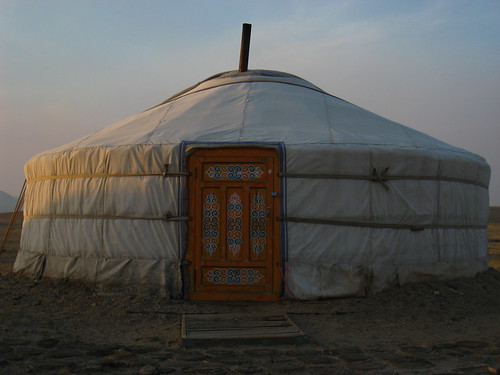
Zam Uud is only a few minutes drive from the border. It is much smaller than Erlian and much less developed. There is one very new road that goes through the town from the border (I assume the Chinese built it). Other than that there are a few ugly concrete square buildings, some charming if decrepit wooden homes and some Gers. Its pleasant to look around but it doesn't take long. I was dropped off in front of the Railway Station. The black building to the left of the Railway Station sells tickets. Mongolians like most Asians don't queue. There was hardly anyone purchasing tickets but people still tried to push in front of me even when I was in the act of buying the ticket. I got a kupe ticket (4 berth) for 15,900TUG (about $16) for the overnight journey to Ulan Bator. Downstairs is a left luggage room (250 TUG) staffed by an intimidating and authoritarian Mongolian lady who turned out to be quite friendly after I attempted to say 'thankyou' in Mongolian. When Elton John said sorry was the hardest word he had obviously not tried to pronounce thankyou in Mongolian. I kept saying it and people look at me strangely I repeat it a few times until I'd say thankyou in English whereupon they would say it in Mongolian, I would repeat it incorrectly and they would say it again, I again repeat incorrectly and they would cut their losses.


Mongolian train attendants look somewhat mean and menacing in their 1970s style stewardess outfits. I half expected a large spike to appear from the sole of their knee high boots. In my kupe was one Mongolian woman and two Mongolian traders. One was short and round and called Batu, he spoke a bit of English. He had a tall friend with a large scar across his face. I didn't catch his name but Scarface struck me as appropriate. I arrived in the cabin to find Batu tucking into his lamb dinner, a large fatty bone was thrust in my direction whether I wanted it or not. Whereupon a bottle of vodka was produced, much like the leg of the lamb I was expected to join in. The bottle of vodka ran out in no time at all and I was sent to the restaurant car to procure another bottle. Luckily enough they would not sell me a bottle unless I was eating in the restaurant car. On the way back I came across a guy who was being tasered. I am not sure what he had done to deserve this. He was not having a good time whereas the guy with the taser was. Mongolians were walking up to him and twisting his ears. The sunset from the train was particularly beautiful as we crossed the desolate countryside. We then hit the Gobi desert where the train became uncomfortable. It was an old train so lots of dust managed to fill it. All the windows were closed which meant it was very hot and stuffy. I discovered that my bed was not very comfortable and the vodka hangover was beginning to kick in. Unfortunately Batu and Scarface returned just as I was dosing off. They had been to restaurant car and by all accounts had had a very good time and brought some bottles of vodka back with them. I did not want to play and after repeatedly saying no and stopping them from dragging me out of bed they eventually gave up. In the morning I was pulled out of bed at 7.30am because the attendant wanted my sheets. Batu offered me a can of beer which I declined while Scarface was knocking back the vodka. The two hours into Ulan Bator were very beautiful as we crossed the steppes. The closer you get to Ulan Bator the uglier the view becomes. Although there is something exotic seeing the suburbs filled with Gers.


I had heard lots of negative stories about Ulan Bator. I had been forewarned about the cab drivers. I hadn't booked a hostel. I caught a taxi to UB Guesthouse (if you pre-book they will come and pick you up). The driver decided to double his price when we arrived. I started yelling out of the window whereupon he gave in and let me take my bags. In the dodgy courtyard outside the hostel a girl vomited in front of me while appearing to carry cans of glue. I discovered that dodgy courtyards are the trend in ex-Soviet countries. The idea being that the workers would live in a nice community with a large area in which to socialise. Unfortunately now it seems these courtyards are surrounded by big imposing buildings with lots of dark alleys for people to hide in and places for large groups to congregate. UB guesthouse was a nice small hostel. I had a dorm bed for $5 a night. The beds were very uncomfortable but the guys who ran it were friendly and helpful. UB Guesthouse (aswell as all of the other hostels and guesthouses) run their own tours around Mongolia. I was hoping that a short tour would be leaving when I arrived, unfortunately that wasn't the case. Their advice was to carry nothing on you when walking the streets, and not to be out after midnight. I didn't witness any muggings myself but there were lots of stories to confirm what I was told. Ulan Bator does have an international feel to it from the large number of International Aid workers there. For a small city the traffic in Ulan Bator is pretty bad. The traffic is not helped by the driving style of the locals which combines Asian crazy driving with Russian aggressive driving. Ulan Bator is not as bad as it is made out, there are a few things worth seeing such as the Natural History Museum and the Gandan Monastery. There are also lots of restaurants that are very cheap, if you are heading on to Russia this will be the best value for money you will get in a while The reason for coming to Mongolia is to not to spend your time in Ulan Bator but to visit the countryside. I didn't have as much time as I would have liked because of my Russian visa expiring at the end of June so I headed out the day after arriving for a Ger camp. I went to stay at Elstei Ger Camp which is run by Shuren Travel. It is a beautiful site about an hour from Ulan Bator. When I arrived there was only one other group of guests there. Backpackers on an organised trip from Moscow to Beijing. Elstei Ger Camp is not your typical Ger camp. For starters there are hot showers and a restaurant. The food was excellent and plentiful. The Ger's are very comfortable. If you don't fancy roughing it but want to get a taste for the great outdoors then it could be the best option. The sense of space is amazing on the steppes. I went horse riding while I was there which was a bit of a sore experience. I visited a nomadic camp and had fermented yak's milk. After a few days at the camp I went back to Ulan Bator. The only trouble I had in Ulan Bator was on my return from the Ger Camp. I was staying at UB Guesthouse but this time in one of their side apartments. I was sharing a 4 bed dorm with two Dutch guys and an Australian. All seemed fine until they returned at 3am screaming and shouting. They took great pleasure in annoying me. I took great pleasure in taking their shoes in the morning.

Tuesday, June 03, 2008

Where am I?

If you have been following my travels you may have noticed my blog is not up to date. I will eventually type up where I have visited and what I have been doing. In the meantime I thought I would give a brief summary of my month in China.

China is enormous and a month does not do it justice. I crossed into China from Vietnam. From Nanning I caught a train to Guilin and then spent a week in Yangshuo. Yanghsuo is beautiful with limestone karst scenery. I did a day trip to the stunning Dragon's Backbone Rice Terraces before catching an overnight train from Guilin to Wuhan. I then travelled to Wuyuan to visit the Huizhou villages. I also visited villages in Yixian county near Tunxi. The villages are wonderful time capsules. I then walked up Huang Shan mountain. I think I walked about 45kms in 24 hours broken with a fitful sleep in a very smelly dorm room on the summit. I went back to Tunxi where I caught a bus to Shanghai. I travelled by overnight train to Xi'an and visited the Army of Terracotta Warriors which isn't quite as good as you think it might be. It was in Xi'an where I felt the earthquake tremor. From Xi'an I caught an overnight train to Beijing. I had a very busy week of sightseeing in Beijing. The undoubted highlight being the 10km hike along the Great Wall of China from Jinshanling to Simatai. I left Beijing by overnight train to Datong where I visited the Hanging Monastery and Yungang Caves. I arrived in Erlian today. Erlian is the Chinese side of the Mongolian border. I cross tomorrow and hope to catch an overnight train to Ulan Bator.

If you would like to see my photos from the trip then visit www.flickr.com/photos/skimmens. The photos are up to date, unlike the blog.

China XII - Zai Jian (Goodbye)


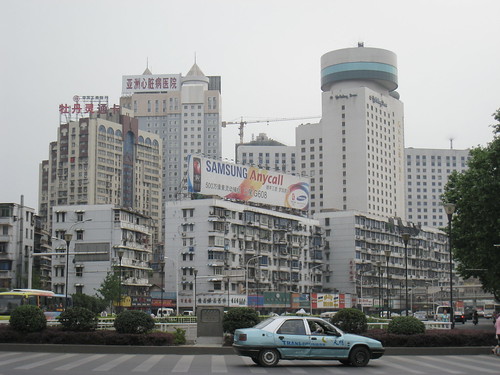
I left Beijing and headed for Mongolia. I had intended to catch the direct Trans-Mongolia train from Beijing to Ulan Bator, unfortunately the train I would have to catch before my visa expired had been cancelled. I decided to travel to Ulan Bator via Datong. Datong is not a destination in itself. It is a large unattractive city even by Chinese standards. The reason to come to Datong are the Yungang Caves and the Hanging Monastery. I took an overnight train from Beijing to Datong, spent the day visiting the attractions and left the next morning for Erlian (on the border with Mongolia).


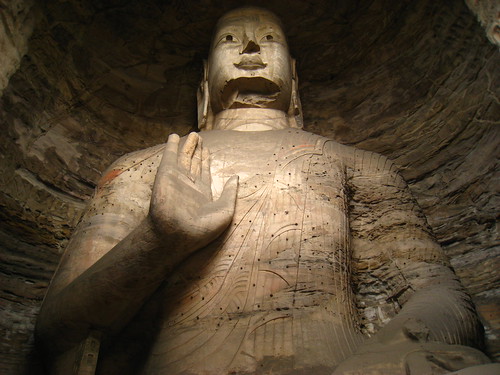
As soon as I stepped out of the station I was met by a very polite CITS agent. He was selling the CITS tour to the Caves and the Monastery. I choose to go it alone and regretted it. I was wandering around the main square and met Simon. Simon offered a taxi to take me to the Yungang Caves and the Hanging Monastery. It seemed like an excellent deal. What I hadn't grasped was that it relied on other people sharing the cab. We took off and for some reason drove around Datong. I was becoming fed up with their delaying tactics until they decided to take me to the Caves. We arrived and they looked for other people I could share the cab with for the drive to the Hanging Monastery. The Yungang Caves are very impressive. It does feel like an Indian Jones set with the huge carved Buddhas towering over you. When I returned after over an hour wandering around the caves I found Simon with a French couple who had been waiting an hour for me to return. We set off for the two hour drive to the Hanging Monastery. The taxi driver turned out to be the slowest driver I had come across in Asia. We arrived at the Hanging Monastery to be confronted with a very loud building site. It seems the local authorities have decided to upgrade the existing tourist facilities. The Hanging Monastery is impressive to see but not quite as impressive or extensive as the Caves. I met people there who had taken the public transport option to get there and they did not recommend it. In the end I saved a small amount of money with the taxi but it was not worth the effort.


While Datong is an ugly industrial city in the midst of a rebuild there is a certain charm to it. The people were very friendly. I was walking across the enormous square infront of the railway station and a man yelled hello at me from the other side of the square and waved (he was arm in arm with another man at the time). Another guy ran up to me said hello, giggled, and then ran away. I was on the way to dinner and came across a rag tag bunch of teenage security guards armed with truncheons who all smiled and waved at me.
In the evening I looked for somewhere to eat along Xima Lu. I tried to enter a couple of restaurants only to be met with smiling faces but waving hands saying 'no'. I eventually found one restaurant who let me in even though they were slightly bemused by my presence. A picture menu was produced. A waitress stood over me as I flicked through. The trouble with a picture menu is you are not entirely sure what you have ordered. In China the waitress hangs around and I am never sure whether I have ordered the correct amount of food. After haphazardly pointing the waitress said something. I replied 'tingbudong' (I don't understand). There was a group discussion amongst the army of waiting staff. A delegate was sent to my table to retrieve my English-Chinese dictionary. A few minutes later a diner came over to my table. She spoke some English and said that the waiting staff were concerned I had ordered too much. I suggested they cut out anything they wanted, this did not cross the language divide. After much discussion between her and the waitress fraternity it was decided the order would not be changed. The various dishes finally arrived and were pretty good. The woman who had acted as translator periodically checked in on me. The funny thing in China is that the Chinese act paternally towards foreigners, they are concerned for your welfare and will help you even when it isn't required. For instance, the waiting staff then decided that my chopstick skills weren't up to scratch and replaced them with a knife and fork.
I stayed at the Railway Station Hotel in Datong. I paid 110Y for a deluxe room (reduced from 128), though they wouldn't reduce the standard room from 107. The corridors were very long and everything was well passed its prime. The staff were very friendly even though they didn't speak English. The other guests were most surprised to see me wandering around. While the smart hostels of Beijing, Xi'an and Shanghai were very nice they do leave you in something of a Western bubble. There is some cache to walking down the corridors of a seemingly dodgy old Chinese hotel to be greeted by smiles from the other guests.

I left Datong the next day for Erlian. I paid 86Y for the seven hour journey. The bus leaves from the main square in front of the Railway Station at 9am. I had been fighting a pretty successful battle stopping people smoking on board. Unfortunately they all grouped together at the back of the bus and fended off my challenges. The drive to Erlian is interesting for the change in the landscape as you cross Inner Mongolia. In and around Datong things feel different. Donkeys appear and are used to plough, there are no water buffalos (nor rice paddies) in sight. There are even sheep. Upon leaving Datong the scenery really changes. The further into Inner Mongolia the flatter and sandier everything becomes. Other than the road and railway line there is nothing to see for miles around.


The only reason to be in Erlian is to use it as a transit point into or out of Mongolia. It is a small town by Chinese standards. I found the Erlian factsheet on Lonely Thorntree useful. If you are crossing the border to Zam Uud make sure you buy everything you need here because there is nothing in Zam Uud. Erlian is quite a busy town especially around the market. In Erlian I got quite a few surprised stares from the locals and some hellos. I stayed in the hotel opposite the Railway Station. I got a twin ensuite (hot shower) for 100Y. The price on the wall was 128Y, I wrote down 100Y and they accepted immediately (I should have pushed them harder). An interesting sight in Erlian are the huge steel dinosaur models on the road into town (which you can see from the railway line aswell).

Friday, May 30, 2008

China XI - Beijing

I did not have an auspicious start to my stay in Beijing. I arrived at Beijing West Train Station in a melee of people. I tried to hunt down the number 47 bus that the hostel I was staying at told me to get. Unfortunately the number 47 bus does not stop in the bus station at the train station so after walking up and down the street I eventually found the stop. There was a large group of people that had spilled on to the road. After waiting for half an hour the number 47 finally arrived and the crowd stormed the bus. I went in elbows blazing. I made my way in only to have an old guy ranting and raving at me. I don't know what he was saying but I ranted and raved at him back. I may be an 'outsider' as the Chinese call foreigners but that doesn't mean I won't give as good as I get. If I took anything from five years of Welsh PE teachers bellowing in my ears it was "Ruck over lads".

Beijing is a city of contrasts. There are the parts that are brand spankingly new. They out do anything I have seen in any other country I have been to. For instance, the city park surrounding the ruins of what is left of the City Walls (after Mao knocked them down). Then there are the parts that look very dated. In between is the construction work going on. It seems that everywhere I go in China something is being built and something is being knocked down. I am amazed at the number of cranes I keep seeing. The subway network is a case in point. The original underground train lines feel very dated and they still haven't finished the electronic ticketing. The new lines that they have just finished for the Olympics are very shiny and new and out do Shanghai and Singapore. On the inside of the subway lines they have put advertising so when you look out of the train window you see LED screens. The clever part is that they have managed to animate them at such a speed that it looks like one screen stays with the train as you move along. The advertising in the tube lines is dominated by the Chinese hurdler who has Chinese Olympic track and field hops on his shoulders, read an article about him and the hopes the Chinese have for him from the BBC. In Beijing I have got a lot of stares though Beijingers seem to look you up and down more than look at you. I have got the impression that a lot of locals take the piss out of you. It seems they have a Parisian attitude to foreigners at times.

I have now seen two of the three pickled Communist leaders. I saw Mao in what was a less respectful setting and much more Chinese affair than Ho Chi Minh in Vietnam. In China Mao figures a lot less than Ho Chi Minh in Vietnam. In Vietnam there are lots of Communist banners and billboards, not to mention Vietnamese flags, lining the streets. Ho Chi Minh figures on at least half of these. He may have been dead for over a quarter of a century but you would be forgiven for thinking that he still ruled the country. An impression the current leadership would quite like you to have. In China there is the odd Mao statue or his face on a memorial, and of course on banknotes, but his presence is not overarching. The Mao mausoleum is strange because you are literally pushed through in groups either side of his coffin. All you can see is his face and a big hammer and sickle flag draped across his body. There are white gloved porters pushing people to fill up space in front and move through quickly. It is hardly respectful but it is very Chinese. The Mausoleum is in the middle of Tiannamen Square. You are not allowed to take bags or cameras in with you (though the Chinese were walking in with mobile phones). The locker rooms for bags is on the opposite side of the road to the east of the Mausoleum.

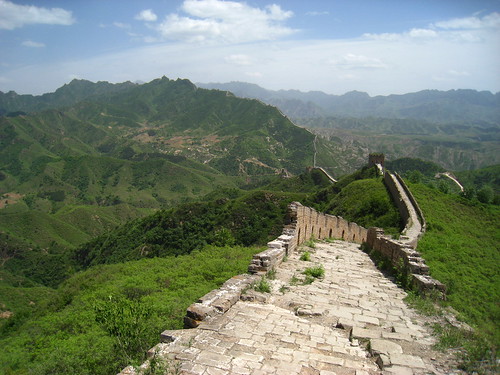
There is a huge amount to see and do in Beijing. I had a week and was rushed off of my feet getting round to see everything. The Forbidden City is enormous. The best place to see just how big it is is from Jingshan Park which has a hill overlooking the Forbidden City. I spent a good 5 hours wandering around the various courtyards. It is impressive though gets a bit much in the end. The Summer Palace is very pretty and pleasant to wander around but nowhere near as impressive as the Forbidden City. Tiannamen Square is enormous and the centre of Beijing. It is peculiar to be there because of its history. Without a doubt the best thing I did in Beijing was to visit the Great Wall of China. I have visited a number of so-called wonders of the world and they don't always live up to the hype. The Great Wall hike fulfilled my expectations. Parts of the wall have been restored whereas others have been left to ruin. The Wall winds its way up and over the green seemingly unspoilt countryside. There were hardly any tourists and even the the locals following you trying to sell you things weren't too persistent. As ever in China if you can avoid visiting at the weekend then it will be quieter. It is also important to choose where you visit the wall. There are a number of different options. I did the 10km hike along the Great Wall from Jinshanling to Simatai. Other sites are renowned for having the authenticity restored out and being full to the brim with tourists and touts. The hike cost 220Y booked through Red Lantern Hostel. This did not include the entrance fees to each section of the wall which cost an extra 50Y and 40Y. The 220Y charge covered the bus there and back, lunch and some sandwiches for breakfast. You are not guided along the wall (it would be pretty difficult to get lost). Although a Norwegian and I managed to march off ahead of everyone else and take the long way round, which meant we got to see more of the wall and in a quieter environment.

Silk Street is a large department store selling all sorts of clothing at cheap cheap prices. The designer names brings the westerners in to pick up a fake Rolex watch or Gucchi bag. I went to have a look around and possibly get a suit made. As ever the stalls all sell the same thing so the stall keepers all fight it out to get your attention and your money. At first this can be charming. Unfortunately the Chinese and Chinese women take things too far. I was grabbed and pulled back into stalls, which I didn't take kindly too and was more than happy to give them a taste of the back of my hand than the inside of my wallet. I saw a number of Chinese women pulling huge strops (hissy fits if you are from America) when negotiations didn't go their way or westerners decided to pull out of a deal. In general I have seen a lot of Chinese women pull strops like toddlers. I have also seen lots of Chinese children pull strops. I can't help but wonder whether the 'one child' policy produces lots of spoilt children. I had one woman corner me in her shirt shop and get very angry simply because I came up with a low price (I'm sure it wasn't that low) and then she wouldn't let me leave. I pushed passed her and then she got my thumb in a lock. She apparently wanted to see the back of my hand. I don't understand why she would think I would want to buy anything from her. On the other hand I bought come tourist tat from a stall on a side street off of Wangfuling Dajie. The first stall came up with ridiculous prices and would not drop them so I walked off. The next stall the guy came up with ridiculous prices but dropped them and was friendly at the same time. We had the sort of fun bargaining where I thought I had a good deal (10% of his initial price) and he made a big profit.

I have been looking to buy a tailored suit since I had been in South-East Asia. However, I never quite worked up the enthusiasm to go through with the hassle. As Beijing is my last stop to get a suit made on the cheap I headed for Silk Street. The first tailor I went to had a salesman who stood far too close to me and wouldn't budge on the price even though they didn't want me to leave. I didn't want him measuring me up and left when a couple of westerners arrived while he chased me down the hall tapping on his calculator. The next one I went to seemed much nicer. I got the impression that the girl doing the sales pitch was a trainee (or it was a ploy), still she was not nearly as pushy and the prices were lower even before we started haggling. I got a 3 piece suit and shirt for $200. I can't say I am altogether happy with the suit that I got. I would suggest being very careful at the fitting stage and not to let them push you around.

While I was in Beijing I stayed at Red Lantern Hostel. It is a nice hostel in a Hutong style. However, I spent very little time there because I was always out and about doing and seeing things. It might be better to choose a more central location over character.

Wednesday, May 28, 2008

China X - 1,321,000,000 people


China is the world's most populous nation. Unsurprisingly then wherever you go in China there are lots of people. Whether the Chinese are out in the country in tour groups, or whether you are visiting another huge city, or even discovering how many people can be involved in changing a light bulb, you cannot escape 1,321,000,000 people.


The Chinese apparently love travelling in large groups. If you are unlucky enough to be visiting a Chinese tourist attraction over a weekend you will come across large groups of Chinese tourists. They are led by tour guides with their own microphone and speakers, as well as a flag and hats for all of the group. These groups do not pull any punches. The Chinese treat one another like members of one very large family, so they have no inhibitions about barging one another and you out of the way.


Chinese cities are enormous. While I have heard of Shanghai, Beijing, and Xi'an. I had not heard of other enormous cities that I came across on my travels, such as Nanning, and Wuhan. These cities have not reached their limits but are continuing to grow. Everywhere you go in China the sight of construction and cranes is common. The journey into Shanghai seemed to be through one colossal construction site for two hours.
Not only are there lots of people and the cities huge but there always seems to be more people than the Chinese know what to do with. The seemingly oversupply of people was best illustrated in every shop, restaurant, or just about anywhere employing anyone. In the Beijing West Train Station Cafeteria at 11pm there were possibly 15 customers. It was not quiet however because of the raucous yelling between over thirty members of staff. Of the thirty perhaps ten were doing something. The high levels of staff across China do not necessarily equate to high customer service levels rather the reverse. Service is generally more akin to a McDonald's teenager. I can only assume that people are cheap to employ. With all these people there are strange ways that jobs are created. In a bookshop in Shanghai they had at least five cashiers with shop assistants on each floor. When I purchased a book I took it to the cashier and paid I then had to go to the door where two security guards stamped my receipt, put my book in a plastic bag and sellotaped it shut. In restaurants the till is often separate to the kitchen so that one person takes your order, the other person takes your receipt and some other people cook your food. There are a million security guards hanging around business who do not look particularly secure. Government buildings are even worse with army guards, police guards, and security guards. Security guards in China are a mixed bag. They are often dishevelled looking. If their job is to walk around then they wear trainers which spoils the big hat and uniform look. The large uniformed presence can be intimidating, however, in all my encounters they have been harmless and somewhat bored. Tiannamen Square has to have the largest guards I have come across on my travels. To enter the square your bags are often searched, there are security cameras watching your every move and guards spread out across the square. As a foreigner you wonder whether they are watching you but it seems that authority fears more from the locals.

Tuesday, May 27, 2008

China IX - A to B in China


China is enormous. I spent 6 months in South East Asia. If you look on a map South-East Asia is merely a thumb nail against China. I am only in China for a month so I have had to cover alot more ground much more quickly. China is geared up for long distance travel. Unlike America China doesn't rely on cars or aircraft instead trains make up the backbone of long distance transport. It is estimated that at anyone moment there are 10 million Chinese on the nation's railway network.


A Chinese train station is like a European Airport. They are huge. When you enter the station your bags are x-rayed (though they don't search individuals). The next stop is the waiting room for your train. The waiting rooms are pretty big and yet they manage to get packed. Everyone is herded into different queues for their trains before the gate is opened and the crowd surges through. As with any crowd situation in China pushing and shoving is the norm. It doesn't matter what delay is up ahead someone behind you will be trying to push passed.


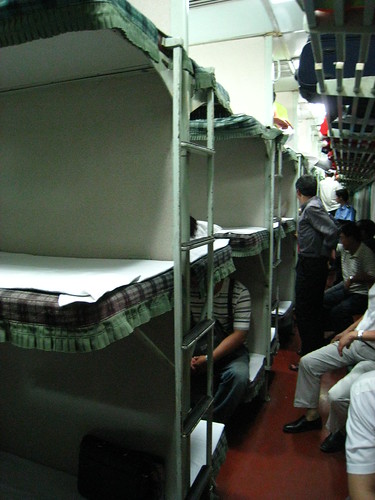
All the trains I have been on in China have been full. I've tried booking trains and not been able to get on them, even a few days in advance. I have travelled on hard seat double decker trains where they squeeze a large number of people in with relative comfort. The hard sleepers are carriages with bunk beds in three levels that face each other in pairs. In one carriage there are 60 beds. It is not a good place to swing a cut. The bottom bunks become a bench for eveyone while there are a couple of fold down seats in the aisle, but you do have to avoid getting your knees and elbows whacked by all and sundry who move pass.


The squat toilets onboard are pretty abysmal. I wouldn't fancy squatting over one with the slippery floor and the train juddering about. The smells on board can be strong from the number of bodies and the food that the Chinese eat. Dried fish snacks are very popular. While alot fo the facilities are very new the old habits of the Chinese diehard. In the scrum waiting for the gates to open for the overnight train from Guillin to Wuhan there were plenty of guys wretching and spitting on the shiny floor. In the brand new Wuchang train station (in Wuhan) I saw a woman pick up her baby and suspend the baby mid-air over a bin while it did its business. The walk to the toilets was obviously too far. Chinese children come ready equipped for such situations with chapless pants (in South-East Asia children often don't wear any clothes on their bottom halves).


Chinese trains do not have vendors going up and down the carriages like you find in Thailand. There are food and drinks carts that go up and down the train regularly (apart from on the T28 from Xi'an to Beijing). It does seem though that some of the attendants on board have taken it upon themselves to make some extra money. A female attendant on the train from Wuhan to Jiulong had a shopping basket full of tat that she attempted to sell to everyone.

Monday, May 26, 2008

China VIII - Brothels in Xi'an


Brothels are ten a penny in Xi'an. The whole city seems to be a red light district (other than the Muslim Quarter). Chinese brothels are not all that obvious because they sit in plain view of everything else on the street. They look like a hairdressers with some girls hanging around inside, with at least one hovering by the door. Chinese shops always have too many staff and someone is generally hovering by the door. Distinguishing between a normal shop and a brothel is further complicated by Chinese women dressing like prostitutes. I was making my way down the 16km long west path of Huang Shan mountain to see a Chinese woman walking up in high heels and fishnet stockings. The only way to distinguish between a hairdressers and a brothel is the bed inside, the dodgy curtains pulled across the front and the red light at night.

People visit Xi'an to see the Army of the Terracotta Warriors. Unfortunately the warriors are overrated. The trouble is you have seen so much of them before you arrive that your expectations are set very high. The warriors are housed in enormous aircraft hangers so there is little atmosphere. It is also impossible to get up close to them. All in all it felt a somewhat peculiar experience. generally you visit the site of something you have seen on TV or in a book to get up close and gain a greater appreciation for it. I can't help but feel that seeing the Warriors on tour in the British Museum would have been better. It is not all bad I would just keep my expectations in check and not plan to learn anything new from a visit. Disappointingly, though not unexpectedly, the visit finishes with you departing through a shopping centre with the usual calls for your attention.

Xi'an does have other attractions. The most fascinating part of the city is the Muslim quarter. It is an area of narrow streets and masses of people. The Muslim Quarter has its origins roughly from 742 when the Great Mosque and its surrounding area first appeared in the imperial records. It developed via the Silk Road trade. A highlight of a visit to the Muslim Quarter is an opportunity to have Yang Rou Pau Mo (Crumbled unleavened bread soaked in Mutton stew).The Big and Little Goose Pagodas are interesting towers that are worth having a look at. the Big Goose Pagoda has an enormous water fountain show outside of it, supposedly the largest in Asia (although the one in Singapore made a similar claim). In the same complex as the Little Goose Pagoda is a museum of local artifacts and explanations of how the city has developed. I thought it was more interesting than the highly acclaimed Shanghai museum. The city walls, dating from the Ming dynasty, have been restored around the city centre and you can cycle to your hearts content along them. I stayed at Xiangzimen International Youth Hostel in Xi'an. It was an excellent hostel that was more akin to a hotel.

Sunday, May 25, 2008

China VII - Did you feel it?

I was sitting in an internet cafe in Xi'an when my chair started shaking. I looked around to find out who was shaking it. There wasn't anyone so I went back to typing. At which point everyone else in the internet cafe launched themselves towards the stairs. It turned out it we were feeling an aftershock of 6.4 magnitude from Sichuan. Xi'an is the closest I have been to the epicentre of the earthquake. The building didn't fall down and the greatest danger seemed to come from the crowd rushing down the stairs. Outside everyone had gone into the streets and was standing around relaying their tremor stories. I was curious to know what an earthquake felt like but I wasn't best pleased to feel it in a building that didn't look tremendously sturdy. I did eye the ceiling with some trepidation.

While I have been in China the two big news stories have been the Olympic Torch Relay in China and the Earthquake. The trouble in China is if you don't speak Mandarin it can be quite difficult to follow what is going on. It is not always possible to find the English language news channel and internet cafes are hard to come by (if the news websites haven't got a block on them). If you do get the English language news channel (CCTV9) then it doesn't necessarily fill you in with unbiased information. The coverage I do see is more like a disaster movie and is heavily concentrated on the heroic actions of the rescuers. There is no questioning of why certain buildings fell down. The only critical coverage I have seen has come from international news media outlets, such as the the Herald International newspaper, on the BBC news website, and on the NY Times website. Here is an
article from the New York Times which you would never see in the Chinese media. The 3 days of mourning passed me by. I was climbing up and down a mountain for two of them and only found out about watching the news on the top. What I do find strange is how the earthquake is being spun as an opportunity for China to be one nation and face adversity together. I understand that is how most societies react but it seems that acting as one in China equates to crowds of people chanting (or that is at least how the media presents it). They have also taken to calling the earthquake 5.12 in echo of 9.11.

Saturday, May 24, 2008

China VI - Flame of Controversy

On my last day in Shanghai the Olympic Torch Relay was passing through. While I am no fan of China's One Nation policy or the xenophobia it produces in its citizens (in Wuhan I saw a t-shirt for sale in a normal high street shop that said "China's Voice: Tibet is, was and always will be part of China"). I was interested to see how the locals would react to the torch. In the Chinese media the Olympic Torch Relay is big news and was the top story until the earthquake. I was in Vietnam when the protests in the West took place so I can't comment on the Chinese reaction. The Chinese media present the Chinese people as being madly in love with the torch. I've spoken to a few Chinese people and they all seem very enthusiastic about the torch and the Olympic games.

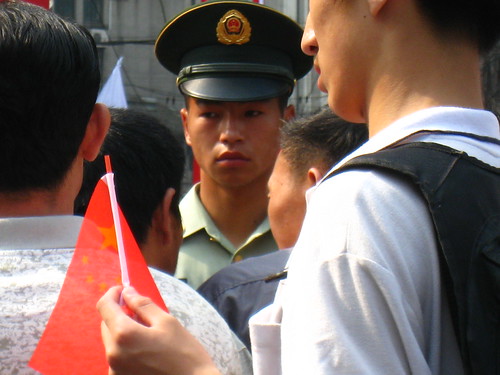
My experience of the torch relay in Shanghai underlined the country's authoritarianism. There were hundreds of police and army guards on the streets. The streets were closed off and people, whether they were going to work or to school were not allowed to pass. What made the situation particularly daft was that the pavements were quite clear of people and it would have been possible to walk along them but for some reason these were closed by policemen and badge waving officials. It appeared that the pavements had been reserved for school children and young people clad in uniform outfits to cheer the torch. Normal people who had turned out with flags and stickers stuck to themselves apparently did not represent the harmonious society that the authorities wanted to project. The groups of school children were marched off in pairs once the torch had passed. The massive security presence was not to stop protests because there was no one protesting. The police took no interest in me and seemed more intent on making the locals' lives as awkward as possible.

In itself the relay was uneventful and unexciting. A couple of commercial sponsors came through on trucks (Samsung and Coca-Cola) with scantily clad girls dancing. Next was a coach with the relay runners on board who were dropped off at no more than 25 metre intervals. This coach was closely followed by a coach full of army guards. After a while the actual torch appeared. The relay runner ran his alloted 25 metres and set alight to the torch of the next relay runner. The torch was followed by another coach of army guards.

Friday, May 23, 2008

China V - Shanghai

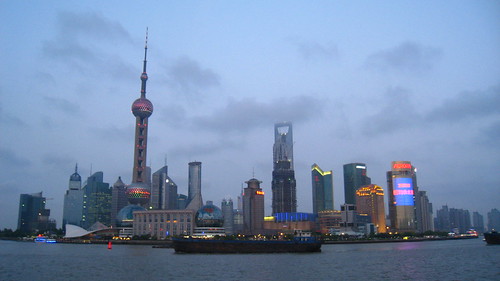
Shanghai is not quite as vast and monumental as I expected. The buildings are undoubtedly grand and modern and the skyline looks great. Yet I did not feel it had quite the impact on me that Nanning did. Shanghai still retains some of its historic districts such as the Bund and the French concession. These historic districts are undoubtedly the most interesting parts of Shanghai to wander through.

Ordering food in China is always an experience. A and I went in to a small restaurant up the road from the hostel. They produced an English menu with one particular dish that looked particularly interesting, 'Noodle with Double Happiness' . There were four waiting staff and a number of cooks, while there were only three tables. There was a great deal of difficulty ordering, I wanted steamed rice with dumplings but the steamed rice really confused them. We put this down to us being outsiders. A Chinese guy sat down at a table and began ordering he had a similar problem to us because he said "I hear but I don't understand" to the waitresses. A understood his comment because he can speak a little bit of Chinese.
Shanghai is a city of excess and poverty living side by side. There were quite a lot of homeless people living on the streets. At the same time there were boutique shops and bars. I visited the Cloud 9 bar at the top of the Jinmao Tower. The bar is part of the Grand Hyatt Hotel. To reach the bar you have to pass through the opulent hotel, and if you are like me get lost as you change lifts to get to the 87th floor. I had a cocktail that cost 90Y plus a 15% surcharge. The biggest rip-off in Shanghai is the Bund Sightseeing Tunnel. They charge you 40Y for the privilege of riding in an underground tunnel to cross the river. The carriages are glass so they have filled the tunnel with lights. The metro charges 3Y without the lights.

Shanghai has a few tourist spots that have acquired the harassment disease. Out of nowhere guys and girls appear with a handful of watches or a sheet full of things you can purchase. As you walk along East Nanjing Road you are constantly asked "Hello you want watch, bags, t-shirt". If you walk along the busy promenade to enjoy the view then a variety of people selling an assortment of different things will attempt to grab your attention.

I was waiting for a train in Shanghai to Xi'an when I heard a loud commotion I thought there was a fight instead it turned out to be a woman talking on her phone. Everyone in China appears to have a mobile phone. The Chinese like to show everyone else that they have a mobile phone. When talking on the phone it is amazing how loudly they will shout. The Dom Jolly sketch would not draw laughs here because everyone would think it was standard practice. I was sitting have a coffee in a posh bar in Wuyuan. I was the only customer when a group of three men men arrived. They sat down on the opposite side of the room. At which point one of the three decided to make a phone call and began shouting down the phone like his life depended on it. While his friends sat nonchalantly by treating this all as normal.


I arrived in Shanghai from Tunxi (Huangshan City) a 6 hour bus journey. I bought my ticket from the hostel for 132Y and the bus came to the hostel to pick us up. It was quite comfortable with some decent legroom. I stayed at Mingham Hostel (aka Hiker's Hostel) in a 4 bed dorm for 45Y a night. The room was small, but the hostel was very nice and the facilities were very good. The location is very central, close to the Bund. I left Shanghai by overnight train to Xi'an which cost 312Y. I bought it from the Chinese ticket office just round the corner from the hostel. The ticket office wasn't busy and they didn't charge a commission.

Tuesday, May 20, 2008

China IV - Smelly dorm on a Mountain top

The Chinese love their mountains and love nothing more than climbing up and down them. My legs were a touch sore after walking 45kms in just over 24 hours. I spent one night on the top of the mountain in one of the most unpleasant dormitories that I have stayed in in two years of travelling.

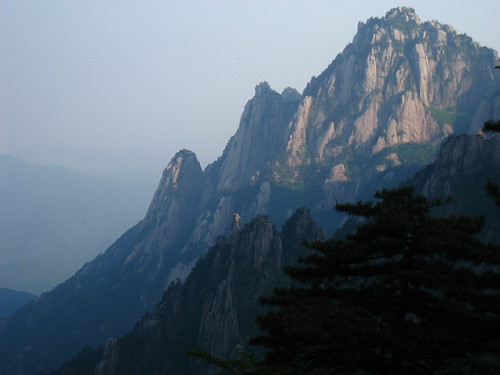
Huang Shan Mountain (Yellow Mountain), is actually a mountain range that covers more than 460 square miles. The mountain is famed for the sharp peaks and trees clinging to the top. They are mentioned in poems and can be seen in paintings. Unesco has added Huang Shan as a world heritage site because "of its stunning landscape and its contribution to Chinese art and culture". The Olympic Relay visited shortly ater I had been, click here to read an article about it on the BBC website.

My 45km walk began at the base of the mountain. The normal way to go up is to catch a bus or taxi to take you 10kms up to the entrance at the chair lift on the Eastern side, then walk up the rest of the 6.5kms to the top. I went to the bus station and was put in a taxi only to find the taxi driver trying to charge me an exorbitant amount, so I decided I would walk the whole 16.5kms to the top taking me three and a half hours. For the privilege of walking to the top pf the mountain you have to pay, 200Y. It was pretty sweaty and tiring. I timed it well to miss the crowds. The good thing about the Eastern steps is that they are covered by trees and they are not as steep as their Western counterpart. I watched the sunset amongst the pine tree clad peaks.
I then went to Paiyunlou hotel and stayed in a dorm (140Y). While the mountain top did not seem too busy the hotel was packed. While the room seemed quite new and appeared clean. It stank of stale sweat, more akin to a dirty gym than a place to sleep. I went for a wander and returned to the dorm. It was full. The smell was even worse when full. I wasn't quite sure why it was so smelly when there was a shower ensuite. The Chinese are not the quietest at the best of times and sharing a dorm with them proved to be no exception. The Chinese act as one big family so they don't have the same hang ups that we might have around strangers. A young guy was happily shouting down his phone to someone. No one else in the room seemed to give him any attention, however, I did not want to hear him shouting all night so I indicated to him it would be best if he went outside. He quietened down only for the guy in the bunk above mine to start shouting into his phone. Once all of the shouting died down the rumble of snoring from every corner grew. I did my best to shake beds to stop them, but I could not manage three beds at a time. Then the cold seaped into the room and I was beginning to lose my good humour.
Luckily I was up early at 4.30am to get down to Refreshing Terrace for the sunrise. For Sunrise the hotel provides thick coats for free. Across the mountain various rocky out crops have been given various peculiar names. "The Peacock playing the Lotus", "Watching Fairy Peak", "Bookcase Peak", "Monkey Watching the Sea", "Heavenly Dog watching the Moon", Immortal walking on stilts", and "Eyebrow Peak" to name but a few. I headed off into the Grand Canyon (or Illusions Scenic Area) for a three hour walk back to the peak. I did not realise what I was letting myself in for. The engineers who decided to attach pathways to the edge of these huge statues of rock must have had a job on their hands. The paths are perched precariously on the edge of the rocky outcrops. The scenery along the walk up and down the Grand Canyon was spectacular, matching the steepness of steps up each side.

An amazing sight walking up either set of steps is the locals carrying things up or down. For some reason they don't use the chair lifts to take everythng up and down. Men have bamboo poles that they dangle goods on each end. I even saw a generator being carried by four men down the 6.5km Eastern steps. You can even be carried up or down in a sedan chair.

When I made it back to the summit the crowds had started arriving. One of the things you discover in China is that the Chinese live for the weekend. The weekend arrives they jump on trains and go and visit their tourist sites. When you travel you forget what day of the week it is, in China it is all important to time where you are for the weekends. I visited Huang Shan mountain from Tunxi. While it was not the weekend that did not stop the crowds emerging. The locals do not seem to believe in being prepared to climb the mountain. I often saw Chinese women wearing short skirts and high heels!I met a Western couple who visited the mountain over a weekend and said it was awful. They spent most of their time fighting their way through the crowds. I had a bit of a crowd to fight through on the Western steps on my way down. Although once I got passed the top cable car entrance the crowds thinned out. The Western steps seemed to go on forever. Whenever I thought I had reached the end there was another corner to turn and another row of steps.

I would certainly recommend a trip to Huang Shan and its great to be there for sunset and sunrise, just watch out for the dorms. I caught the bus from Tunxi to Tangkou the major town at the bottom of the mountain. There is not a great deal in the town although I did find Mr Hu helpful, and he'll probably find you when you arrive. I booked my hostel on top of the mountain through the hostel I stayed in in Tunxi. I stayed in the YHA in Tunxi which was excellent. The staff were very friendly and helpful and the hostel's facilities were excellent.


Sunday, May 18, 2008

China III - Back to the Huizhou

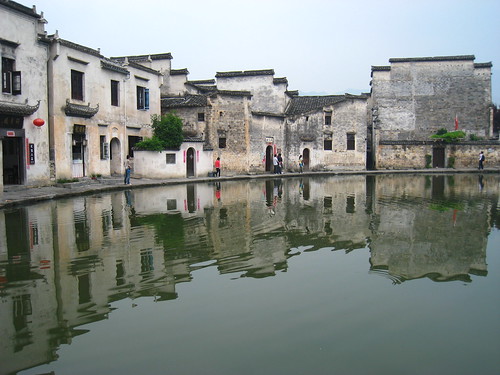
The Huizhou villages are wonderful time capsules of a bygone age. They are a complete contrast to the huge cities of China today. While they have not escaped tourism, some are listed as world heritage sites, they do still retain a unique charm. They do appear to be off the western tourist trail. It was the longest I went without seeing another westerner, five days, and the longest I went without coming across someone who could speak English. Although that is not to say the Chinese do not know about the villages and as with anywhere in China avoiding visiting over a weekend is probably a smart move.

Although modern Chinese tourism has managed to get its claws into them. My first taste of Huizhou villages was around the city of Wuyuan. I hired a motorbike and driver for the day. My driver didn't speak a word of English but that didn't stop us negotiating a price for the day and where I wanted to visit. The only trouble I faced was that even though he didn't speak English and I didn't speak Chinese he did insist on leading me around all of the villages. While that did give me a chance to sit down and eat peanuts with some locals it also led us to having a falling out. We visited Qinghua for Rainbow Bridge (20Y). There was not a great deal to see and while the bridge is historic and pretty it would not be a great loss to skip it. It was interesting but there was not a great deal there and it was very touristy. I went to Big Likeng (20Y) which was amazing. Of all the Huizhou villages I have visited it was the least touristy and most atmospheric. I spent part of the afternoon sitting with the driver in someones home eating peanuts and drinking Green tea while watching earthquake coverage on the TV. The drive there and back was pretty good as well winding through the forest following the river. We drove to Qinghua for lunch. Lunch was a bit tricky as no one spoke English, eventually I managed to order a bowl of noodle soup with meat which turned out to be pretty good. The Chinese ability to down a bowl of noodles is a sight to behold. The afternoon stops at Si Xi and Yancun (36Y) were excellent, although me and the driver were having a falling out by this stage. I think this was down to me becoming increasingly frustrated with playing follow the leader with him. I spent the night in Little Likeng (30Y). We went on to Xian Qi (20Y) which was a glorified tourist market, though there was a pretty little village on a walk across fields. The whole day cost 160Y (including 40Y extra to visit Xian Qi). I stayed in a small basic guesthouse in Little Likheng for just 40Y (shared bathroom). You might assume that Little Likeng is smaller than Big Likeng, however, you would be wrong. Little Likeng is very pretty with a small river running through the centre. I was lucky enough to see the village ducks being rounded up along the river as the sun set. It is also one of the busiest places for tourists in the Wuyuan. I would recommend spending the night in Little Likeng so that you can appreciate the place before the tourists arrive (or after they have left).


Hongcun is one of the UNESCO listed Huizhou villages. The whole village was originally laid out in the shape of an ox. The west end of the village, called Leigang Hill, resembles an ox head and that is where two huge trees stand like ox horns. At the front and rear of the village are four bridges that span a Jiyin stream and resemble four legs of the ox. The several hundred well-arranged houses form the body of the ox, and the 1,000-meter-long Jiyin stream that meanders through the village is regarded as its intestines. A crescent pond in the village is the ox‘s fourth stomach, its known as the postage stamp and is a great place for photographs. I arrived in Hongcun in the evening. I went wandering off into town to try and find somewhere to stay. I found one quite large hotel with no one inside. a woman appeared and after some gesticulating she led me to a room, we agreed on a price and I started unpacking. A guy arrived had a loud conversation with the woman and then gesticulated that I could not stay. I tried to understand why not and gesticulated back, but to no avail. I went off wandering again and ended up at the entrance to Hongcun (by the bridge) where there was a small but very modern hotel, with a price to match of 150Y for a double ensuite. It seems the hoteliers of Hongcun are rather unused to Westerners. After agreeing upon a price I then had to go through an elaborate charade to demonstrate my understanding the principles of a key deposit (that I return the key when I leave). A couple of Chinese students who spoke a bit of English were drafted in to help with the charades. I think the hotelier assumed I had just been parachuted into central China without staying anywhere else before. The great advantage of staying the night in the village is being able to explore the myriad of alleyways at dusk and dawn without the hordes of tourists. However, the Chinese do get up early so it does not take long for them to arrive. Some people might suggest that once you have seen one Huizhou village you have seen them all. While this isn't true it is nice to be able to break up the visit by going to Mekung. Mekung (20Y) is a very small Huizhou village high up on a ridge overlooking a bamboo covered valley. The walk through the bamboo forest to the village takes about an hour. It is beautiful, and while I was there very quiet even though Hongcun was busy.

Wuyuan was a much bigger city than I realised when I returned to it from visiting the villages. I went to find the Post Office so I could send some postcards. I found the word for Post Office in the back of my guide book and headed out asking locals as I went. I eventually found the Post Office. The women working there were most surprised to see me walk in and were a bit flummoxed by what I could possibly want. After a while they cottoned on to my wanting stamps. In the meantime a crowd of customers surrounded me to see what was going on. A particularly short Chinese guy was most impressed by my height and that I was from England. I had some dumplings for lunch which again was a bit tricky. I walked into a dumpling shop. I was met by surprised stares. When they decided I want something to eat they got a pointing stick for me to use on the wall menu the only trouble being it was all in mandarin. I used the poking sticking to point at the food of the other customers. I also stumbled across the peculiar Chinese brothels. Peculiar because they are as obvious as anything sitting in the street barely disguised as hairdressers.

I reached Wuyuan from Wuhan. It was a convoluted journey. I caught a train from Wuchang to Jiulang., It was a hard seat in a double decker train which took three hours. I arrived at Jiulang only to have a problem finding the bus station. After wandering around for a while a girl approached me speaking English offering to help me. She helped me to find the bus station where I then caught a bus to Jindezhen which took another two and a half hours along a large empty dual carriageway with helpful signs in English such as 'Overspeeding Prohibited". I arrived in Jindezhen at the bus station opposite the train station to discover there no onward buses to Wuyuan. I walked around to the other bus station in town where I caught a bus to Wuyuan for the one and a half hour journey. The journey to Wuyuan was very beautiful once we left the urban sprawl of Jindezhen behind. I arrived in Wuyuan at 7pm. I was immediately latched on to by a moto driver wanting to take me to one of the nearby villages. I eventually lost him and settled into a hotel next to the bus station for 80Y. After spending the night at Little Likeng I caught a bus from Wuyuan to Tunxi which took two hours. I caught another bus straight on to Yixian (one hour, 12Y) and then another bus on to Hongcun (2Y). I caught a moto from Hongcun to Mekung (30Y). I got the moto driver to write down his mobile number so that I could call him from the guardhouse for the journey back to Hongcun. I then caught a bus to Yixian and a bus from there to Tunxi.

Wednesday, May 14, 2008

China II - Yangshuo and Tour Group Rebellion

Yangshuo was described to me as the most Western friendly town in China. Yangshuo is a tourist town. The reason everyone is here, of course, is for the stunning scenery. Huge karst rocks pop out of the verdant green rice paddies while rivers sweep around the hills. The area covered by the karst scenery is vast and its easy to spend a few days cycling around.


Yangshuo is pleasant but it does suffer from tourist town problems. There are for starters lots of people there as tourists and lots of people attempting to make money from the tourists. It isn't a bad place to be based and it is quite easy to escape the town and get into the karst scenery.

In a contrast to the karst scenery of Ninh Binh in northern Vietnam old buildings and villages have survived to a greater extent and they lend an atmosphere to the scenery. Unsurprisingly with the number of tourists in Yangshuo there are lots of tourists out and about in the countryside. The vast number of which stay in certain tourist traps. I went off cycling on my own and escaped the crowds. Without doubt the prettiest area was along the Yulong River. The river is lined by the karst cliffs and green rice paddies. I had a great lunch and a long chat with the owner of the Mountain and Water Farmer Restaurant in the old village of Jiu Xian. She had a book of English words that visitors added to. For some reason we got chatting about arteries and veins. I'm not sure she entirely understood my definitions of the two. Another great village was Xing Ping where I did a disappointing cruise along the Li River. However, the village itself was very interesting once you got into the back streets away from the river.


On the way back from my second day of cycling along the Yulong River the chain slipped off on my bike and jammed between the gears and the wheel. I could not budge it for love nor money. An old man appeared to see what was going on, whereupon he disappeared to return with an adjustable spanner. By this time my hands were covered in grease. The old man disappeared again only this time to return with a bowl of water and some soap.

For some reason at the end of my stay in Yangshuo I broke a cardinal rule of travelling. I decided to do some organised tours. I'm not sure why I chose to do this but having done my best to avoid the organised tour in South East Asia I chose to do a couple in Yangshuo. An organised tour is not always a bad thing, however, prices are so low in Asia it is nearly always possible to organise it yourself with a local. I did a boat trip along the Li River for 60Y which was really disappointing. A bus picked me up from Fawlty Towers guesthouse and we were driven to Xing Ping for 5.50Y put into smaller buses costing 2Y where we were driven up the river to another landing stage and put in small boats where we had possibly a twenty minute trip along the river before stopping on a sandbank for twenty minutes and then coming back down the river. I followed this up the next day by visiting the Dragons Backbone Rice Terraces. These are beautiful rice terraces carved on the mountain side by hill tribes. It is a beautiful spot well worth a visit. It is possible to catch public transport there. I chose to do a day trip from Yangshuo and get dropped off in Guilin on the way back where I could catch a train to Wuhan. We spent four hours on the bus getting there. As we neared the guide then informed us that having paid 160Y we would each have to pay an extra 50Y to watch a 45 minute show about the long haired hill tribe women. When we voiced our unease about this and the fact it was not part of the advertised itinerary the Chinese tour guide got very angry. I lead a rebellion of the westerners on board who wanted to spend as much time on the rice terraces themselves. The coach was half Chinese and half Western tourists. The tour guide would not drop us at the bottom of the rice terraces so we had to walk the fifteen minutes to the entrance and she made a big deal of saying that if we were late back she would leave without us. Some of the Chinese tourists joined us and we marched off in search of the rice terraces. There is another bus you have to catch to the rice terraces themselves and then there are a couple of main view points. What was particularly annoying was that if you went to see the long hair show you would not have time to go to both view points. The only reason to do the tour is to save time, if you have a few days then it is much better to do it yourself.
I travelled to Guilin from Nanning on the N722 train. I had purchased my ticket the previous day from a very smiley ticket seller. I think I bought a hard seat but I wasn't entirely sure because everything on my ticket was in Mandarin apart from some numbers. The ticket cost 65Y. Hundreds of people were getting on the train the next morning. Everything was organised. I wandered down the train with my ticket whilst the waiting attendants pointed me in the right direction. Once I was aboard passengers helped me find the right seat in the double decker train.

I arrived in the huge Guilin train station intent on catching a bus straight to Yangshuo. It was not as easy as I hoped. The Chinese passengers headed off in different directions. There were lots of buses milling about but I was struggling to work out which ones went to Yanghsuo whilst trying to avoid the shouting touts. After getting on a couple of buses and refusing the prices they tried to charge me I found a bus that would take me for 14Y. I headed off for the hour journey to Yangshuo with a guy behind me blowing his nose on the floor. I stayed at Fawlty Towers Guesthouse immediately opposite the entrance to the bus station. The staff were friendly and helpful. However, I was disappointed in the tour they sold me for the Li River.

Thursday, May 08, 2008

China I - Into China

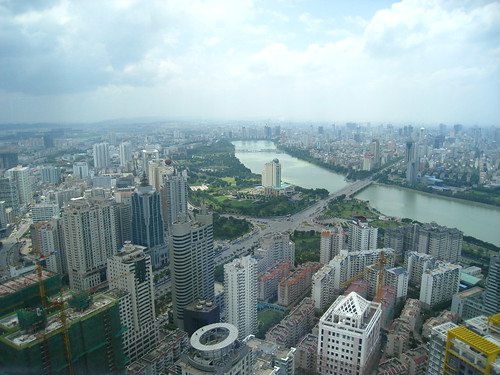
I finally left Hanoi after what turned out to be a month stay. Hanoi grew on me while I was there and it was nice to have a break from travelling, but I was still glad to be leaving. The contrast between Hanoi and Nanning is vast. Both are sprawling cities but Nanning has such a feeling of space, maybe characterless space but space nevertheless. What I found amazing is that Nanning is not a famous or particulatly big Chinese city and yet it is huge. Not only is it huge but it is getting bigger. Nanning does have something of a Milton Keynes or Canberra feel to it. The streets are big and wide. Everything is spread out and planned. On the face of it there doesn't appear to be any links to Nanning's past. The border crossing was a bit laboured on the Chinese side but I eventually got through, luckily I'm not Sloakian.


The border crossing on the Vietnamese side is quite low key. There is an immigration section to check your passport, the guy said something to me in Vietnamese which I didn't understand but the Vietnamese found funny. The bus doesn't cross the border instead bright yellow golf buggies drive you to the Chinese side. The Chinese immigration building is vast. It is a big impressive statement. The Chinese side of the border seems to be something of a tourist destination. There is a big gate and some old buildings. Once inside you have the health check to go through. This involves filling in a card and saying you don't have any SARS symptoms. The official took the cards and didn't bat an eyelid. Next up is customs who were searching a Chinese (or Vietnamese) guy's bags but waved me through. Out of the 6 of us on the bus only one other was a westerner, another backpacker. He was Slovakian. He wasn't scruffy and from his accent it sounded like he had been educated abroad. For some reason the Chinese immigration official didn't like his passport. The only question I overheard was, "Where are you going?" and I got the impression that the answer wasn't sufficient to quell the official's interest. At this point another official arrived with a very big magnifying glass. An official then appeared next to me and asked to see my passport and arrival card (you fill one of these in). The Slovakian and I were then sent back to customs. My bag was opened by a very nice and very young Chinese official whose English was excellent. He pulled some things out of bag and took an interest in my documents folder where I keep photocopies of passports and visas but he didn't really thoroughly search it. I had my Lonely Planet China guidebook wrapped up inside and he didn't find it. Apparently Chinese customs have been known to confiscate Lonely Planet China guidebooks because the map shows Taiwan as a separate country which is not correct according to China. I was sent back to immigration where the official (again another young guy) thoroughly checked my passport and asked me to remove my glasses to check I matched my photo. He was particularly interested in the emergency contact details of my relatives. These guys were't American customs and immigration officials. They were really quite pleasant. All of the officials asked me where I was going and I told them Nanning. They didn't ask where I was staying or delve any deeper. I'm not really sure why the Slovakian registered such interest. He was still at immigration when the golf cart drove off outside.

The drive from the border to Nanning was uneventful. While uneventful just crossing the border showed a marked changed between China and Vietnam. Not only were the Chinese immigration buildings much more grand. The road was a dual carriageway all the way to Nanning and even 3 lanes at times. I've not been on such a big modern road since Thailand I'm pretty sure they aren't in as good condition. Lining the roads the scenery could have been from Vietnam. Lots of rice paddies with farmers in conical hats working away. There were small towns of square concrete houses. Yet there were also big petrol stations that you see in Western countries and we stopped at a motorway services. The buildings were huge and looked very new but there didn't seem many people around and the buildings seemed to be mainly empty. It was true of the roads aswell. There was very little traffic.

Nanning appeared out of the green countryside like an oasis in a desert. Not that it was a welcome sight rather it just seemed to come out of nowhere. Normally when you approach a city you travel through the suburbs, small houses and shops, and as you get closer to the centre the buildings get bigger. It was only when we turned off of the motorway that Nanning appeared. The outskirts were huge towers and skyscrapers. Not only were there lots of huge towers but there were even more being built. I've not seen so many cranes in one place before. When we arrived at the station the coach station was packed with coaches and buses. I caught a bus (number 6) to the train station, at least I hoped so. I got on and showed the bus driver the symbol in mandarin and he motioned me to get on. The journey across Nanning took some time. There is alot of traffic and Nanning is big. The newest tower seem to be around the bus station but there is building work across the city. Once you get closer to the train station you start to notice some old buildings. Its strange to see them, something common in cities across the world. A glimpse at what Nanning once looked like. They aren't necessarily attractive and it looks like they will be soon wiped away.

Nanning is alot less chaotic than Hanoi. The streets are very wide. In the middle are 3 or two lanes for traffic going in either direction. On either side are bicycle and motorbike lanes. All the traffic obeys the traffic lights and no one touts their horns. It was quite a hazy day when I arrived and the towers in Nanning appeared out of the haze. I'm not sure if this is pollution or just the weather, but the haze did seem to get worse further into the city. The second day was much clearer but there was still a bit of a haze. To appreciate the size of Nanning I went up to the City Top viewing gallery in Royal Plaza (Royal Plaza has large statues of Elephants which you can't miss on the number 6 bus route). From up high you can see how big Nanning is and how much bigger it is getting.


I stayed at Ying Bin Hotel opposite the train station. I got a double room with ensuite hot shower, air-conditioning, TV, and a computer with internet for 120Y. Ying Bin Hotel is huge and has the feel of a hospital. There are two receptions, I went to the one on the corner with Cahoyang LU and there always seemed to be someone who spoke English. In the corridors there was a great sign which had a picture of lips and a finger over them with some mandarin chracters underneath was written "lightly". After I had checked in I wandered down Chaoyang Lu to look for somewhere to eat. The streets were pretty busy. During the day the streets are not busy but there is still lots going on. In the shade of the trees men sit around playing Chinese chess and what appears to be poker. There is also line dancing, which in the evening takes on a techno theme while alongside people are ballroom dancing. I went down a side street and came across a noodle shop. I wandered in and tried to order something to eat. The staff didn't speak English and I couldn't work out what was actually in the noodles. In the end I pointed at the picture on the wall and ordered a drink which came to less than a dollar. The noodles arrived in a very spicy broth with peanuts some greens and some wontons. It was very nice though very spicy. The staff took a keen interest in me. They were all teenagers apart from the cook. I tried to get them to teach me some Chinese. One of them was not impressed by my chopstick technique. I'm pretty good with chopsticks, I was picking peanuts out of the soup and can eat rice with them. He considered my technique all wrong and kept moving the chopsticks in my hand to his satisfaction. The next night I ate at Pizza Hut. Pizza Hut is quite a flash affair. Not only have they mastered the western pizza but they have also mastered Western serving standards. They seemingly forgot about my pizza and it wasn't until I reminded them that my pizza suddenly after everyone else had left the restaurant. The meal cost me $14, quite a difference to the bowl of noodles and not quite so satisfying. On the way back from Pizza Hut I was walking along Chaoyang Lu when I noticed groups of women hanging around suspiciously. I say suspiciously because while there were lots of people out on the streets these women were in groups but not talking to one just watching the crowd. When they noticed a man or a group of men walk passed they would walk along side them and chat to them. It seems that prostitution is really blatant in China. In my hotel room I had a telephone and throughout the evening it would ring. I'm not sure what they wanted but in the guidebook it says prostitutes will ring rooms directly. I took the phone off of the hook.

I got a bus from Hanoi to Nanning with Honggai Tourist for 300,000VND. I bought the ticket at Hong Ha Hotel (204 Tran Quang Khai). The bus company have a new office next to the front entrance to the hotel, but if no one is in there go to the hotel. The bus leaves from opposite the hotel, it is a green bus. There were only 6 people on the bus when I got it but it still departed at 9.30am on the dot. There are two buses one at 7.30am and 9.30am. Once you cross the border you are transferred to another bus to take you to Nanning. I arrived in Nanning at 5.30pm (China is 1 hour ahead of Vietnam). I changed the bus ticket 6 times because of the troubles with getting visas arranged and they never gave me a problem changing the ticket (or charged me a fee).

Wednesday, April 30, 2008

SE Asia XXXX - England United

In Vietnam you are guaranteed to be asked, "Where are you from?". Generally it is part of a triumvirate of questions the other two being, "How old are you?" and, " Are you married?". When I say "Anh" (England) the response is always positive. It seems in Vietnamese eyes (if not South East Asian eyes generally) the defining feature of England is football, or more precisely the Premiership. Lots of Vietnamese do not speak English, or have a limited grasp of English and yet when they discover I am English they want to know if I am from Manchester. In no other country have I been asked if I came from Manchester. Manchester Untied appear to be the unofficial national team of Vietnam. I'm yet to meet a Vietnamese who supports any other team. In Laos the majority of people I spoke to support Arsenal, Chelsea, Liverpool and Manchester United, or as one Monk put it, "I support the Premiership". In Thailand the big four receive a hearty following but Liverpool are the undoubted leaders. In all my travels I am yet to find a South East Asian who supports Tottenham. Although the Vietnamese upon hearing that I support Spurs reply, " Robbie Keane".

When I was in Thailand I had a long chat with a guy from Bangkok on the train to Ayutthaya who lambasted McClaren's decision to drop Beckham. In Kuala Lumpar I was in an unsavoury part of town and saw a street stall with a TV showing highlights of the England vs Croatia qualifying game for Euro 2008. When it was announced that England had failed to qualify there was shock amongst the group. In Trang I was having difficulty explaining to a group of Thais that I was English. We were at a bus stop and the bus stop had a huge Barclays Premier League advert on it, after pointing at that for a while the penny dropped. When I arrived at my guesthouse in Hanoi the manager launched into a match report on the Champions League semi-finals. In Laos whilst doing a trek through the Luang Nam Tha National park I was discussing with one of the guides his support of the Big Four.

Tuesday, April 29, 2008

SE Asia XXXIX - Hanoi Visa Woes

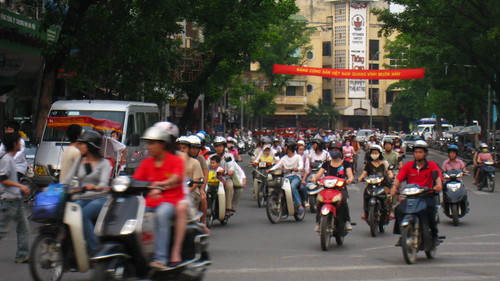
I had a love hate relationship with Hanoi. The city is vibrant. The Old Quarter is full of old buildings and has lots of atmosphere. However, the city is manic. The narrow streets of the Old Quarter are full of traffic. It feels like you are part of the traffic as you walk around and dodge the motorbikes. It felt stressful simply wandering the streets. The Old Quarter reminded me of the packed streets near the riverfront in Phnom Penh. While they are not as chaotic or dirty they feel suffocating especially when the traffic backs up during rush hour.


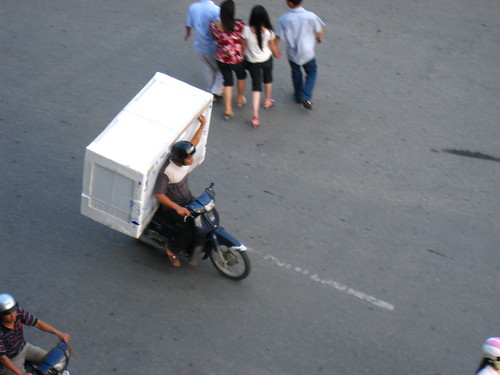
The traffic in Hanoi is amazing. The motorbikes swarm the streets in a constant whir of action. The sight of western tourists standing by the side of the road waiting for a gap is common. The trick to crossing is to step out and keep walking whether there is a gap or not. Moto's will carry everything and anything. A mattress presents no problem, even a family of five on a motorbike is not a problem. In such chaos I was surprised at how rare it was to see an accident.

A must see in Hanoi is Ho Chi Minh's mausoleum. You would be forgiven for believing that Ho Chi Minh is still alive with the number of images you see of him across Vietnam. White uniformed guards line the way as you walk single file into the mausoleum. They are there to shush anyone who dares to speak in Uncle Ho's presence. It is a bit strange seeing his grey frail body lying there.

The first place I stayed in Hanoi was Thien Trang. I had a broom cupboard of an ensuite room for $10. When I got back from Halong Bay I moved to Real Darling Cafe. I had an ensuite for $8. Real Darling also had dorm rooms and there was a travellers atmosphere in the cafe downstairs. I stayed there for two weeks and get on well with the staff. Real Darling Cafe were very helpful and charged one of the better prices for organising visas.


I spent a month in Hanoi because of problems procuring onward visas. The first problem was that the Chinese changed their visa rules. The change occurred just a week before I applied. The change made it much more difficult to get a visa and nigh on impossible to get a double entry visa. The stop in issuing double-entry visas was a problem because my plan had been to go to Hong Kong to get my Russian and Mongolian visas. It is not possible to get a Russian visa in China as a tourist. If I went to Hong Kong then I would have to get another Chinese visa which could prove expensive or impossible. I decided to try and get my Russian visa in Hanoi. Unfortunately the Russian Embassy require that you have the original copy of the letter of invitation to Russia. It costs $35 to obtain the letter from an agent on the internet, however, getting it sent from Russia took 4 working days and cost me an extra $75! I then discovered that the Russian Embassy would only issue me a visa if I had at least a 90 day Vietnamese Visa. I only had a 30 day Vietnamese Visa which I extended once. The 90 day visa cost me an extra $115. In the meantime I got my Mongolian one which was a relatively straightforward affair.

The Russian Embassy is a huge concrete complex which is ugly even by Vietnamese building standards. The address of the Russian Embassy is 191 La Thanh. However, the Embassy is located next to 1133 La Thanh. I don't know if this is a cunning deception to confuse enemies. The Consular is on the other side of the complex down an obscure alleyway. If you follow the high walls round you will eventually find some benches opposite a steel door. The only thing to tell you this is the place is a plaque with opening hours, and a glass cabinet with pictures of Russia. Apparently Russia has aircraft carriers, women and missiles. The steel door opened a little after 9am. It did not open so much as you heard a click, whereupon the Vietnamese guard opened the door. Inside the steel door was a small square with a single door in the corner. There was no sign of the person who unlocked the steel door. I wasn't sure whether to open the door in the corner. I nudged it and it opened. I was presented with a small room and a huge metal detector. On one side was a large window with a letterbox at the bottom and a very tall beautiful Russian woman standing behind the glass. I showed her my passport and she gave me an English application form. I filled it in. While I was filling it in the Vietnamese women who had been sitting on the benches outside came in. I queued up behind two of them. A third walked in and moved in front of me. A fourth walked in and managed to squeeze herself between me and the newly arrived third woman. I was somewhat amazed and tapped the woman on the shoulder. She looked at me and giggled. These four women were thoroughly enjoying themselves peering over one anothers shoulders to see what the Russsian official was doing. The Vietnamese don't really undertand queueing and my tap on the shoulder rather than eliciting a realisation of her queue jumping seemed to signal a different intent on my part. She wouldn't make eye contact with me but her compatriots did. They looked at me, chatted with their friend, giggled, and looked at me again. The Vietnamese left and the Russian offical looked at my papers. They all seemed to be in order. It turned out that she did speak English as she asked me when I wanted my passport back. One day processing costs $55. All in all my 30 day tourist visa cost $255.

The first time I went to the Russian Embassy it was very quiet and I was shown in ahead of the few Vietnamese who were waiting. The second time it was absolutely packed and I had to wait an hour before I could skip the queue and queue inside for another hour. How quickly you can skip the queue depends on what Vietnamese guard is outside. I went back because the machine readable line at the bottom had a spelling mistake in my first name. Apparently this doesn't matter so long as your name is spelt correctly on the main part of the visa. (I didn't have any problems in Russia with the misspelt machine readable line).

The Mongolian Embassy in Hanoi is the least official embassy I have visited. The Embassy is in the new diplomatic quarter. It is off the main road behind the Pakistan and Nigerian Embassies, and the opposite the Brunei Embassy. The address is Villa No. 5 but consular activities take place at Villa No. 6. A Vietnamese guard pointed me across the road. I rang the door bell and a gentleman opened the gate for me and showed me into the house. I was lead into what appeared to be someone's living room. A large desk sat at one end with a computer and some seats. A large Mongolian with a Russian accent sat behind the deak. He gave me a form in English which I filled in, I asked for same day processing which cost $60. (I got a 30 day visa with up to 90 days before entry). I did not require a letter of invitation or an itinerary.

I arranged my Russian and Mongolian visas myself. I went through Real Darling Cafe for my Vietnamese visa extension, 90 day Vietnamese Visa, and my Chinese visa. There are a few people who work there but the best person to use is Mrs Nguyen Thi Luong who always knew what she was talking about and if she did not know the answer she phoned someone to clarify. Real Darling Cafe Guest House, 33 Hang Quat Street (0084) 48269386. I found them to be very helpful.

How to find the Russian and Mongolian Embassies in Hanoi


To find the Russian Embassy you head west along Kim Ma St until you reach the huge Daewoo Hotel, from here carry straight on along Kim Ma St until you pass a boating lake on your right (Swan boats). There will then be a large junction over to your left is a huge ugly concrete complex, this is the Russian Embassy. Follow the high walls along to the right (as you face the Embassy) and you will come to an alleyway. If you walk down this alleyway you will come to a row of benches and a steel door. The Russian Embassy in Hanoi is open Monday 9-12, 16-17, Tuesday 9-12, Wednesday 9-12, 16-17, Thursday 16-17, Friday 9-12.


To find the Mongolian Embassy go to the Family Medical Practice (on the Lonely Planet map) 298i Kim Ma Street. From the clinic walk west to the first junction with traffic lights, turn right and cross over the road, about halfway down the road is the Nigerian Embassy turn left along the street between the Nigerian and Pakistan Embassies. Follow the short street to the end, on your left is Villa No. 5, infront is the Brunei Embassy, and on your right is the Mongolian consular Villa No. 6. It is only open Tuesday and Thursday morning to process visas.