Tuesday, January 22, 2008

SE Asia XIV - Train travel through Ancient Kingdoms

I left Bangkok for northern Thailand via the ancient kingdoms of central Thailand. Ayutthaya, Lopburi, and Sukhothai have amazing ruins with few tourists. I often had the ruins to myself, giving the trip an essential Indiana Jones quality apart from all of the antiquities having been taken and the rows of headless Buddhas. Travelling by train is a great way to see Thailand and Thais. Before heading north I went on a day trip along the Death Railway to Hellfire Pass.

Third class trains are a great way to see Thailand and Thais. The windows are wide and open. The country rushes by and, apart from the odd fire with the ensuing influx of flying embers, the coaches with bench seats are a relatively comfortable way to travel. The locals are surpised to see a farang travelling with them in third class. I always managed to find myself near a Thai who spoke English and wanted to chat. The thai passengers are an endless list of characters, ably supported by the food vendors wandering between the carriages. Third class is also cheap as chips. The journeys from Bangkok to Ayutthaya and Ayutthaya to Lopburi both only cost 15B. The five hour journey to Phitsanulok cost 125B. A great source of information for train journeys in Thailand (and the rest of the world) is www.seat61.com.

Ayutthaya is an hour north of Bangkok by train. It is an ancient capital of Siam and was founded in 1350. It is a natural island surround by the Lopburi, Prasak and Chao Phraya Rivers. The great aspect of the ruins of Ayutthaya is how they have survived next to a modern Thai town. Half the island is given over to the town while the other half has the ruins scattered around. Ayutthaya is a Thai town going about its business with the ruins in the background. The ruined temples do not appear to have been heavily reconstructed. Wat Chaiwatthanaram sitting on the river was particularly picturesque with the setting sun behind it. It is very easy to wander around the temples. There is an admission fee of 20-30B for each temple. I was standing outside one ruin with lots of Rooster statues when an old Thai woman appeared next to me with a lotus flower and candles. I protested that I wasn't Buddhist and shouldn't really be praying to Buddha, but she didn't understand and I didn't want to be rude to an old woman. I paid for them (10B) and she prayed for me, it then turned out we were going to another Buddha shrine (I paid another 10B) and she prayed for me again, we then went to a third shrine (I paid 10B again) and she prayed for me again. People feeling the need to pray for me appears to be a habit I have got into. The train station is on the eastern side of town. I hired a long boat and visited the temples on the rivers surrounding the island. It cost me 500B and was a great way to see them. There is a cross river ferry that will take you into town. I was surprised to find so few tourists and guesthouses. I can only assume that because it is so close to Bangkok people simply visit on day trips. Even so I only saw a couple of groups of tourists at a few of the more famous temples, otherwise I had the place to myself. I stayed at Bann Kun Phra which has an excellent restaurant on the river. The rooms have ensuite cold showers but the walls are paper thin. I paid 300B for a double bed. It is a fine place to stay apart from the woman who runs it, who seemed to be somewhat paranoid and became increasingly suspicious of me during my stay.

I caught another third class train for the hour journey to Lopburi. Lopburi does not have the extensive ruins of Ayutthaya or Sukhothai but the ruins it does have are amongst the old town. The old palace is well preserved and sits in the centre of the old town. There is a museum in its grounds as well as some hedges cut into the shape of elephants. Opposite the train station are more ruins. To the south of the old town are the remains of a temple known locally as Monkey Temple. It is swarming with monkeys. So much so that local guides wander around with sticks to keep them in check. I had one monkey run up my leg and jump on top of my backpack. The monkeys are not restricted to the temple they have infiltrated the town. They use the telephone lines to cross roads and get between the buildings. I spent a good hour watching a group of monkeys leave a path of destruction through the town centre. A similar problem has befallen Prachuap Kiri Khan, a charming little seaside town south of Bangkok. The monkeys on Chong Khra Chok hill have large grounds but they are moving into the rest of town. It is peculiar to see monkey's running riot in a petrol station. If you arrive at the train station in Lopburi looking for accommodation walk out of the train station turn right and then left and you will find the Tourist Information office who will provide you with a map. I stayed at Nett Hotel, 200B for an ensuite cold shower with TV.

A 5 hour train journey took me to Phitsanulok, where I caught a bus to Sukhothai an hour away. The ruins at Sukhothai Historical Park are considered the best in Thailand. Sukhothai was founded in the 13th century and was the first capital of Siam. The most famous temple is Wat Mahathat which is full of Buddha images. Sukthothai Hiostorical Park is broken up into zones and you buy a ticket for each zone. The most restored ruins are in the centre, inside the city walls. Outside of the city walls (especially to the West and South) you are surrounded by countryside as you cycle around. The ruins aren't amazing outside of the centre but it is still very enjoyable. There are a couple of amazing temples to the West and North. Wat Saphan Hin has a huge standing at the top of a hill. At the bottom of the hill is a very happy policeman. He has a little hut and seems charmed by his surroundings. He'll watch your bike and try and sell you some water. Wat Sri Chum is also amazing with a huge seated Buddha squeezed between 4 walls. In the Lonely Planet they suggest that you stay in Phitsanulok and catch a bus to the ruins in Sukhothai. I really liked Sukhothai. It is a typical Thai town with few tourists. There isn't a great deal going on but what there is is Thai. I saw an Elephant wander down the street one night. I stayed at TR Guesthouse run by a very friendly couple. I had a double bed with hot water ensuite for 250B, it also included free internet. The owner will even pick you up from the bus station, his telephone number is 055-611-663. If you want to stay as close as possible to the ruins then there are a number of guesthouses inside the city walls of the Historical Park and they seem to charge similar prices to Sukhothai.

My train travel's in Thailand began before I left Bangkok when I went on a day trip along the Death Railway. The Death Railway is synonymous with pain and suffering. 13,000 Allied Prisoners of War and another 80,000 Asian labourers died building the line. Thai railways run a day trip along what is left of the line. The day trip isn't to commemorate the history of the railway but to visit Sai Yok waterfall at the end of the line. It costs only 100B for the return journey and makes for a cheap day out for Thai families. I was the only farang on the train apart from a Japanese guy (who was going to the waterfall). I didn't ask him about his views on the history of the line. The day trip is a full day, the train left at 6.30am and didn't get back until 9pm. As the only Farang aboard I was the subject of great interest. People wanted their photographs taken with me and to say hello. On the return journey to Bangkok I boarded at a different station to everyone else because I didn't visit the waterfall. My absence appeared to cause a great deal of confusion on board, its embarrassing to lose your only farang. My return at the next station down the line was greeted by much enthusiasm, a round of applause followed my walk through the carriages. The first stop was at Kanchanaburi for the Bridge over the River Kwai. The river was originally called Mae Khlung, the railway runs alongside the River Kwae but doesn't cross it, due to the success of the film the Thai authorities changed the name of the river. Kanchanaburi is heavily built up with tourism and when we arrived late in the morning the bridge was packed with tourists (you can walk over it). The end of the line is Nam Tok, it is a much smaller and nicer town than Kanchanburi. The railway line is particularly scenic between Kanchanaburi and Nam Tok, passing over Wampo Viaduct. I hired a sawngthaew, for the extortionate rate of 600B, to Hellfire Pass. My sawngthaew driver was in no hurry and whenever we were on even a slight descent he took the car out of gear and let it roll. When I finished at Hellfire Pass I came back to find him sound asleep. Hellfire Pass was a particularly bad section of the line for the POWs they were forced to cut through solid rock without machinery. It was called Hellfire Pass due to the deathly figures cast on to the walls by the fires lit when the POWs were forced to work through the night. A POW who worked here came back in the early 1980s to find it. He found Hellfire Pass covered in jungle and enlisted the support of the Australian Government to clear it and turn it into a memorial. It is a moving monument to the men who were forced to work and die here.

Monday, January 21, 2008

SE Asia XIIV - Expectations


Bangkok is the number one toursit destination in Thailand. Chang Mai is the number two tourist destination in Thailand. When travelling in South East Asia popular opinion (or at least the people I've come across) is that Bangkok is a pollution infested, traffic gridlocked, dirty city. Whereas Chang Mai is a cultural wonder. Bangkok surpassed my expectations and I spent 10 days there. CHang Mai on the other hand fell far short and I only stayed a few days.

Bangkok is a city of two halves. The old city with the narrow srtreets, klongs (canals) and old buildings focused along the Chao Praya River. The other half of Bangkok is the new city starting from Siam Square and heading out along Sukhumvit Road. New Bangkok is just a bit plain, it isn't a bad modern city it is just a little bland. I had Sircumvit recommended as a good area to stay. I only think this is the case if you are desperate to shop or visit dodgy ping pong shows (not table tennis). It is far more convenient to stay within the western ghetto of Khao San Road and enjoy the old city close by. South of Khao San Road is the Grand Palace with the sacred (and ridiculously busy) Wat Phra Kaew the home of the Emerald Buddha. Just south of the palace is Wat Pho with the huge Reclining Buddha. Across the river from here is Wat Arun an amazing sight easily visted on a cross river ferry. There is a great little cafe to the left of the boat landing on the opposite side of the river to Wat Arun. There are lots of great temples all around Bangkok and the further from Khao San Road you go the less likely that you will encounter any other westerners there. Further south of the palace is China town a crazily busy area packed with street markets whre you can buy anything from knives and swords to SWAT body armour. Nancy Chandler's Map of Bangkok is useful to have and gives you tips on where to find some of the least disturbed parts of Bangkok. A bus map is also very handy. Buses are very cheap (under 15B a journey) and it is easy to get from Banglampoo (Khao San Road). to Siam Square, getting back is another matter and that is where the map comes in handy.


I mentioned in a previous blog that the Khao San Road area is a Farang ghetto. I stayed on Soi Rambrutti, an extension of the ghetto, at My House. There is a lot of accommodation in the area and it suits a varioety of budgets. My House is at the cheaper end, 200B for a single (a rarity in Thailand) fan ensuite cold shower and a window. It was clean even though the walls were decorated with curious stains. The staff were not particularly friendly and only entered into conversation with me about my royal t-shirts.

Bangkok is renowned for appalling traffic and it lives up to its reputation. I sat on buses that didn't moved for half an hour. The sky train is a good way to bypass the traffic but only if you are travelling along a narrow corridor. The river boats are a good way to get around the old city, especially if you are staying Banglampoo (Khao San Road). There are big ferries that run up and down the river and cross river ferries (which are just small barges). The ferries are often very crowded. The Chao Praya River is very busy with ferries, longboats, barges and other vessels. A journey along it is rarely smooth.

The fastest way to get from Banglampoo to Siam Square is on a river bus along the Klong. Bangkok was known as the Venice of the East and while most of the Kloings have been concreted over some still exist. the boat stop is under the bridge next to CentralWorld in Siam Square. The journey to Banglampoo (the stop is next to the Octagon Fort) costs 12B. It has a James Bond quality to it. The conductors walk up and down the edge of the boat collecting fares while the boat is speeding down the narrow canal. They wear a crash helmet for protection when passing under the numerous low bridges. An unusual safety feature by Thai standards and an indication that alot of conductors must have hit their heads. For a particularly low bridge the whole roof folds down, a modification worthy of Q. I thought it was hilarious. For more info click here.


With all the reports I had heard about Chang Mai I envisaged a place that was small and old, full of temples, with friendly, helpful people and not blighted by tourism. It does tick most of these boxs but tourism has its tentacles all over the city. The trouble is that Chang Mai is much smaller than Bangkok so it is much more difficult to absorb the shear number of tourists. There are markets but I found these markets to be orientated to the tourist and not as interesting as their Bangkok equivalents. The locals are friendly and maybe a lot friendlier if you have only encountered Thais trying to sell you something on a beach or on Khao San Road. However, the Thais in the towns between Bangkok and Chang Mai are much friendlier because they don't come across as many farang.


One of the easiest trips out of Chang Mai is to Wat Doi Suthep. It is a very important temple to the Thais on a hill overlooking Chang Mai. The views are meant to be great, unfortunately I was confonted with a thick haze. The temple is heavily visited by tourists and locals, and is surrounded by tourist tat stalls. If you want to walk it is an hour to the base of the hill and then in a sangthaew 40B from the base to the temple. They are queued up and when there are enough passengers they drive up. The way down isn't so organised. There is a flat fee of 30B the trouble is finding a sangthaew full enough to go down. The easiest way to find one is to walk down the hill to the first big bend and wait for a sangthaew to drive passed, they will pull over and you can jump in.


Chang Mai is busy with tourists of all types. I found cheap accommodation to be more diffiult to come by then anywhere else in Thailand. I wandered the sidestreets of the eastern moat and ended up in Moonlight Guesthouse. It was an uninspiring place, 200B for a room with a bunk bed, and a shared bathroom. I moved the next day to Mataka. I had a double bed with cold ensuite shower for 180B. The rooms appear to have been recently refurbished.

Lampang is just south of Chang Mai and can be visited on a day trip. I stopped there on my way north from Sukhothai. Even though it is close to Chang Mai it is a sleepy place with few tourists. I stayed at Riverside Guesthouse, 250B for a triple room with shared bathroom. I walked from the bus station to the centre of town, which is alot further than you might think, a sanghtaew is a better idea. Lampang has a number of temples. The most beautiful temple I have visited in Thailand lies just south of Lampang. Wat Phra That Lampang Luang is spectacular. There is a really distinctive atmosphere as you walk into the coutryard. It feels like you could be on a top of a remote Tibetan mountain (probably diminished by the coach loads of tourists who arrive later in the day). I was quoted 500B for a round trip from Lampang, I found another sangthaew who was heading south and dropped me at the temple for 60B. I persuaded him to hang around and he took me back to Lampang for 100B.

On the main road between Lampang and Chang Mai is the National Elephant Institute. It is possible to get any Chang Mai bound bus to drop you off here. They have two Elephant shows a day here (aswell as Elephant rides and Mahout courses). I arrived for the afternoon show. The show was thoroughly entertaining. Over 20 elephants are used and they seem to enjoy themselves, at the very least no force is used on them to perform the activities (apart from prodding). The show begins with the Elephants bathing. They then march into the arena and line up. One rings the bell to start the show while another raises a flag. The show involves displays of log dragging, lifting and pushing. They play some musical instruments and paint pictures. One picture was an impressionistic piece, the other was a still life of flowers. The show closes with an opportunity to feed them sugar cane and bananas.
Sunday, January 20, 2008

SE Asia XII - Highway to the Danger Zone

Kenny Loggin may not have had in mind Thai transport when he wrote his 80's classic but it is a pretty accurate description for some of the things you see and experience on Thai roads. In Thailand to say that there are rules of the road would be a very liberal interpretation of rules. A very simple rule is to drive on the left. It is loosely applied. Motorcyclists go wherever they choose. Minibus drivers feel the need to show their police car chase credentials every time they get on the road. Coach drivers do not want to stop wherever you are getting on or off. Travelling in Thailand is always an experience.


In Thailand to say that there are rules of the road would be a very liberal interpretation of rules. A very simple rule is to drive on the left. It is loosely applied. If you want to drive to the right of oncoming traffic you can. Motorcyclists go wherever they wish. On dual carriageways the hard shoulder is a motorcycle lane where motorbikes can go in either direction. Motorcyclists legally have to wear a helmet, they rarely do. If you see a motorcyclist with a passenger it is almost guaranteed that one of them won't be wearing a helmet, even police motorcyclists don't all wear helmets. The helmets most people wear have more in common with a horse riding helmet rather than something that will protect you in case of an accident. The road isn't the only domain of the motorbike. I have had to jump out of the way of motorbikes on pavements, including police motorbikes. I don't know what the legal age to ride a motorcycle is but I have seen some very young looking teens speeding around. The Thai youth have mastered the art of fitting as many people as possible on to motorbikes. The art is most practised before and after school. Four people is not rare, and I've seen six with two toddlers being held in arms out to the side.


Minibuses are the most dangerous way to travel in Thailand. This is a statement not backed up by statistics but they certainly feel like the most dangerous. Minibus drivers seem to have a death wish. They drive like their pants are on fire. They pass everything in their way no matter whether its on a blind corner, double lines, oncoming traffic or if driving through the middle of a town. To make matters worse you are crammed in like sardines. They are not Ford Transit van size but Japanese minivan size. Normally they squeeze in 16 people but I've been in one where there were over 20. There are no seat belts, there might be one in the front seat. In the book "First Time around the World" they suggested carrying your own seat belt, I thought this sounded daft and it is for first world countries but it makes a lot of sense in Thailand. To top it all minibuses are generally overpriced. In tourist towns they are advertised as if they are the only way to get to the next town. They might be the only transport that will pick you up from your guesthouse and take you to the next town but there will be lots of coaches doing the same route. Coaches are generally three times cheaper than the minibus equivalent. If the minibus isn't picking you up then you generally have to wait until it is full. "We leave now" never means straight away.


Coaches are a very cheap way to cover long distances in Thailand. The cheapest are third class, they have sliding windows and stop for any passengers who want to get on or off. In the south they generally ply short routes, up north they seem to be prevalent on most routes. They aren't always designed for western sized people. I was on a bus from Ban Pasang to Chang Rai. It was standing room only and while all the Thais could comfortably stand up straight I had to have my head bent over to one side. The space between seats can be too small to accommodate western length thighs. While they can be uncomfortable they are one of the most entertaining way to travel long distances. The conductors are particularly vocal calling out for more passengers and you often find locals puzzled at you being on their bus with your backpack. Second class coaches have air conditioning, and first class or VIP have air conditioning, toilets and sometimes a stewardess dealing out refreshments. I generally travel second or third class because they are so cheap. Coach drivers have less of a do or die attitude than minibus drivers. However, all coaches I have been on avoid stopping. The journey is a fluid motion where getting on or off is done while the coach is still moving.


Outside of Bangkok Sangthaews are the main local transport. They often run regular routes. Sangthaew means two benches. They are pickup trucks with two benches in the back and a roof on top. There are often grab rails on the back for people to hold on to when the inside is full. Sangthaews can be an Australian style ute but they can also be old trucks with wooden cabins crafted on to the back. I have shared the back with a variety of Thais and their baggage. On on occasion the back was full of raw meat and egg yokes. On another I had a severed pig's head staring at me with some of the rest of the bits of his body. When his owners got up to leave they left a pool of blood on the floor. Normally they are a very cheap way to get around town (or go further). The only problem for the traveller comes when the Sangthaew mafia decide that tourists need to hire a whole vehicle to go to an attraction. I can understand it when locals don't go to a certain place. However, it irritates me when they drive passed the place anyway. For instance, in Krabi Wat Thom Seua (Tiger Cave Temple) is a popular tourist attraction outside of town. I could not find a Sangthaew driver who would take me for less than 100B. On the way back I discovered Tescos was just down the road from the turnoff for Wat Thom Sea. I walked there in under 20 minutes and caught a Sangthaew back to Krabi for only 20B. Sangthaews are usually safe to travel in because they run a local route, and if they go further afield they are on the look out for more passengers so do not drive fast. The scariest journey in Thailand I have had was in the back of a Sangthaew. It was from Trang to the pier for Koh Sukorn. The driver must have gone to the Australian Ute drivers school. I was hanging on in the back with piles of boxes and an old Thai woman who found it all hilarious. I have heard it said that Thai's drive like maniacs because of their Buddhist belief. I have often seen passengers in Sangthaews wai (prayer like gesture) Buddhist temples as we drive passed. I was sitting in the front of a Sangthaew and the driver took his hands off of the wheel (on a winding steep downhill mountain road) and wai'd the Buddhist temple. I'm yet to see a motorcycle driver follow the same principle but it wouldn't surprise me.

Wednesday, January 16, 2008

SE Asia XI - Who to trust in the Garden of Eden?

Knowing who to trust when you get off a train or a bus is tricky. Backpackers stick out like a sore thumb. It isn't difficult for touts to pick out the walking ATM, like shit attracting flies you attract touts and tuk-tuk drivers. In the end you have to trust someone, and this Thailand land of the Buddha and smiles.
I find it dificult to trust tuk-tuk drivers at the best of times but when they are the first to greet me I am even more suspicious. When I am jumping off of a train and I am immediately approached "Where you go?" my defensive barriers are up and I go and find information somewhere else. It might be easier just to go where the tuk-tuk driver wants to take me and just pay the extra but I like to think that I can get there under my own steam. In Lopburi I didn't have a map, I couldn't find anyone who could help apart from a cycle rickshaw driver who had fixed his sights on me even before I had gotten off of the train. I choose not to give in and wandered outside. I immediately stumbled upon a Tourist Authority Thailand sign and was sitting in the office chatting to a guy about the merits of Lopburi in minutes. When I arrived in Phitsanulok station I found a bus stop (passing the ever would be helpful tuk-tuk drivers) and was on a local bus to the coach station amongst locals. The conductor seemed to take a particular interest in me.

While being somewhat suspicious of people's intentions can be useful it can also turn you into a defensive traveller with all locals who offer help. This is Thailand and people are naturally helpful and friendly. The people who are most likely to want to get more baht out of you are those who deal with tourists most often. When one farang doesn't kick up a fuss about a high price why should the next? Even so these Thais should not be treated with contempt. In the end if they do rip you off it won't be a huge amount of money. After all "You'll never be screwed as sweetly as you will in Thailand" (I don't know who to attribute this quote to, but it's a good one).

Khao Sok National Park is beautiful. I have heard it described not inaccurately as the Garden of Eden. When you arrive on the coach from .... you are dropped off at the junction with the main road and the entrance road to the park. Along this entrance road are a series of bungalow enterprises. When you get off of the coach you are surrounded by bungalow touts. The natural response is to get defensive and ignore all these requests for your interest. I saw one guy get off the coach walk through the scrum, sit down and have a cigarette still ignoring the touts and then walk to the park gates with his pack on his back. However, the touts at Khao Sok are a tight knit bunch consisting of locals who have grown up in the area and have started businesses catering for the farang. The tout for Smiley Bungalows is the owner. I along with another couple choose Smiley Bungalows over all the other competition. Once we had the rest of the touts started moaning comically, "everyone chooses Smiley", "smiley, smiley smiley", "go off to your Smiley bungalow". When I left Khao Sok I missed the first coach and the second coach drove passed without stopping. During my two hour wait I was invited to sit down with the touts and play cards with them. I even managed to win enough money off of the owner of Smiley Bungalows to pay for my coach journey. It was a fun and friendly atmosphere.

Khao Sok has grown steadily more popular in recent years, as a highway has been built passing the gates of the park. It is still relatively quiet and peaceful in the tourist town built outside the gates although I can see it becoming overdeveloped in not too many years. Activities have sprung up to cater for the tourists. I did an Elephant trek. It was disappointing. It cost 850 Baht and lasted about two hours. It is quite something to be sitting on a bench on top of an elephant and to plod along. However, the trek element was sorely lacking. The impression in the advertising is that you will go through jungle, in fact you go up the road you drove in on and then down another dirt track to a pool. The journey back is reversed. I have been told that there are much better treks in northern Thailand, where there is more trekking for less money. The Elephants didn't appear to be mistreated by their mahouts, they had wooden canes which they used to prod the elephants. The control came from their voiced commands. I have heard stories of some very rough treatment being doled out to elephants on other treks in southern Thailand. The activities offered don't actually take part in Khao Sok. There are plenty of trails to follow in Khao Sok and you can hire a guide if you want to go further afield.

Smiley Bungalows was a particularly nice place to stay. It is the best value accommodation I have stayed in in Thailand. The bathroom had the luxury of a lukewarm shower and there was a big balcony to strecth out on. The woman who runs it is very friendly and speaks very good English. She is more than happy to sit down and have a chat with you (and play cards if you are waiting for a bus). I was charged the rate of 300 baht for a large bungalow because they didn't have any small ones left (the normal rate is 500 baht). The top photograph is the view from my balcony. They will also take you to feed the monkeys at sunset for free (most of the bungalows offer this aswell).While the town that has grown outside the gates is for tourists it has a very friendly feel. They don't seem to be fed up with the farang quite yet. There are plenty of places to eat and prices are reasonable.

Tuesday, January 15, 2008

SE Asia X - T-shirts

You know whether a place is truly Thai by the t-shirts that the locals wear. If it is a Thai town the locals will wear pink, yellow and blue t-shirts. If it is a town for tourists then they will dress more like westerners that surround them. If it is a Thai town there be lots of shops selling a variety of pink and yellow t-shirts. If it is a Thai town there will be images of the King everywhere.
Any day is a good day to wear yellow or pink. The best day to wear yellow is a Monday when everyone else wears yellow. Thai's wear yellow on a Monday due to that being the King's birthday. If you want to be super patriotic then you can have a yellow shirt with a pink jacket. I even saw a dog whose owner had dyed its fur yellow (I think it was for the King, I can't think of any other reason). The reason why pink became an overnight fashion sensation is because the King left hospital in November wearing a pick jacket. My pink t-shirt has a drawing of the King with "Love King 80" written on it. If you were wondering about blue it is the colour for the Queen.
If Bangkok is a city of villages then Banglampoo and more accurately Khao San Road is the village of the farang. It used to be a backpacker ghetto and is now a place for all the farang passing through. You see the 18 year old backpackers, the too cool for school backpackers, the dreadlocked hippie backpackers, western couples of all ages, western families, and the farang man and thai woman couples (I have never seen the reverse). It has a nice atmosphere to it. Although it is obviously not a Thai area because Thais don't wear pink and yellow t-shirts and you can't buy them here. When you venture outside of Khao San Road arena you see lots of t-shirts being worn and lots of places to buy them. In Chatuchak market I got my blue t-shirt in tribute to the Queen.
Ko Lanta is another farang ghetto. It is a pretty island south of Krabi. I stayed one night at Sea Coconut. I didn't like Ko Lanta because it didn't feel special. It just felt like a westerner holiday spot. The prices were higher than Trang, and nobody was wearing pink or yellow t-shirts. Krabi is a town built on tourism, however, it is not dominated by tourists. I spent a week in Krabi, somewhat unintentionally as a large part was spent sitting on a toilet. The town has plenty of shops selling yellow and pink t-shirts and there are lots of pictures of the King plastered around the town. I visited Rai Leh from Krabi. Rai Leh is a beautiful peninsula with beaches surrounded by karst limestone cliffs. It is full to the brim with tourists. I also climbed Wat Thom Seua. It is a buddhiust temple with a Wat on top of a karst cliff. It is a killer walk (and climb at times) to the top of 1237 steps.
I seem to always get a favourable response from the locals when wearing my pink or yellow t-shirts. I get an even better response in western enclaves when the locals are extremely surprised to see a farang in a pink or yellow t-shirt. I am often asked "Do you love my King?" to which I dutifully reply Yes. The King is a great source of national pride and he appears to be widely loved across the population. Admittedly it is illegal to criticise the King, so liking him is an easier option. The fact that I'm asked "Do you love my King?" and not 'the' King demonstrates the personal pride that the Thai people feel. It is also not something limited to the ethnic Thais. I have seen Chinese and Muslim Thais wearing the t-shirts. I have seen many Muslim women with pink or yellow head scarfs on with the royal insignia. It is not limited to age groups or economic classes. To wear yellow or pink is a sign of being Thai, not a sign of being rich, poor, old or young. There is a topic thread on Thai Forum and a contributor suggests that an element of peer pressure is involved in the fashion trend.

The King is everywhere in Thailand. There are huge billboard images in every town. The entrance to towns has archways or bridges decorated with pictures of the King and Queen. If you go into shops, guesthouses, or people's homes (they can be all be the same thing) there will be an image of the King or three and maybe a picture of a past favourite King. In markets there are stalls that just sell pictures of the King. There are shops that specialise in King memorabilia. I remember being surprised by seeing a picture of Queen Elizabeth II in Canadian immigration when I crossed from the US. In Britain in recent years support for the monarchy was at its height during the Queen's golden jubilee, I remember lots of flags but I do not remember huge billboards with a picture of the Queen taking a photograph or looking at a map. Here is a link to the BBC News website to an article, "Why Thailand's king is so revered".

The King is not simply respected he is revered. His opinion, his ideas, his actions matter. In Britain amongst the general population I would suggest that the Queen is respected but I would not suggest that this would extend to her opinions on economic or political matters. In Thailand the military coup government adopted as government policy an initiative led by the King for Thai economic self-sufficiency. If you visit the Teak Palace in Bangkok there are two houses devoted to pictures taken by the King. The King is an avid photographer and the displays tell you how he has invented a number of innovative photographic techniques. One gallery relates to pictures taken by the King during flooding in Bangkok in the early 1980s. The captions explain how the King's photographs were clear and enabled officials to see clearly what the problems were and how to deal with them. The King is also a musician. In the gallery are pictures of him playing saxophone with Louis Armstrong.

If you had been travelling in Thailand for the passed two weeks you might wonder where all these yellow and pink t-shirts are. Princess Galyani Vadhana died on the 2nd January. She was the King's older sister and died of cancer at the age of 84. The country has entered mourning and part of that mourning is to wear black. Here is a link to an article about her death on BBC News. Her death has been met by a reaction similar to that of the Queen Mother's death. Books of condolence have been opened in all towns like in Britain, but unlike Britain the billboard images of the King have been replaced by pictures of the Princess. Thai's have stopped wearing yellow and pink while they mourn her death. The Royal Family are observing 100 days of mourning and those who work for the government have 15 officials days of mourning, they must wear black to work. In the Bangkok Post (15th January 2008) an article entitled "100 days of mourning sought", it begins "The cabinet will today consider extending the official period for Her Royal Highness Princess Galyani Vadhana from 15 to 100 days." In another article in the Bangkok Post they mention how black clothing has been selling out, "In Trang, a clothing shop owner said black t-shirts and suits had been sold out since January 3rd, one day after the Princess passed away".

Tuesday, December 25, 2007

SE Asia IX - Christmas Day in Burma

On Christmas Day I went to Burma. Kawthaung is a Burmese town on the opposite side of the river Perchan to Ranong in Thailand. It is a popular place to do the visa run. Most westerners arrive at the immigration hut, pay their money, get their stamp, and jump on a boat out of Burma. It is an intimidating chaotic atmosphere, which doesn't encourage lingering. In the guidebooks they actively encourage people not to have a look around and say that Kawthaung has little to offer and is just the same as the Thai town you just left. This is complete tosh. Kawthaung is quite different to Ranong and while it won't win tourist destination 2008 there are a few sights worth visiting.

Westerners do the trip to Kawthaung to renew their visa for Thailand. If you leave Thailand and then retrn you get given another tourist visa (although you can only do it 3 times consecutively before you have to visit a Thai embassy or consulate). It is called the 'visa run'. When you arrive at Burmese immigration in Kawthaung you pay the Burmese officials $10 (US dollars). They stamp you as a day visitor (you can stay 2 nights). The $10 has to be absolutely perfect, the notes cannot be marked or creased. I gave 10 $1 notes and the official checked each of them before stamping my passport. It is a dubious honour to say that you have given the Myanmar regime $10 of clean crisp notes.
I would recommend doing the visa run (even if you don't want to visit the town) just because it feels like something out of a bygone age of travelling. Ranong port is filled with long boats. Once you have boarded one and waited for more passengers ("We leave now" never means now but when the vessel is full) you head off to Thai immigration. Thai immigration is a hut on stilts in the river. Long boats crash into one another pulling up outside the hut. The boat man grabs your passport, hops between the long boats, and disappears into the hut. He returns with your stamped passports and the next stop is Thai customs. Thai customs is another hut on stilts next to a small island. When we left Thailand they waved us through. When we returned to Thailand they boarded the long boat and I had to empty my bag before the grinning army boy, who sniffed my ginger tablets, and helped me put it all back in my bag. It is then a 30 minute crossing of the estuary to Burma. It is practically open water. You are first met at another small island by Burma customs, who check some of the passports. The next stop is Kwantaung itself. The port is again filled with long boats and you crash into some as you make your landing at the pier. Once you get off the long boat you are greeted by all sorts of people selling you just about anything. For instance, after my tour around the town I was sitting in a long boat to return to Thailand. Two boys were chatting to me. One of them I had met waiting at Burma customs as he was working on another boat (he is the boy doing the 'peace' sign behind me in the top photo). He was 15 and his younger brother 13. The 15 year old boy tried to sell me a prostitute based on her being much cheaper than a Thai equivalent. His brother tried to sell me viagra and do a currency exchange on 30 Euro cents. Burmese immigration is in a hut on the otherside of a small bridge. The Burmese officials were very nice and spoke excellent English (I expected an American style immigration welcome where they want to kick you out as soon as you have arrived). The whole process is completely mad and well worth experiencing. Alot of Westerners pay big money to go in a big boat with other westerners and not mix with the riff-raff. If you do it that way you miss out on half the fun. The long boats I was in were full of smiley locals who seemed quite impressed to have a Farang in their boat.

I could have turned tail as soon as I arrived in Kawthaung but I wanted to have a look around. I had paid for a guide, Jung, to show me around for a couple of hours. It is possible to wander on your own, but I wouldn't recommend it. The area around the pier is swarming with people looking to make money out of you. The fact that I had Jung, a local, showing me around meant alot of people didn't bother hassling me and those that did I could ignore. Jung took me for a cup of tea with a mate of his Win. We chatted about Burma and Kawthaung. He gave me some options of what I could do over the next couple of hours. I choose the motorbike tour. We hired a bike, he drove and I sat pillion, and headed off to Victoria Point. There are statues of King Bayintnaung He is not popular with the Thais. He had a habit of invading Thailand and doing it successfully. The big golden statue has him pointing at Thailand. We then headed for the main road in town. The first thing I noticed was that there weren't any cars, just lots of motorbikes, and some very old trucks (possibly from the Second World War). Officially they drive on the right however this seems to very loosely followed. The Pyi Taw Aye Pagoda is stunning. It also has a great view over Kawthaung. We headed back into town and stopped at a few souvenir shops and the market. Thais visit Kawthaung for the shopping, everything is cheaper here.
The Burmese people, like the Thais, are very friendly and I was greeted by lots of smiles. The poverty in comparison to Thailand is noticeable. There was alot more begging than I had encountered in Southern Thailand. I was met by a little girl outside a shop who spoke excellent English. We chatted briefly and then she asked me for money. When I arrived I was followed by a young monk who had his begging bowl extended (Jung asked him to go away). When we went for tea piles of different food stuffs arrived on the table. I had a pastry. It seems that if you don't eat what appears infront of you you don't pay, and seeing me everyone wanted to get their choice morsels under my nose.
The whole experience can be intimidating and I wouldn't recommend trying to do it alone. I paid Kiwi Guesthouse in Ranong 400B for the whole visa run process. It made it a much more enjoyable experience. I also paid 300B for a tour guide (Jung) for 2 hours in Kawthaung who also accompanied me on the long boat trips. The hire of the motorbike cost an extra 150B. I would recommend the guide, you get a personalised tour where you find out alot more and see alot more then you would if you ventured out alone. I went through Kiwi House to arrange the guide. Alternatively Jung and Win are trying to setup an independent venture (very difficult under Burmese law). If you would like to call Win direct his mobile number is 0848436241. He offers a 500B 2 hour walking tour (minimum of 2 people), a 750B tour in a car including lunch, and a 2000B night in a hotel including a car tour and breakfast and lunch. If you go to Kawthaung under your own steam you'll probably be greeted on the pier by Win. He is an Indian guy with a withered hand. If you don't fancy a tour he'll try and sell you some viagra.

Saturday, December 22, 2007

SE Asia VIII - Corrupted


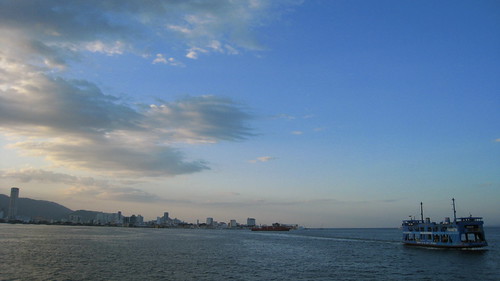
The above picture was taken at Koh Panyee a Muslim fishing village in Ao Phang Nga. I didn't want this picture. I was strolling through the market when a monkey appeared under one arm, another on the other, and a ladyboy on the other side. It cost me 100B. I could have refused to pay, but I was impressed by their speed and dexterity. In Australia people pay 1000B for a picture with a Koala bear which craps on them, and they don't get a ladyboy in theirs either. The reason I have displayed this picture is because it illustrates how parts of Thailand have been corrupted by Western tourism.

On my travels I have met many people who have been to Thailand. They have all said how friendly the Thai people are. Once I got to Malaysia I met a couple of travellers who told me a different story. They found that Thailand had been corrupted by the tourist baht. They said that when Thais smiled at you they were actually cringing on the inside. The picture illustrates exactly what these travellers told me. However, it is not representative of the whole of Thailand. The corruption has taken place in Western ghettos. The amount of money has attracted Thais who want to get as much baht out of the Westerners as possible and the locals who have remained have become jaded by tourism. In Koh Panyee the local people would not make eye contact with you. If I said hello they would respond but they would not instigate it. A complete contrast to the way Thai people were in Trang and on the islands of Koh Libong and Koh Sukorn.


I was in Koh Panyee on an overnight trip into Ao Phang Nga. Ao Phang Nga is a beautiful area of limestone karst cliffs. The two main tourist attractions are Koh Panyee fishing village and James Bond Island. Boat loads of tourists visit both attractions each day from Phuket. I did my trip from Phang Nga in a long boat. There are two main tour operators in Phang Nga, Mr Kean and Sayan. If you get the bus into Phang Nga the first person to greet you will be Mr Kean. He speaks excellent English and is friendly (although he cools off once you pay for a tour). Sayan and Mr Kean charge the same money for the same trips. I had a problem on my tour because we were going to be left on a floating barge for an hour while 4 people in the boat went off kayaking for an hour. I phoned Mr Kean and complained. He got us moved to James Bond Island. He protested his innocence and insisted it had been a mistake and it would not normally happen. The other problem with the tour was that the boat man did not speak English. If you like your tour guides to keep quiet this is the tour for you. Also bear in mind that you will be sitting in a long boat on wooden planks for the best part of 7 hours and if you go to the outer islands it can get a bit bumpy in the long boat.


James Bond Island is an island that was used in the Man with the Golden Gun. It is a pretty island. Unfortunately it is covered in tourist stalls. These stalls sell the usual tourist tat and the only thing James Bond related is a t-shirt with James Bond Island written on it. The island gets extremely busy when the boats from Phuket arrive. A big tourist activity is kayaking. I envisage kayaking as a solitary or small group of canoes activity. In Ao Phang Nga there is one area where they have huge barges moored. A Thai guy sits on the end of your inflatable canoe and does the paddling, with hundreds of other inflatable canoes.

In saying that I thoroughly enjoyed my day and night in Ao Phang Nga and would recommend it. Koh Panyee is well worth visiting. It is quite something to wander around the village on stilts and it is better to stay overnight because then you get to see it when all the tourists have gone. I stayed at Panyee Bungalows and had an excellent meal while the sunset and a thunderstorm passed by. Ao Phang Nga is a big area so whilst certain areas get busy with the boats from Phuket in a long boat you can find places all to yourself.

If you do want to meet local friendly Thais all you have to do is visit Phang Nga (on the mainland). I was sitting in the bus station and got chatting to Bud. I'm not sure what Bud's job was but it involved being at the bus station. He had lived in Phang Nga all his life. Bud's English wasn't the best and my Thai is practically non-existent even when accompanied with a phrasebook. We still managed to have a very entertaining chat for an hour whilst waiting for my bus to turn up. We got talking about the King (I was wearing one of my 'I love the King' t-shirts). We were sitting in a cafe, the owner of the cafe brought out a picture of the King at a banquet with other monarchs. Prince Andrew was standing in the background beaming from ear to ear. We had a good long look at this. The cafe owner disappeared with the framed picture and then brought out the picture as a gift to me. Bud and I then moved on to talking about football, he is a big fan of David Beckham, Michael Owen and Wayne Rooney. (I might suggest bringing England footballer pictures as presents for the locals). Bud even spoke to the bus company on the phone to check what time my bus would be arriving. The reason why I mentioned that I don't know what Bud's job was is because he gained nothing from helping or chatting to me. He was just being Thai. He wasn't acting alone either. There were various Thai people who took part in the chat or were looking on smilingly (apart from the cafe owner who didn't say anything even after presenting the gift of the picture of the King).

Friday, December 14, 2007

SE Asia VII - It's a Thailand Trang

I decided to make Trang my first stop in Thailand only because Hat Yai wasn't meant to be nice and I didn't fancy landing straight in tourism central in Krabi. I didn't know that Trang has a great deal to offer in its own right. The islands haven't been overrun by Western tourism and it is still possible to find locals living traditional lives. On Koh Libong and Koh Sukorn I was made to feel like a guest rather than a visitor, and an honoured guest at that.

Trang hasn't been overrun by tourism. It means that the people welcome Westerners and see them as something of a novelty. I seemed to provide great hilarity wherever I went. I would walk down the street in Trang and be greeted with waves and hellos. Most people do not speak English in Trang, a few speak some words, and a handful speak somewhat fluently. The road and shop signs are all in Thai. It can make things a bit awkward when trying to find something. The Thai alphabet appears to be written upside down and back to front. I have also discovered that the English translation is not consistent. A Thai street can be written in one way on one map and another one on a different map. You are then faced with the problem of correctly pronouncing the name of the street to locals to see if they can point you in the right direction. In general I am struggling with pronunciation in South-East Asia. In Singapore I came up with a multiple of ways of pronouncing Bugis (only 2 syllables) all apparently incorrect. My English pronunciation also leaves alot to be desired according Malaysians. I went into a shop to buy a bottle of water. I couldn't find the water so I asked a shop assistant. He looked at me dumbfounded. I repeated "water", he said back to me "Watta?", I said "Yes, Water", he said "Watta?", I pulled out a bottle of water from my bag and his eyes lighted up, "Oh, Water". When I left the minibus office in Hat Yai for Trang the women in the office found it hilarious to repeat my pronunciation of Trang (one syllable) loudly and gregariously.

My Lonely Plant guidebook only gives a brief mention to Trang and doesn't mention the existence of islands along the coast here. I was pleasantly surprised to find a bustling town and even more surprised to discover a myriad of islands existing off the coast. I might be stretching the point to suggest that Trang and its islands are undiscovered. In all the restaurants I ate it in Trang whilst the waiter or waitress couldn't speak English they all had English translations of their menu. There are local travel agents geared up to getting you out to the islands, although again communication can be tricky.

The main islands off the Trang province coastline are Koh Libong, Koh Sukorn, Koh Ngai (or Koh Hai), Koh Mook (or Koh Muk) and Koh Kradan. I visited Koh Libong and Koh Sukorn. The great thing about Koh Libong and Koh Sukorn is that they have large local populations. There are a number of long boats running to and from the islands all day. It makes it a lot cheaper to reach them. If you want to visit Koh Ngai, Koh Mook, or Koh Kradan you have to charter a boat or go through a travel agency. Travelling to the islands with the locals means you are straight into local life and get a local perspective on the island. There isn't a barrier of us and them.

The first island I visited was Koh Libong. Koh Libong is the largest island in the area and is home to muslim fishing villages. There are three separate villages on the island. I caught a local minibus from Trang to Hao Mei pier to catch a boat to the island. The boat in question was a longboat. A long boat is a wooden boat with an engine mounted on the stern with a long pole attached to the drive shaft and a propeller on the end of the pole. The skipper stands on the stern. The long boat is steered by moving the engine on its pivot which in turn moves the propeller. Before we departed the passengers climbed aboard (I was the only Farang), we were seated on wooden planks under a tarpaulin. The front uncovered section was filled with various supplies and then more passengers jumped on top of the supplies. Life vests are not included. Once we left the river estuary the sea spray picked up so another piece of tarpaulin was pulled over the front of the covered section and the guys sitting in the front got soaked.

On Koh Libong I felt like the Queen. On Koh Libong wherever I went everyone wanted to say hello and wave to me. The people of Trang were friendly but nowhere near as friendly as the people of Koh Libong. There are 3 bungalow 'resorts' on the island. I stayed at the Libong Nature Beach Resort. It is a very pleasant place designed by Scandinavians as an Ecotourism venture to put money back into the local community. The local population is pretty big so they haven't become jaded by westerners. Alot of the Koh Libong tourists seem to spend their time on the beach outside their bungalows. They don't go into the interior of the island. I wandered over to a fishing village on the other side of the island and was made to feel like an honoured guest. When I left the village for the hour return walk a local guy offered me a lift back to the other side of the island. When we arrived I offered him money and he refused. I met an American retiree couple and we managed to invite ourselves to a wedding reception. We were looking for somewhere to eat and saw an awning with tables and chairs. We walked up and asked if they were still cooking. They didn't speak English and they seemed surprised to see us. Slowly but surely more locals surrounded us in curiosity at what we could want. We came to the conclusion that they must have stopped cooking for the night so we walked off, they called us back and then got us to sit down. They brought out the food, which was very nice. A guy then emerged who spoke a little bit of English, he said he was on the island for a friend's wedding. He invited us to a BBQ on the beach. We went to pay for our meal and they wouldn't accept any money. We then realised that we had somehow invited ourselves to the remnants of a wedding reception. The next day the awning and all the tables and chairs disappeared.


I went back to Trang after Koh Libong and then went to Koh Sukorn. Koh Sukorn is the main destination sold by the travel agents in Trang. It is a bit more civilised than Koh Libong. There is a concrete road running round the island, whereas on Koh Libong the roads are nearly all dirt tracks which are heavily pot holed. I stayed at Sukorn Beach Bungalows, which are very nice but expensive and a much cheaper (and still a nice place) is Cabana Bungalows. I went cycling around the island and ended up sitting in a shop in the village on the island chatting to the locals. When I passed through the village everyone waved at me and said hello. They were again genuinely pleased to see me.

While I was in Trang I stayed at Yamawa. It is the best value accommodation I have stayed in in Thailand. It was 200B a room. I had a TV, ensuite (cold shower), double bed and the room had a bit of character to it. On Koh Libong I paid 600B at Libong Nature Beach Resort and on Koh Sukorn I paid 800B at Sukorn Beach Bungalows. The people of Trang are very helpful, a particular travel agency went beyond even the high levels of Trang helpfulness. They ran through a whole heap of information with me without hard selling anything to me. One of them even came with me to a mobile phone shop to help me buy a SIM card (1-2-Call) because I had no idea on what I should buy. Unfortunately I can't remember the name of the travel agency (it is probably in Thai anyway) but if you want tot find it walk from the station towards the clock tower, it is the second travel agency on the right handside with a sliding door.

Wednesday, December 05, 2007

SE Asia VI - Penang

Penang is an island on the West Coast of the Malay peninsula. It is famous for being an outpost of the East India Company. It isn't a relic of the past, it is a living and breathing city. There are jungle clad hills to escape to, an assortment of temples, and beaches. If you can only spend time in one place in Malaysia I would recommend Penang, because it has a little bit of everything.

Penang is centred around Georgetown, the colonial capital of Penang It is similar to Melaka, in having historic buildings lining narrow traffic filled streets, however, Georgetown is a bit bigger than the old town of Melaka and the architecture is a bit more varied. Georgetown does have a certain air of decay to it. The colonial buildings are falling apart and it seems that building new houses is more important than refurbishing the pre-existing ones. There is a building boom on the island in condominiums, apartment complexes. The three cultures of Malaysia; Malay, Chinese and Indian, are well represented in Georgetown. Little India is the most colourful and dynamic part of Georgetown.

I mentioned in a previous post the tensions existing within multicultural Malaysia, especially with the Indians. The Malaysian Government has recently banned a leading Indian political organisation from holding protests. While the tension exists it is not apparent to the tourist and no one ever mentioned it to me directly. From a tourists point of view the three cultures are thriving in Georgetown. A great aspect of maintaining the identity of each culture is the variety of food on offer. There are a number of excellent food courts in Georgetown. World Food Market north of Komtar is very good and cheap, and few westerners seem to be aware of its existence. Indian food in Penang is particularly good, especially the banana leaf meals ( you eat off of a banana leaf).


The establishments I generally eat at fall somewhere between the street stall and the restaurant, hopefully combing the cheapness of the stall with the hygiene of the restaurant. The staff at these establishments are not always the easiest to pick out. The guy sitting down eating his dinner is the waiter, the guy picking his feet is the chef, and the guy standing outside who looked like he was going to mug you is the owner. It isn't surprising to find by the end of your meal that everyone eating in the restaurant is somehow involved in the operation. I would often find at these establishments that I would try and order something. The waiter would look at me quizzically and reply that what I wanted was not a good thing to order and in actual fact I wanted something completely different. The waiters expertise was generally spot on.


The seemingly undiscovered gem of Penang is Taman Negara Pulau Pinang (National Park of Penang). It is just a case of jumping on the 101 bus from Komtar which will take you to the northern beaches. The majority of people stop at Batu Ferringhi which is pleasant but heavily developed, the next beach along is Teluk Bahang. There is a small fishing village and the people are very friendly, it is also the gateway to the national park. After an hour and a half walk (and wade) through the jungle you arrive at Monkey Beach. It is a beautiful spot, with few people and plenty of wildlife. When you walk through the jungle you come across Monkeys and even Goannas. A family of dogs live on the beach, and are very cute. They are extremely happy to sit around you without feeding or patting them, and they are photogenic. Although watch out for Dad, he wandered off with one of my sandals.

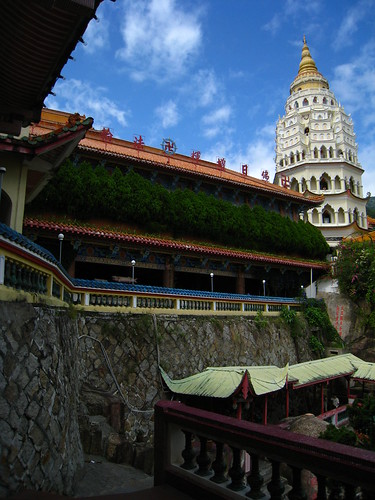
There are plenty of things to see in Penang. There is the world's third largest reclining Buddha. A Burmese Buddhist temple sits opposite the Thai temple (with the reclining Buddha) and is prettier. There is also Kek Lok Si another Buddhist temple this time perched on top of a hill. It is a beautiful spot overlooking the town of Air Itam. There are the expected tourist stalls on the way in but what I found disappointing were the stalls inside the temple complex. I can understand the sale of roof tiles with your name written on them to finance refurbishment, but stalls selling the usual tourist tat spoil it. Penang Hill is another very popular trip into the centre of the island. There are great views from the top, somewhat spoilt by the pollution haze. I choose to walk up with a hiker from the Cameron Highlands, Z. We went up the Jeep track, which is a road, but it is amazingly steep. It was a 6km walk up an incline that reminded me of Baldwin Street in New Zealand, the world's steepest street. I met plenty of friendly Malaysians on the way up, especially a couple of groups of school children who delighted in saying Hello to me. The problem with Penang Hill is that the funicular train that takes you down (and up) is very busy, the queue is about an hour at both ends and then you are packed in like commuters on the tube.

I stayed at Hutton Lodge in Georgetown. It is a recently opened guesthouse and not in the guidebooks yet. I only found out about it because of where I stayed in KL, Pondok Lodge, has the same owners. It is a renovated old building and has a historic feel to it even though it has been thoroughly refurbished. The staff are very friendly. I became Mr Steve for the week. Whenever I returned from a day out and about they would always ask me where I had been and what I had seen. One of the guys seemed particularly pleased to shake hands with me at any opportunity.


Penang was my last stop in Malaysia. I will certainly be back. Whilst there are tensions between the three peoples of Malaysia I found them all to be friendly and welcoming. The three cultures give the country great variety. The British seem to be very popular in Malaysia. There are a plethora of English football shirts (Man Utd, Liverpool, Chelsea and Arsenal). I was in a night market in KL after England lost to Croatia. I was walking passed a street stall with a TV showing a match report in Bahassa. The locals were shocked and genuinely disappointed that England had lost. (I don't know if the same sense of affection exists towards the Scottish and Welsh national teams.) I rarely got hassled in the country. The only regular annoyance were the taxi drivers and that was very mild. When walking passed restaurants and cafes you will get asked to come in but it isn't aggressive and there is generally a but of humour involved. For instance, I was walking through Tanah Rata when a waiter at an Indian restaurant tried to get me to come in, when I told him I had already eaten he replied "But you still look hungry sir". In short Malaysiua is an easy country to get to, straightforward to get around, there is lots to see, it is cheap, and the people are friendly.

Sunday, December 02, 2007

SE Asia V - Cameron Highlands

The Cameron Highlands are an oasis of cool air and calm rolling mountain hills in Malaysia. A complete contrast to KL. The scenery is stunning. There are jungle clad hills and tea plantation clad hills all around. There are also lots of Land Rovers. While I was in town I did some hiking and went to visit an Orangi Asli village in the jungle.

The Cameron Highlands have beautiful scenery. The scenery is not matched by the towns. The biggest town, and where most of the accommodation is, is Tanah Rata. Tanah Rata has the architectural quality of Basildon. The people are friendly and there are lots of good places to eat. I stayed at Father's Guesthouse in Tanah Rata. It is an institution on the backpackers circuit. The accommodation is in army style Nissan huts. They are basic (and a bit chilly at night) but at RM10 a night you can't go wrong. The toilet facilities are basic, but they do have hot showers and western toilets. There is a cafe which serves breakfast and dinner. Gerrard runs Father's Guesthouse and he is very helpful. I booked the tours he recommended and was not disappointed.

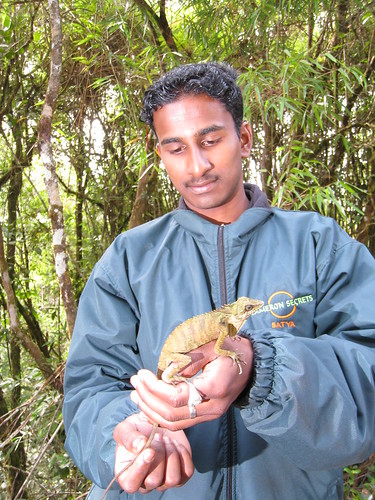
I did two tours in a day with Cameron Secrets (http://www.cameronsecrets.com/). I was up at 5.30am for the Morning Madness tour. We were taken to Gunung Brinchang the highest peak in Malaysia accessible by road. We were lucky enough to have a superb sunrise. We then did a hike through the mossy forest. Our guide Satya was excellent, he was an excellent source of information and funny with it. After that we went to the BOH tea plantation. The Cameron Highlands is famous for its tea. The tea here supplies the majority of what Malaysia drinks and they drink alot of tea. The tea hills are beautiful to look at.The British brought Indians to the Cameron highlands to create the tea plantations and to maintain them. It is only in recent years that wages have dropped and they jobs have gone to Indonesians on two year work contracts.

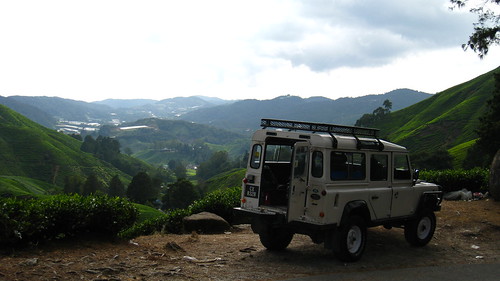
We spent the day driving round in Land Rover Defenders. The Cameron Highlands are packed to the brim with Land Rovers. I have never seen so many in one place before, and I have been to Land Rover club meetings. It seems to be one of the few parts of the world where the Toyota Landcruiser doesn't rein supreme. It is a legacy of the British involvement and the use of the Land Rover during the Communist insurgency on the peninsula. When the British left they sold the Land Rovers to the locals. They are used for absolutely everything. While you drive around the winding bends of the Cameron Highlands you see locals piled into the back of them, others with boxes of vegetables stacked high and the suspension giving under the strain.

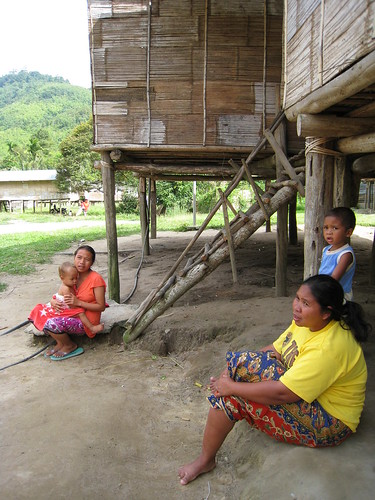
In the afternoon we visted an Orangi Asli village. The Orangi Asli are the native people of Malaysia. Their way of life, like most indigenous peoples, is slowly dying out. The Malaysiuan government is 'persuading' them to leave the jungles and move into the towns. The tour that Cameron Secrets offers is special because you are taken to a village in the jungle, an hour and a half from Tanah Rata. The particular village only allows Cameron Secrets to visit because the chief has befriended the two guides. The village is therefore not inundated with tourists and we were treated as guests. Kumar the guide was full of information and we had a much greater appreciation of the Orangi Alsi by the time we arrived. The village is just what you would expect, bamboo homes on stilts, lots of kids, chickens and dogs running around. Initially I felt somewhat awkward in the village. Whilst there was only me, Z and the guide it still felt like we were intruding. I like to merge into the background when I travel, to observe rather than be observed. It is achievable in the Western world but once you are taller and look different to everyone else it becomes a bit tricky to not literally stand out from the crowd. When visiting a native village you are guaranteed to stand out. The villagers noticeably warmed to our presence and interacted more and more with us over the time we were there. The children ran around us. A group of teenagers spoke to me in halting English. We were taught how to use a blowdart. it was a bamboo tube a few metres long, you are given a dart, you put it in the tube with some cotton wool (natural version), focus on the target (a flip-flop) and blow. I was pretty good, though the chief didn't seem particularly impressed. He invited us inside his hut where we shown musical instruments and tools. We were given a nose flute to play. I pushed it up my nose and blew threw it, the correct technique is to play it just in front of your nose and then blow. We were given an excellent cup of herbal tea, some jack fruit seeds and tapioca. The jack fruit seeds have the texture of bark, taste like BBQ crisps and apparently if you eat ten you will die. After the meal we had a go at a string puzzle. It was a piece of string looped through a bamboo puzzle. I had no idea how to do it and the chief demonstrated how you solved it. When we left the chiefs hut the kids were skipping outside. Kumar thought it would be a good idea if we took part. I haven't skipped since the early 1990s, which was shown in my efforts.

The Cameron Highlands have a number of trails marked through the hills for you to do under your own steam. Me, Z, Margeritta and Ella, a group of Melbourne girls, attempted Trail 8. It was an extremely gruel climb up tree routes through the jungle to the summit of the hill. It was followed by an equally taxing hike down the other side. The Cameron Highlands may not be humid but I was still sweating like it was going out of fashion.

Friday, November 30, 2007

SE Asia IV - Grand Prix Bartering

My bargaining skills had a great deal of practice at the A1GP in Sepang. A1GP is similar to Formula 1, the main difference is that the teams represent nations, the slogan is the 'World Cup of Motorsport'. The Sepang circuit is 75km from KL, next to the airport, though this doesn't mean it is easy to get to.

The first day I to went was practice. It was free to get in and one man and his dog showed up to watch. I got the train to Nilai, which took an hour, I then planned to catch a bus to the circuit as the Sepang website told me. Unfortunately there were no buses running to the circuit so I caught the bus to the airport, this took another hour. When I arrived I asked for the bus to the circuit and was told that no buses were running and I would have to catch a taxi. The taxi cost me RM38 (about 5 pounds) not an arm and a leg but the previous two hours of travel had cost me RM6. On the way back I stood at the side of the motorway with another spectator and attempted to flag down coaches bound for KL. We stood there for an hour unable to get a coach to stop. A plethora of taxis did attempt to come to our aid. It doesn't matter where you are in Malaysia, you can be minding your own business strolling down a street, when you will hear the light toot of a horn announcing that a taxi is ready and raring to take you wherever you may wish. Whilst waiting at the side of the motorway we negotiated with several drivers. They would propose outlandish charges of RM70 and we would counter with RM10. Eventually we found a driver who we haggled down to RM15. We got to the airport and then jumped on a coach to KL, it only cost RM10.


The next day was qualifying. I caught a coach to the airport and then managed to persuade the airport bus driver to go via the circuit (this was after I refused to get off the bus until I was taken there). When I left the circuit the extra spectators for qualifying had prompted taxis to pull up outside the entrance. "You want taxi sir?", "How much to the airport?", "50 Ringgits", ""I paid 15 yesterday", "No, no sir 40 Ringgits". I had this conversation with a number of drivers and carried on walking to the motorway. I was met with the toots of horns from taxis. They would offer me a price, and my new tactic became shutting the door on them after a bid I didn't like. A couple of drivers pulled up and after I rejected them they reversed along the hard shoulder to the previous turnoff. I was beginning to wonder whether my confidence in getting a low price was misplaced when a taxi pulled up and offered me the fare of RM10, I didn't bother haggling.

On race day I managed to get the airport coach to drop me off at the circuit. There was a decent turnout of spectators, probably around 5,000 people. At the end of the day I wandered out of the circuit and found drivers who weren't interested in taking me to the airport, they wanted the big fares to KL. I continued my stroll toward the motorway when a driver pulled up next to me and offered me RM40 to the airport, I said no 10, and shut the door. He opened the door and offered 30, I said no and shut the door. He opened the door and offered 20, I said no and I would accept 15. He said no so I walked off. I could hear him yelling in the background and then he pulled up next to me, "Jump in sir, I take you airport for 15 Ringgits". I should have gone lower.


I would recommend visiting Sepang for a race. It is a beautiful circuit, very modern, with great views of the track. It also gives you a crash course in bartering.

Sunday, November 25, 2007

SE Asia III - KL

Kuala Lumpur is a cross between Singapore and Melaka. It has the infrastructure of Singapore but is slightly mental. For instance, they have traffic lights but they are rarely obeyed. I was in Medaka square crossing the road at a set of lights, the green man started walking (he is animated in Malaysia) and the countdown clock started. I crossed only to have a motorcycle flash passed infront of me, a car carried on behind me and another car had to do an emergency stop next to me (talk about skid marks). I try to follow the policy of crossing when a local does and putting them between me and the oncoming traffic.

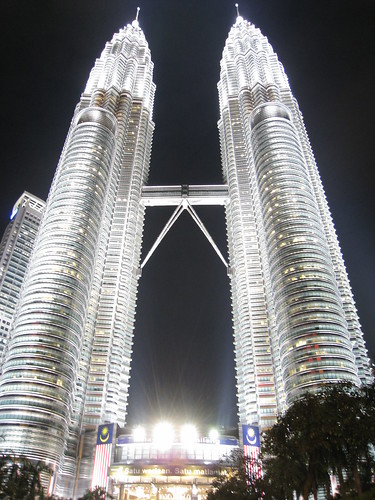
KL is a raw version of Singapore. The Petronas Towers are more dazzling than anything Singapore has to offer. Yet there are so many litter strewn alleys that you pass. There are whole streets of ruined buildings. The most disturbing scene I've yet seen on my travels was a man lying in the gutter outside the Times Square Mall. He was spread eagled on the floor with an open wound on his leg. There was a steady stream of people passing him on both sides of the packed pavement. I'm not suggesting that Malaysians are any less caring than other nations, I'm sure such a scene could be witnessed in London, Paris or New York. It just seems that the gap between rich and poor is greater here and more distinct.


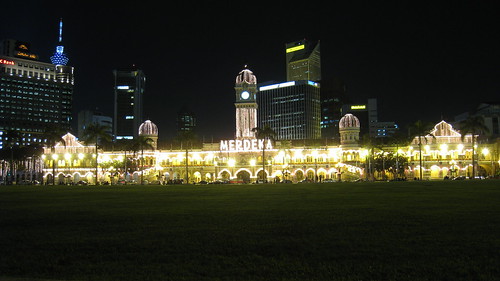
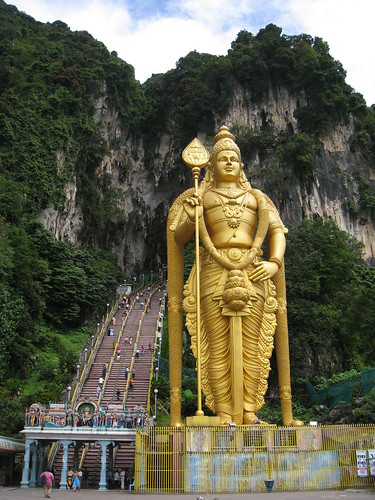
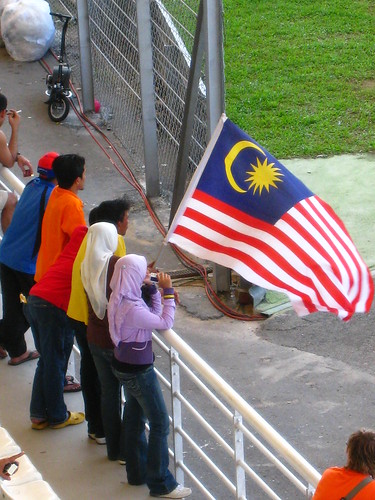
There is quite a bit to see in KL. The Petronas Towers are a must. The visit up to sky bridge is free (you just have to queue up in the morning for a ticket). It isn't the most exciting. partly due to Petronas using it as an opportunity for a company presentation, and partly due to you not being able to see the Petronas Towers. The view from the KL Tower is better, because you are higher up and you get to see the Petronas Towers. Merdeka square is pretty, and it is a good time to visit as Malaysia is celebrating its 50th year of independence, so there are plenty of flags. The Batu Caves are spectacular. They are Hindu temples outside of KL. It takes just over half an hour to get there by bus. When you get there you have to climb over 250 steps to get to the main temple. The main temple is full of monkeys. These monkeys are trained in the art of stealing food from tourists and intimidating small children. The drive on the bus is worth the trip in itself. In KL the bus conductors hawk for business. They hang out the side of the bus as you are driving along yelling out their destinations to anyone walking along the pavement. It gets even more intense at proper bus stops where they compete against one another for business.

I haven't faced a great deal of hawking since arriving in South East Asia, apart from the restaurateurs in Boat Quay Singapore. In China Town KL there is a giant street market. It is hot sweaty and claustrophobic. It is a hawkers paradise. They did their best to tempt me into their stall and at times would grab me by the arm. I met all attempts with a smile and shake of the head. I find that the best way to deal with hawkers is to smile and say no thankyou. It doesn't require you getting angry or frustrated. However, Bukit Bintang can try anyone's patience. It is a popular street in the Golden Triangle, close to where I was staying. During the day it is busy. In the evening it gets busier and the massage shops open. They have hawkers sitting on the street outside their establishments. When you walk passed they jump out at you with laminated picture cards of the work they offer. I tried to meet all advances with a smile and polite no thankyou. It does get frustrating when you are trying to get somewhere and they keep jumping out at you, especially when you have already rejected 5 and the hawker can see this but still believes that they will somehow persuade you.

I stayed at Pondok Lodge in KL. It is in the Golden Triangle just off of Bukit Bintang and within walking distance of the Petronas Towers. I had a bed for RM25.00 which included breakfast. Breakfast was not your typical hostel affair where blood thirsty backpackers compete to grab what they can. At Pondok Lodge they had a guy serve you, admittedly it was just 2 pieces of toast, a banana, a piece of fruit loaf and a cup of tea, but it was still nice. I ended up in twin room with a Pakistani guy who had been living there for a few months. The room was fine apart from the air conditioning being shared between two rooms. There was a hole in the wall between the two rooms and the air conditioning was cunningly placed in the middle. The controls were in the other room and we had the remote in our room. This meant that during the night there was a fight between both parties to keep it on or to keep it off. Pondok Lodge is above a number of bars, so it can be a bit noisy but I never found it a problem. They also have a rooftop terrace which is a great place to escape the hustle and bustle of KL and hopefully grab a breeze to stop sweating for 5 minutes.

Defining who a local is in KL and Malaysia isn't quite straight forward. There are 4 distinct groups of locals. There are the Orangi Asli the native people who live in tribes (more to come on them in the Cameron Highlands). There are the Malays, the Chinese and the Tamil Indians. The Malays are Muslim. I like all the colourful headscarfs. I can't remember which politician said that they found headscarfs 'confronting' but it struck me as a daft comment at the time and after is even more ridiculous when you travel in Malaysia. You are constantly greeted by smiling headscarf clad faces. The Chinese have lived in Malaysia prior to European involvement in the region. They moved to the Malay peninsula as traders. The Indians have a similar history, however, the greater part of the Tamil Indians were brought in by the British either as slaves or as workers. The deal struck between the groups when Malaysia gained independence from Britain was that the Malays would have political power, the Chinese would continue to hold the economic power and the Indians were left to fill in the gaps. On the surface this form of multi-culturalism seems to work. However, the 3 groups maintain separate lives. They work together but they do not live together. In my time in Malaysia even the 3 races working together is somewhat unusual. Shops and restaurants are generally staffed by one race. The people who agitate most against the status-quo are the Tamil Indian community because they get the roughest deal out of all three. While I was at the A1GP in Sepang there was a big demonstration in KL at the Petronas Towers.
Click here for a link to a BBC News article about the Indian Demonstration. The Malay constitution states that only a Muslim can be head of the government. There is also defacto discrimination with Malays being entitled to open shops in certain areas where Indians and Chinese cannot. In a recent law regarding foreign firms starting businesses in Malaysia the law stated that the foreign firm must employ at least one Malay (not one Malay, Chinese, or Indian). This is all the more interesting after you have visited the National Museum in KL. It has a special section on Merdeka, celebrating 50 years of independence from Britain (hence all the Malaysian flags in my photos). There is a video presentation when an old Malay man tells his grandson (Malay) and his two friends (a Chinese girl and an Indian boy) about the struggle for independence. He says how the three races now live side by side, equally, in a free democracy.

Thursday, November 22, 2007

SE Asia II - You say Malacca I say Melaka

Melaka is the first major stop on the West Coast of the Malay Peninsula. It is famous (or infamous) for its colonial heritage. The Portugese got here in 1511, the Dutch kicked the Portugese out in 1641, the British moved the Dutch on in 1795 and the locals got rid of the British in 1957. The locals seem quite proud of this history, or at least the marketing people do. In Bahasa (the Malaysian language) it is spelt Malacca in English it is spelt Melaka.

Melaka is a town of two halves. There is the new part of town with a couple of snazzy new malls and big open spaces. It felt akin to an Eastern European town square. The old town on the other hand has some colonial buildings, a Little India and a Chinatown. (I wonder why they aren't called Little China and India Town?). I liked Chinatown in Singapore because it was big and full of Chinese people. Chinatown in Melaka is even better because it still retains a historic quality. There are old temples dotted amongst the winding streets. The old town is great. It is a maze of narrow windy streets. The traffic through these streets is amazing, cars rush by with motorbikes weaving in between them. There is no footpath, so you try and doge oncoming traffic whilst avoiding falling into the open drains. I was surprised to see the cars had so few dents in them.

My first taste of public Malaysian public transport was the bus from the Coach station to the town centre. The array of buses outside the Coach terminal all looked like they needed a complete overhaul. The driver on mine seemed more concerned with playing with the buttons on the dashboard than paying attention to where he was going. The bus seemed to be in a constant state of motion, even when people were getting on and off, which was amazing considering the amount of traffic surrounding the bus.

I stayed at Shirah's Guesthouse. A bed in a 6 person dorm cost 1.80 pounds. It was only me and an Italian guy who greeted me (and Shirah) by walking down the corridor naked. Generally first impressions aren't the best when the other party isn't wearing any clothes, it makes you wonder what else they consider acceptable behaviour. Nothing dodgy transpired at Shirah's, though there was an unpleasant odour coming from something in the room (possibly the naked Italian). The place was clean and tidy. The shower was cold, but I think that is standard in this part of the world. I was lucky to have a proper shower head, apparently there is normally just a hose connected to the water pipes of the toilet. They also had the luxury of western style toilets, no crouching hidden toilet paper.


I had my customary breakfast of Roti. Roti is an Indian dish, which is a kind of pancake but not quite. Even though it is the morning the Indians will eat Roti with curry sauce and some form of curried meat. They serve both of these in separate dishes to the Roti so you don't have to eat them. Roti is served in a variety of forms. I have had them with chocolate, banana and egg. In all these forms curry sauce and curried meat is supplied.